
Health and Safety Training for Restaurant Staff: A UK Manager's Checklist
By Janos Laszlo
- health and safety
- restaurant training
- kitchen safety
- manual handling
- compliance
- back of house
Quick Summary
-
A restaurant combines hot surfaces, sharp tools, wet floors, heavy lifting, and chemicals in one fast-paced space, and HSE data shows that accommodation and food service has a significantly higher injury rate than the average industry.
-
The Health and Safety at Work Act 1974 requires employers to train staff to work safely from a worker’s first day.
-
Slips, trips, and falls are the single most common cause of non-fatal workplace injury; manual handling is the second most common.
-
The kitchen concentrates almost every hazard at once and needs focused, role-specific training, not a generic induction.
-
Training should be documented and kept current to demonstrate compliance: dated, per-person records are what the HSE expects to see.
A restaurant is one of the more dangerous places to work than it looks. Hot surfaces, sharp knives, wet floors, heavy deliveries, cleaning chemicals, and a fast pace all in one space. The Health and Safety Executive’s own industry data shows accommodation and food services have a statistically significantly higher rate of workplace injury than the average across all industries, and most of those injuries are preventable. The difference between a safe venue and a risky one is rarely luck. It is health and safety training for restaurants, delivered properly and routinely.
This is a practical health and safety guide for UK restaurant managers. It covers the real hazards, what to do about each, the specific risks back of house, and a simple checklist to make sure nothing is missed. It is written to be used on the floor, not filed away.
Why Does Health and Safety Training Matter?
The legal position is straightforward. Under the Health and Safety at Work Act 1974 and the Management of Health and Safety at Work Regulations 1999, employers must provide the information, instruction, and training staff need to work safely. That duty applies from a worker’s exposure to workplace risks to full-time, part-time, and casual staff alike.
But the stronger reason is operational. An injured staff member is a person hurt, a shift short, and potentially a claim or an HSE investigation. Slips, trips, and falls on the same level are the most common cause of non-fatal workplace injury, accounting for around 30% of cases, with handling, lifting, or carrying the second most common at around 17%. These are not exotic risks. They are the everyday reality of a busy venue, and restaurant H&S training is what turns “we should be careful” into people actually working safely.
Why is Health and Safety Training Important in a Restaurant?
Health and safety training is important in a restaurant because the environment combines multiple everyday hazards (hot surfaces, sharp tools, wet floors, heavy lifting, and chemicals) in a fast-paced setting where mistakes happen quickly. UK law requires employers to train staff to work safely under the Health and Safety at Work Act 1974, but the practical value is fewer injuries, fewer lost shifts, and lower liability. Trained staff recognise hazards before they cause harm, follow safe procedures under pressure, and know what to do in an emergency. In a sector with high turnover, consistent training is what keeps standards from slipping every time a new person starts.
What are the Main Health and Safety Hazards in a Restaurant?
Effective health and safety is mostly about controlling a handful of recurring risks well.
Slips, trips, and falls are the most common. Wet floors, spills, trailing cables, and cluttered walkways cause the bulk of restaurant accidents. The controls are simple and constant: clean spills immediately, use wet floor signs, keep walkways clear, and make sure staff wear proper non-slip footwear. Training gets staff into the habit of dealing with a spill the moment they see it, rather than walking past it.
Burns and scalds come with the territory in any kitchen and around hot drinks and pass areas. Staff need to know safe handling of hot pans, oil, steam, and liquids, and to communicate clearly when carrying something hot. Manual handling injuries come from lifting deliveries, moving kegs, carrying stacks of plates, and shifting equipment. Staff should be trained in safe lifting techniques and know when to ask for help or use equipment, which is why manual handling restaurant training matters more in hospitality than many managers assume.
Cuts come from knives, slicers, glassware, and broken crockery and need safe-use training and correct storage. Chemical exposure comes from the cleaning products used throughout the venue, which is a legal training area in its own right under the COSHH regulations, covered by COSHH for restaurants. And fire is an ever-present risk around kitchens, covered by fire safety training for restaurants so staff know evacuation routes and procedures.
Back of House: The Highest-Risk Zone
If health and safety has a front line in a restaurant, it is the kitchen. Almost every serious hazard concentrates in the back of the house, which is why BOH health and safety training needs to be focused rather than a generic induction.
The kitchen combines heat, sharp tools, chemicals, wet floors, and time pressure in a confined space. Hot oil and deep fat fryers are a burn and fire risk. Knives and mandolins are a constant cut risk, made worse by speed during service. Cleaning chemicals are often decanted, stored and used close to food and hot surfaces, raising the stakes on COSHH knowledge. Floors get wet and greasy, making slips more likely exactly where people are carrying hot and sharp things. And manual handling is heavier back of house: moving stock, lifting pans of liquid, hauling deliveries into cold stores.
The practical answer is to train kitchen staff specifically on their environment: safe knife handling and storage, hot oil and fryer safety, correct chemical use and storage, keeping floors clear and dry, and safe lifting. A head chef leading by example matters here, but example alone does not scale to every new starter. Structured training makes sure the porter who joined last week knows the same safety basics as the chef who has been there five years.
If you want your back-of-house team trained on kitchen safety from day one, book a 15-minute demo, and we will show you how it works for your kitchen.
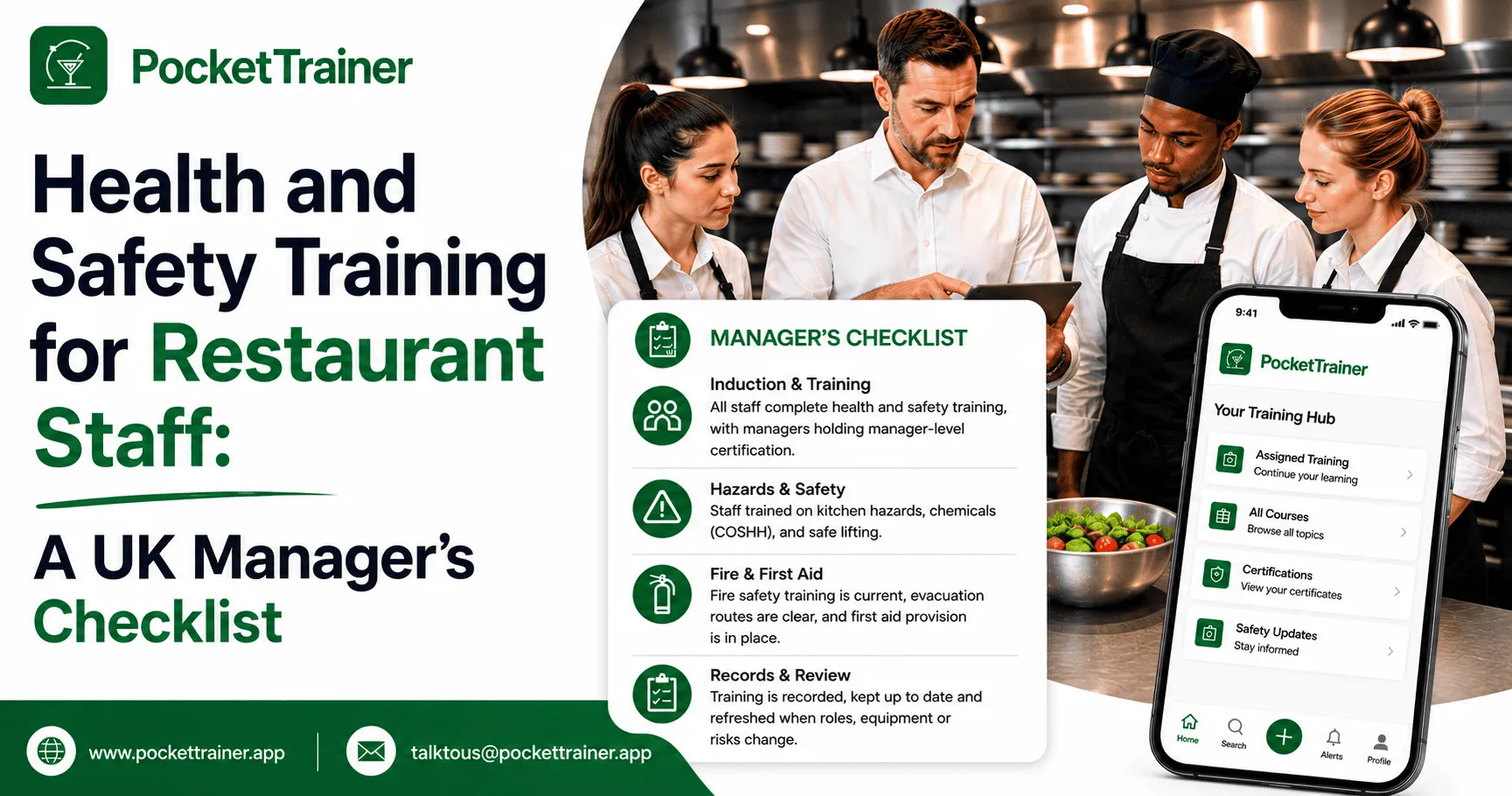
The Manager’s Health and Safety Checklist
Use this as a working checklist for your venue. If you cannot tick every item, that is where to start.
| # | Checklist item |
| 1 | Every new starter completes health and safety induction before their first full shift, not weeks later |
| 2 | All staff have current health and safety training, with managers holding the RoSPA-accredited health and safety training for managers UK version |
| 3 | Kitchen staff have specific training on knives, hot oil, chemicals, and safe lifting |
| 4 | COSHH training is done for anyone using cleaning chemicals, and chemicals are correctly labelled and stored |
| 5 | Manual handling training is in place for anyone lifting deliveries, stock, or equipment |
| 6 | Fire safety training is current, evacuation routes are clear, and staff know the procedure |
| 7 | First aid provision is in place, with a needs assessment done and appointed first-aiders where required |
| 8 | Wet floor signs, non-slip footwear, and spill procedures are used consistently, not just when convenient |
| 9 | Training completion is recorded and up to date for every team member, so you can show it if asked |
| 10 | Training is refreshed when roles change, equipment changes, or a new risk appears |
Working through this list turns health and safety from a vague intention into a set of things that are either done or not done.
Keeping It Current and Provable
Health and safety is not a one-off induction. The law expects training to be repeated periodically and updated when equipment, procedures, or risks change, and the HSE expects it to be documented. Incomplete records are a common weak point, so keeping a clear, up-to-date record of who has completed what is worth the small effort.
A platform that delivers restaurant health and safety training and logs completion in one place, with a dated certificate for each person, makes that record automatic rather than a paperwork chase, which matters most across multiple sites.
The Takeaway
Health and safety in a restaurant comes down to controlling a handful of everyday hazards well (slips, burns, cuts, manual handling, chemicals, and fire and making sure every member of staff is trained to handle them, with the kitchen needing the most focus. UK law requires it, but the real payoff is fewer injuries, fewer lost shifts, and a team that works safely under pressure. Map the training to the roles, deliver it from day one, keep it current, and hold the records.
If you want your health and safety training delivered, tracked, and kept current across your whole team, book a 15-minute demo, and we will walk through it with your operation in mind. You can also see the full set of accredited hospitality courses included as standard, and read more about the hospitality LMS behind them.
FAQs
1 Do all restaurant staff need the same health and safety training?
No. Every staff member needs core health and safety training, but managers require the RoSPA-accredited manager-level course, and kitchen staff need additional back-of-house-specific training on knives, hot oil, and chemicals that front-of-house roles do not.
2 What is the RoSPA accreditation for hospitality health and safety training?
RoSPA (the Royal Society for the Prevention of Accidents) accredits training courses that meet its recognised quality and content standards. RoSPA health and safety hospitality courses give operators an independently verified benchmark to point to, rather than relying on an in-house course of unknown quality.
3 How often should restaurant health and safety training be refreshed?
There is no single legal interval; refresh timing is generally set by the course provider’s accreditation and by practical triggers such as a role change, new equipment, or a new risk appearing. Many operators renew core health and safety training every one to three years as a working standard.
4 Is manual handling training a legal requirement in restaurants?
Yes, in effect. The Manual Handling Operations Regulations 1992 require training wherever manual handling cannot be avoided, and restaurants regularly involve lifting deliveries, kegs, and stacked equipment, which makes manual handling restaurant training a practical necessity rather than an optional extra.
5 What happens if a restaurant cannot show proof of health and safety training?
Incomplete or missing training records are a common weak point at HSE inspections, since the law expects training to be documented as well as delivered. Without dated, per-person records, a business struggles to demonstrate it met its duty under the Health and Safety at Work Act 1974.