
How COYA got staff to actually use its training
By Janos Laszlo
- restaurant training software
- lms for restaurants
- online training for restaurant staff
- hospitality LMS
- COYA
- multi-site restaurant training
- staff development
- case study
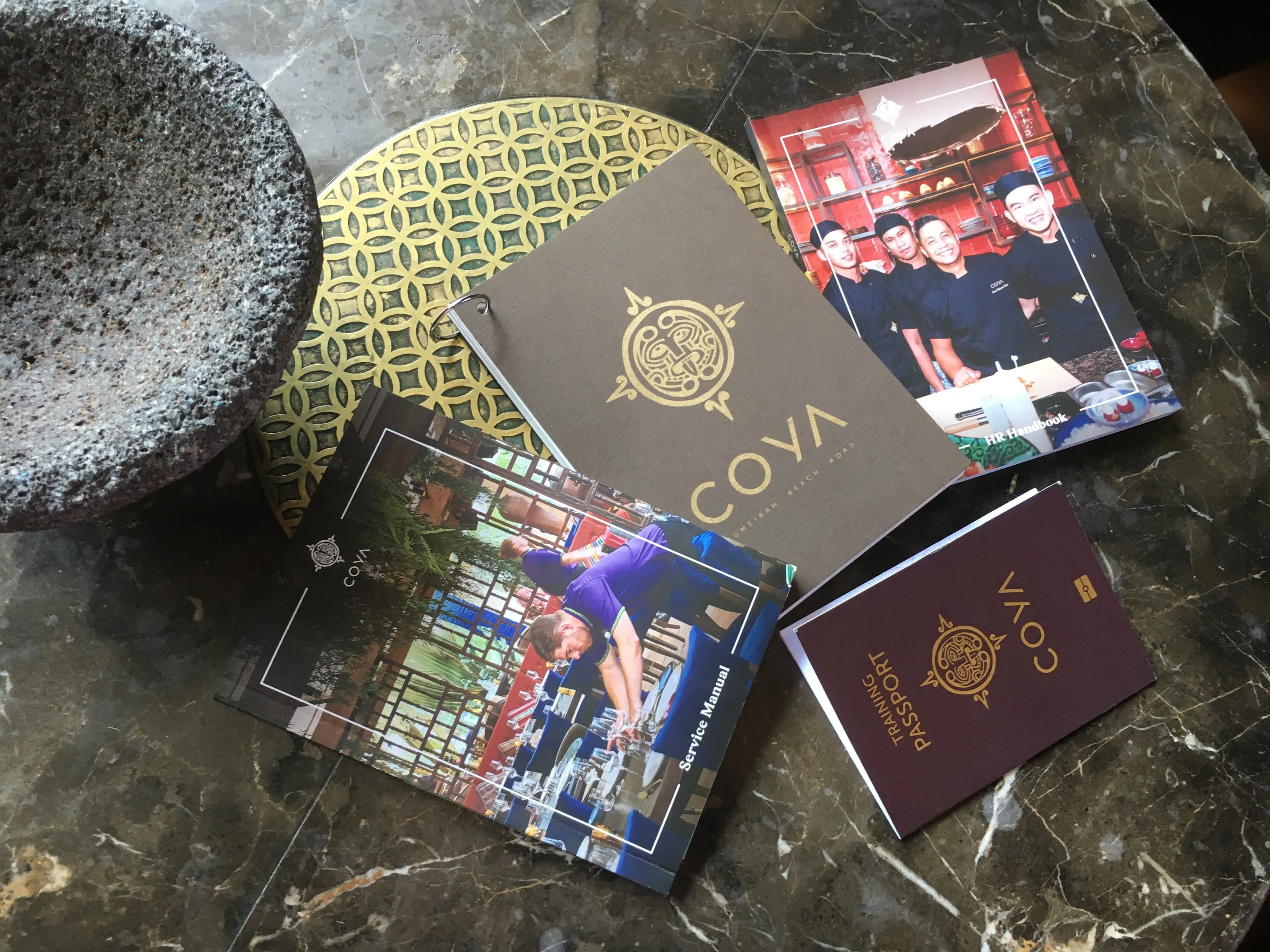
Most restaurant groups have the opposite problem to COYA. They lack training content. COYA had some of the best the Pocket Trainer team has ever seen: detailed, department-specific manuals, beautifully produced, written with real care. And much of it never made it into daily use. The content was excellent. The format was not. This is the story of a group that, regardless of already investing heavily in training, still chose to go further, listening to its staff and moving to digital before the industry told them to.
A group that invested in people before it was fashionable
COYA serves modern Peruvian cuisine and is a multi-award-winning brand across the UK, Europe and the Middle East. It is not a simple proposition: the food draws on Japanese, Chinese and Spanish techniques, and each venue pairs it with a Pisco bar, live music and a curated art programme. Guests come for the full experience, not a meal, and delivering that consistently puts real weight on how well staff know the offer. That depends on people, and COYA has always known it.
COYA was building serious training material for every part of the operation back in 2014, long before learning and development became a standard line in hospitality job descriptions. By 2022, with that investment well established, they moved it onto Pocket Trainer, and today the platform runs across nine of their venues. Throughout, one thing stayed constant: a belief that you develop people on the front foot, rather than reacting to whatever the industry happens to be doing.
That mindset is the reason this story is worth telling. COYA did not adopt restaurant training software because everyone else was. They adopted it because they looked honestly at what they had, saw what was not working, and acted before it became a crisis.
What makes COYA’s approach to training different?
COYA treats staff development as an investment, not a cost. The group built comprehensive, department-specific training material across bar, kitchen, reception, service and HR long before most operators had anything beyond a single induction folder. When that material hit a practical limitation, COYA did not patch over it. They changed the delivery model entirely. The willingness to recognise what is not working, and to invest in fixing it properly, is what separates a mature training culture from a reactive one. As Sany Bacsi, corporate bar manager for COYA Global, told us, “To provide trainings and development to the staff is extremely important, otherwise you lose them.”
The content was excellent. The format was not.
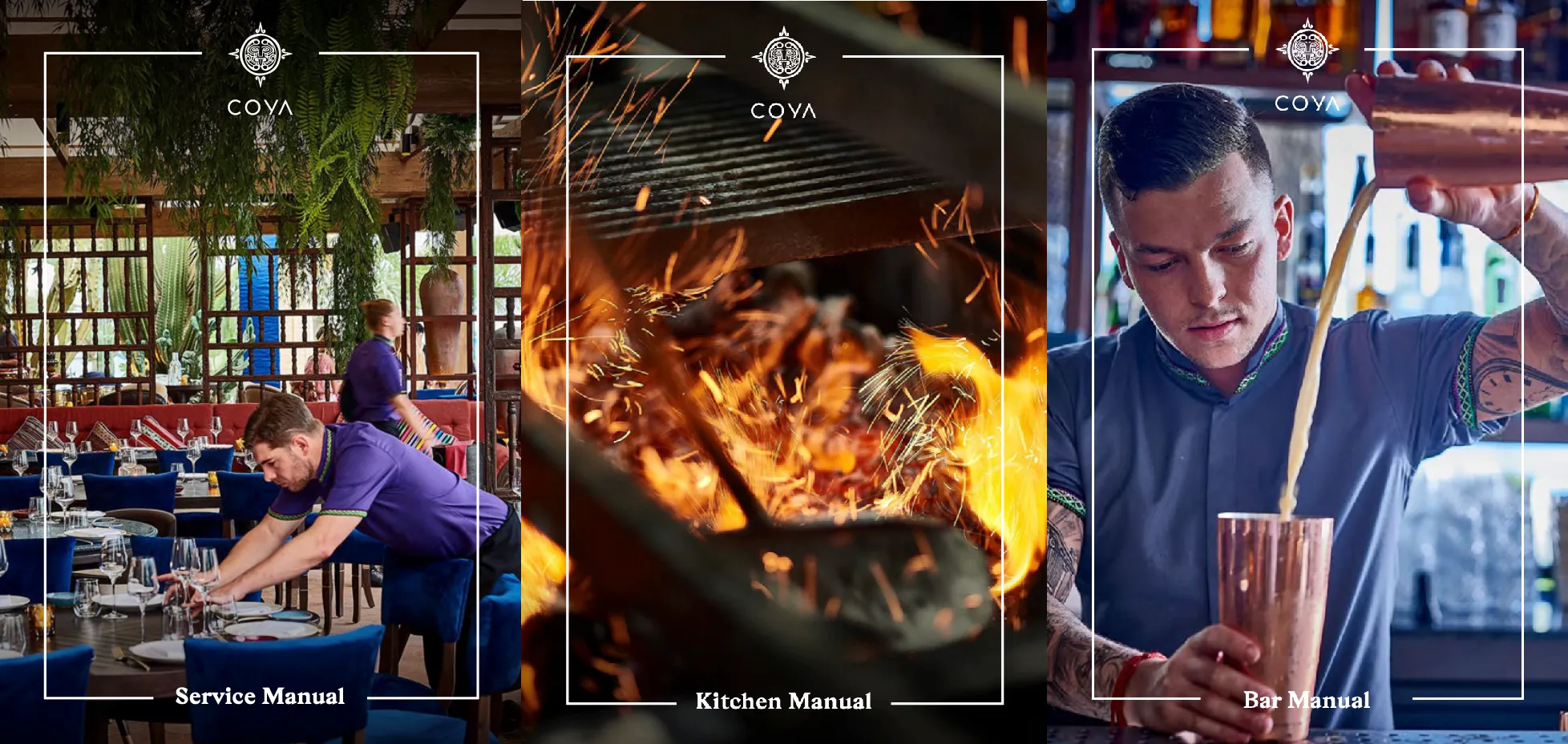
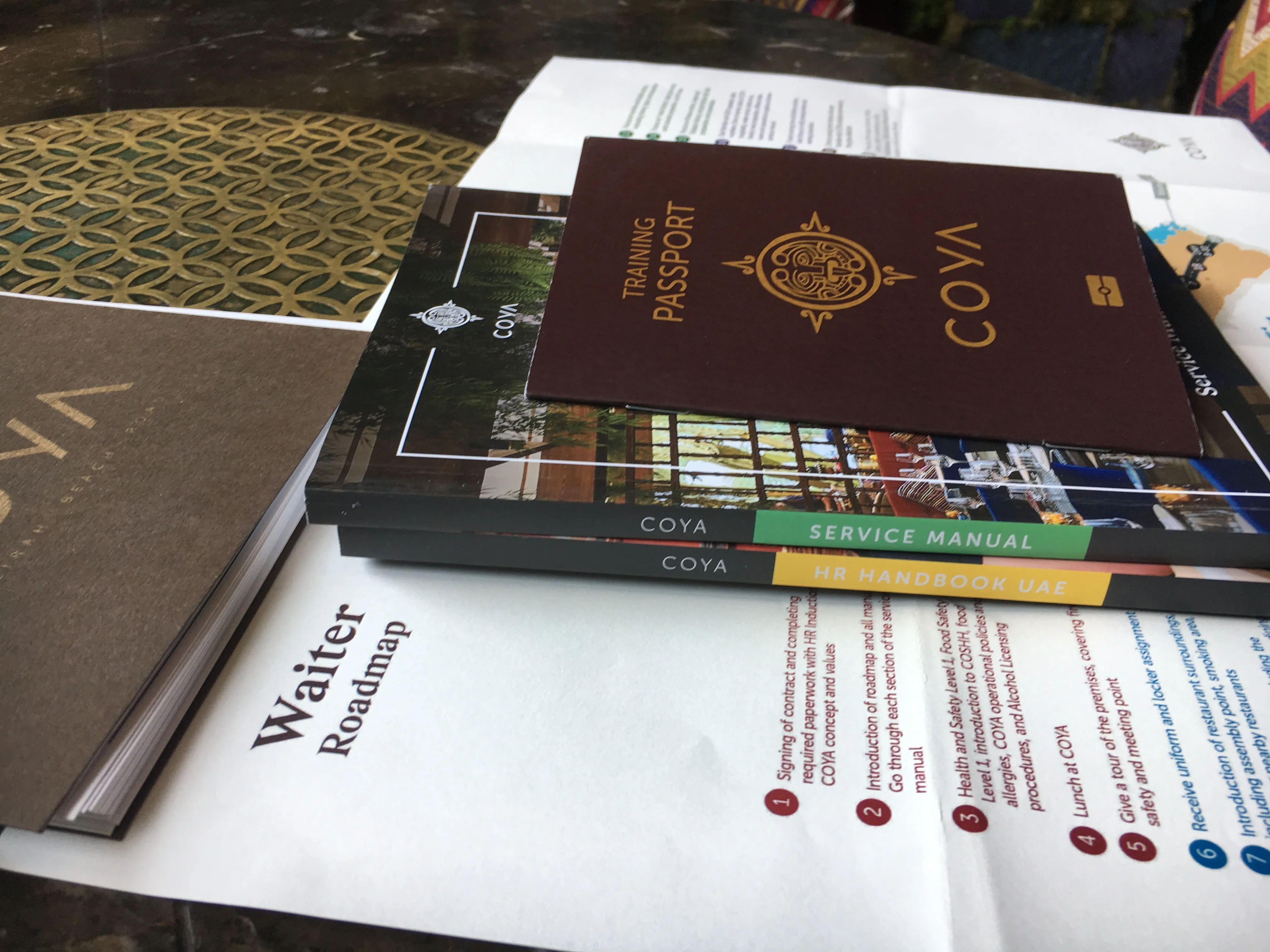
COYA’s training material was not a thin handbook. It was a library. The service manual alone ran past 110 pages. There were separate manuals for the bar, the kitchen, and reception and reservations, HR handbooks exceeding 100 pages for each country, and more than a dozen structured roadmaps mapping out front of house and back of house career paths. On top of that sat food and cocktail bibles, specific to each location, all printed and maintained by hand.
Read that again and the problem starts to surface on its own. Every one of those documents had to be kept current across multiple venues. A cocktail changes, a dish changes, a process changes, and now someone has to update the master, reprint it, and physically distribute it to every site. For a group that refreshes its menu and specials regularly, that is a daily headache, not an occasional one.
Then there is the staff side. A 110-page service manual does not fit in a waiter’s apron pocket. Single printed pages get lost. The material was genuinely excellent, and it was sitting in a format that a young, mobile-first workforce was never going to carry, open or use mid-shift.
COYA did not guess at this. They asked their teams. The feedback came back remarkably consistent: the training was brilliant, but it was not practical. Staff could not carry it, could not reach it when they needed it, could not fit it into the way they actually work.
Why printed training manuals fail in modern hospitality
This is worth saying plainly, because COYA is far from the only group it applies to.
Why do printed training manuals stop working at scale?
Printed manuals fail for two reasons that get worse as a group grows. First, maintenance: every menu change, process update or new standard means reprinting and redistributing across every site, which is slow, costly and almost never fully completed. Second, access: hospitality staff work on their feet and live on their phones, so material they cannot carry or search on a device goes unread. The content can be world-class and still fail, because the format does not match how the workforce actually learns.
COYA’s teams said it themselves. As Tito Bay, restaurant manager at COYA Dubai, told us, “Giving them a food bible is not enough, they will never open a book.” Daniel Kung’U Njenga, a waiter at COYA Dubai, put it just as directly. “We prefer more of a social media kind of experience,” he told us, adding that “the older method of teaching and training won’t work.” What this generation wants is something on the phone, available anywhere, the way they already consume everything else.
That is not a criticism of COYA’s manuals. It is a statement about delivery. The same content, on a device, in short modules, becomes something staff will actually use.
The second gap: COYA wanted decisions based on data, not opinion
Format was the visible problem. There was a second, quieter one that mattered just as much to COYA’s leadership.
The group already ran structured staff evaluations on a regular cycle. But management wanted something the existing process struggled to give them: clear, current data on who actually knew what. When you are deciding who is ready for more responsibility, who should move up, and who needs more support, you want that conversation grounded in evidence rather than impression. As Sany Bacsi told us, “To evaluate the staff is complicated.”
COYA wanted to create and share training content and, at the same time, see engagement and surface knowledge gaps, transparently, for staff, management and leadership alike. Online training for restaurant staff was the obvious answer, because it is one platform that both delivers the training and measures whether it landed.
This points to something many operators miss. A hospitality LMS is not only a content delivery tool. It is also the most practical way to know, at any moment, where your team’s knowledge actually stands across every site.
How do multi-unit restaurant brands track training completion across locations?
Multi-unit brands track training completion through a central dashboard in their LMS, rather than chasing paper sign-off sheets per site. Each course, quiz or checklist records who has completed it, when, and at which venue, so a regional manager can see completion and competency by outlet, role or individual employee in real time. This replaces second-hand reporting with live data, makes knowledge gaps visible the moment they appear, and lets leadership base promotion and coaching decisions on evidence rather than opinion. For a group operating across multiple countries, it is the only way to keep a single, current view of where every team stands.
If you want to see how that works for a multi-venue group like yours, book a 15-minute demo and we will show you exactly how content and completion data sit in one place.
What changed once the content moved onto Pocket Trainer
The shift was not about replacing COYA’s material. It was about putting it somewhere staff would meet it. The manuals, the bibles, the roadmaps, all of that intellectual property moved into a mobile-first platform built for the realities of shift work.
The features COYA’s own team singled out tell you what changed in practice.
Alexandra Malkova, head of reservations for COYA Dubai and COYA Abu Dhabi, told us, “I can add training materials and quizzes to the team, they will be able to access them without me actually needing to be there.” The training stopped depending on the trainer being in the room.
Tito Bay told us the biggest communication challenge had always been how information reaches staff. “With this application it is more effective,” he said, “because I go straight to the point.” Daniel Kung’U Njenga valued accessibility above all. “Anytime you’re on break, anywhere you are, as long as you have the app, you just pop up if you want to refresh on something,” he told us.
Then there is the maintenance problem that started this whole story. Sany Bacsi described the cocktail guide module the way it was designed to be used. “If we create a new cocktail I take a picture on the spot, I upload all the information, staff gets notified instantly,” he told us. The daily reprinting headache, gone. A change at one venue reaches the relevant staff immediately, without a single page being printed.
You can watch COYA’s team describe the change in their own words here: COYA on Pocket Trainer.
The takeaway for operators who already have good training material
If you have invested in strong training content and your staff still are not engaging with it, do not assume you need to rebuild the content. Run COYA’s diagnostic instead:
-
Ask your staff directly whether they can access the material when and where they need it. Listen for “I can never find it” or “I can’t carry it.”
-
Check how long it takes for a single change, a new dish, a new cocktail, a new standard, to reach every member of staff across every site. If it is measured in days or weeks, that is your real problem.
-
Look at whether you have any reliable data on who has actually absorbed the training. If promotion conversations rest on opinion, you have a measurement gap.
-
Only then decide what to fix. In most cases, like COYA’s, the content is fine. The format and the feedback loop are what need to change.
Strong content trapped in the wrong format is one of the most common, and most fixable, problems in multi-site hospitality. The right LMS for restaurants does not ask you to throw away what you have built. It makes it usable. COYA fixed the gap without losing a single thing they had created.
If you would like to see how your existing training material would work inside a platform built specifically for hospitality, book a 15-minute demo and bring a manual with you. We will show you what it looks like in your team’s pocket.
Written by Janos Laszlo, founder and CEO of Pocket Trainer, drawing on 20+ years spent running and developing F&B teams across the UK, Europe and the GCC.