
How to Onboard New Hospitality Staff Faster & More Effectively
By Janos Laszlo
- onboarding
- hospitality staff training
- LMS
- compliance
- restaurant operations
Quick Summary:
- The gap between a new hire’s start date and genuine usefulness on the floor is one of hospitality’s most expensive periods, and most operators treat it as inevitable when it isn’t.
- Six specific bottlenecks slow onboarding down: late compliance training, manual assignment, unstructured shadowing, inaccessible content, forgettable menu briefings, and no clear finish line.
- Restaurant onboarding software removes each bottleneck individually rather than requiring a full process overhaul.
- A newly tightening employment law, the Employment Rights Act 2025’s six-month unfair dismissal window, makes documented onboarding more important than ever.
- Fixing the bottlenecks shortens time-to-competency, reduces pressure on the existing team, and improves retention as a direct result.
The gap between a new hire’s start date and the point where they are genuinely useful on the floor is one of the most expensive periods in hospitality. The new starter is being paid. A manager or senior team member is spending time with them rather than on the floor. The team is covering the gap, and the guest experience is absorbing whatever mistakes happen while the new person finds their feet.
Most operators accept this gap as inevitable. It is not. Here is what specifically slows hospitality onboarding down, and what restaurant onboarding software removes each bottleneck.
What is the fastest way to onboard new hospitality staff?
The fastest onboarding approach combines pre-boarding compliance training completed before day one, role-specific digital training paths that assign automatically on hire, structured shadowing with a named mentor and a daily checklist, and short mobile-first modules new starters complete independently without requiring manager time.
Operators who combine all four report meaningfully shorter time-to-competency, in some cases cutting it from three to four weeks down to ten to fourteen days, though the exact figure depends heavily on role complexity and site.
The six bottlenecks, at a glance
| Bottleneck | What causes it | What removes it |
| 1. Late compliance training | Compliance covered after the first shift, sometimes days in | Pre-boarding: modules completed on the phone before day one |
| 2. Manual assignment | Manager has to manually assign each course | Role-based automatic assignment on hire |
| 3. Unstructured shadowing | ”Shadow Sarah today” with no plan | Named mentor, daily checklist, five-minute debrief |
| 4. Inaccessible content | Reference material buried in a folder or someone’s memory | Mobile access to reference content during service |
| 5. Forgotten menu knowledge | Verbal briefing, retained by whoever was listening | Auto-generated quiz tied to a leaderboard |
| 6. No clear finish line | Onboarding tapers rather than ends | Defined completion: modules, competency check, mentor sign-off |
Bottleneck 1: Compliance training happens after the first shift
In most restaurants, a new starter spends their first two or three days shadowing before anyone finds time to cover food safety, allergen awareness, and fire safety. During those days, the person is handling food without documented hospitality compliance training. That is legal exposure from day one.
The fix is pre-boarding. Send the new starter their training link the day they sign their contract. Compliance modules completed on their phone before the first shift means they arrive certified and ready, not compliant in theory and trained later.
Pocket Trainer’s Food Safety For Restaurants Level 2 UK, Food Allergen Awareness For Restaurants UK, Fire Safety For Restaurants, and COSHH For Restaurants courses are each under ten minutes and issue digital certificates automatically on completion. A new starter can complete all four before their first shift without anyone having to deliver them. Our compliance training guide covers the full picture beyond onboarding specifically.
Bottleneck 2: Training assignment is manual
When a new starter joins, and their training has to be manually assigned by a manager, one of two things happens. Either the manager does it immediately, taking time away from the floor on the day it is least available, or it gets deferred, leaving the new starter without a training queue for days.
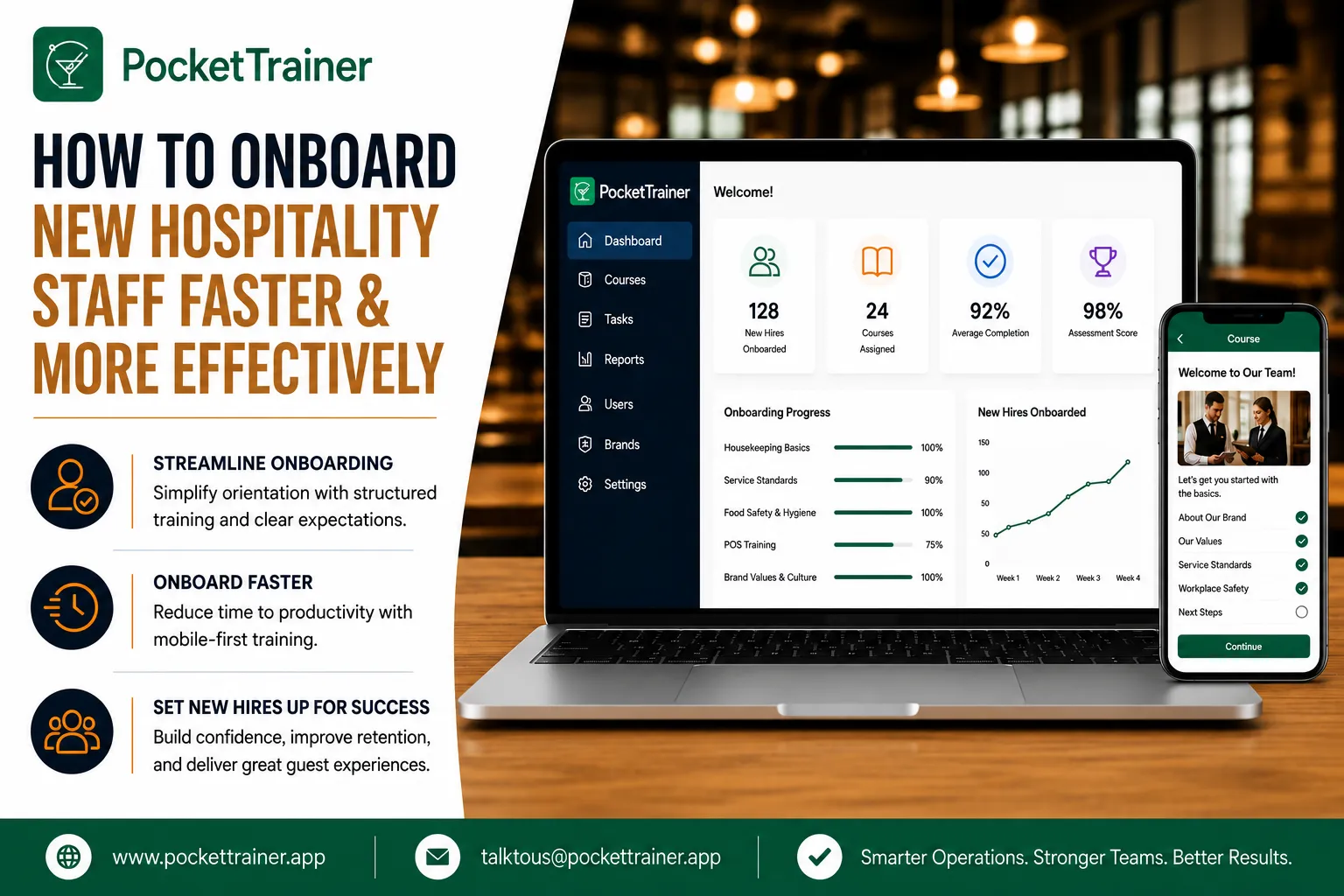
Role-based automatic assignment removes this entirely. The moment a new team member is added to a hospitality training software platform with their role, the right training path is assigned automatically. A new server gets service standards, allergen awareness, menu knowledge, and complaint handling. A new kitchen hire gets food safety, COSHH, cleaning schedules, and allergen protocols. No manager input required.
If you want to see how Pocket Trainer’s automated onboarding paths work, book a 15-minute demo.
Bottleneck 3: Shadowing is unstructured
The most common onboarding approach in hospitality is “shadow Sarah today.” Sarah is experienced, helpful, and completely unprepared to be a trainer. She covers what she remembers, in the order that makes sense to her, while also doing her job. The new starter gets whatever Sarah has time to show them between covers.
Structured shadowing has a named mentor, a daily checklist of what to cover, and a five-minute debrief at the end of each shift. The mentor knows exactly what they are responsible for, and the checklist matches the digital training modules the new starter is completing, so on-the-job practice reinforces the knowledge they are building on their phone.
The daily debrief is the most underused tool in hospitality onboarding. Three questions:
- What went well today?
- What is still unclear?
- What do you need more practice on?
It takes five minutes, catches problems before they become habits, and makes the new starter feel that their development is being actively managed rather than hoped for.
Bottleneck 4: Training content is not accessible during service
A new starter who cannot remember how to handle an allergen request mid-service has two options: find a manager, or guess. Both are slow, and the second is dangerous. If the training content were accessible on their phone in thirty seconds, neither would be necessary.
Online training for restaurant staff with mobile access turns reference material into an on-demand resource: the allergen matrix for the current menu, the steps for handling a guest complaint, the plating specification for a specific dish, all available on the phone already in their pocket.
This reduces how often a new starter interrupts a manager for information they could find themselves, directly reducing the burden on the team during service.
Bottleneck 5: Menu knowledge is delivered verbally and forgotten
A verbal menu briefing covers what was said, in the order it was said, retained by whoever was paying close attention. When a guest asks a question about a specific dish two days later, most of that briefing is gone.
Menu knowledge delivered as a short quiz, built from the actual menu, completed on a phone, and tied to a leaderboard creates retention rather than temporary familiarity. The new starter who scores 90% on a menu quiz and sees their name on the leaderboard knows the menu. The one who sat through a verbal briefing might.
Pocket Trainer’s AI quiz creation generates menu quizzes automatically from a menu PDF or copied text. The manager uploads the menu, the quiz is generated and assigned, and the new starter completes it before service, so the manager sees who is ready.
Pocket Trainer’s WOW Service, Handling Customer Complaints, and The Art Of Selling courses cover the service skills every front-of-house hire needs, delivered in the same short mobile-first format.
Bottleneck 6: There is no clear signal that onboarding is complete
In most restaurants, onboarding does not end; it tapers. The new starter gradually does more independently, and at some point the manager stops checking in. The person is considered trained, but nobody knows exactly when this happened or whether they are actually ready.
A structured onboarding programme has a defined endpoint: a set of modules completed, a set of competencies assessed, a sign-off from the mentor. When all three are in place, the manager knows the new starter is ready for independent service. When they are not, the manager knows exactly where the gap is.
This also protects the business, and it matters more now than it did a year ago. Under the Employment Rights Act 2025, the qualifying period for unfair dismissal protection is reducing from two years to six months, expected to take effect from 1 January 2027 and applying to employees already in service by then. In practice, this means the six-month probationary window most hospitality employers already use now carries far more weight: decisions about a new hire’s suitability need to be made, and documented, within that window, not left informal.
If something goes wrong with a new starter, documented training completion and competency sign-off demonstrates that the operator met their duty of care. Relying on “they were shown” does not, and under the tightening rules, that gap is riskier than it used to be.
Right to work checks: the one step that happens before training even starts
Every UK employer must verify a new hire’s right to work before employment begins, regardless of size or the employee’s nationality. This is confirmed under the Home Office’s employer guidance, and it sits outside training entirely, it’s a verification step, not a course.
Getting it wrong is expensive. Civil penalties reach £45,000 per illegal worker for a first breach and £60,000 for a repeat breach, and from 1 October 2026, employers using a digital verification provider must use one registered on the UK’s official digital identity register.
This isn’t something a training platform delivers, but it belongs on the same day-one checklist as everything above. A new starter who has completed compliance training but hasn’t had a right to work check has not actually cleared onboarding.
What faster onboarding looks like in practice
A new hospitality hire onboarded with these systems in place has a very different first week from one going through a traditional process.
Before day one, they complete four compliance modules on their phone, receive a welcome message through the platform’s news feed, and know exactly what to expect on their first shift.
On day one, their full training path is already assigned. They meet their named mentor, complete the first service standards module during their break, and end the shift with a five-minute debrief.
By the end of week one, they hold current compliance certificates, have completed their service and menu knowledge training, have a leaderboard score, and can handle the majority of service situations independently.
By the end of week two, they are fully independent, and the manager has a documented record of every module completed and every certificate issued.
Watch: Pocket Trainer – INK Hotel Testimonial — how one hotel used a training platform for restaurant properties to fix its own onboarding process, in the team’s own words.
Final thoughts
Faster onboarding is not about cutting corners. It is about removing the bottlenecks that slow the process without adding value: compliance delivered late, training assigned manually, shadowing without structure, knowledge that has no way to stick.
Fix those bottlenecks and the gap from hire to competency shortens significantly. The team absorbs less pressure, the new starter feels more supported, and retention improves as a direct result. If you want to see how a restaurant training platform supports faster onboarding for your operation, book a 15-minute demo.
FAQs:
1 What restaurant onboarding software features actually speed up time-to-competency?
The features with the biggest impact are pre-boarding compliance training completed before day one, automatic role-based training assignment, and mobile access to reference content during service. Together, they remove the delays caused by manual assignment and content that only exists in a manager’s head.
2 Does a hotel staff training platform work differently from a restaurant one?
The core mechanics, automatic role-based assignment, mobile access, and structured onboarding tracking, work the same way across hotels and restaurants, since both involve frontline staff learning role-specific content fast. The course content itself differs by department, but the onboarding structure does not need to.
3 How does the Employment Rights Act 2025 affect hospitality onboarding specifically?
It reduces the unfair dismissal qualifying period from two years to six months, from January 2027, which means decisions about a new hire’s suitability need to be made and documented within that window rather than left informal. Structured onboarding with a defined endpoint and documented sign-off becomes more important as evidence that the process was followed properly.
4 Can menu knowledge really be tested without a manager writing quiz questions?
Yes. Menu quizzes can be generated automatically from an uploaded menu or pasted text, removing the hours of manual question-writing that stop most managers from testing regularly. The quiz still needs to be reviewed for accuracy, but the heavy lifting of question creation is automated.
5 What is the single highest-impact change for slow hospitality onboarding?
Moving compliance training to before the first shift tends to have the fastest, most measurable impact, since it removes the legal exposure of untrained staff handling food and frees up the first days for role-specific and menu training instead. Automatic role-based assignment is the next highest-impact change, since it removes the manual delay at the start of every single hire.