
The Four Licensing Objectives: What Staff Need to Know
By Janos Laszlo
- licensing objectives
- premises licence
- alcohol licensing
- UK hospitality
Quick Summary
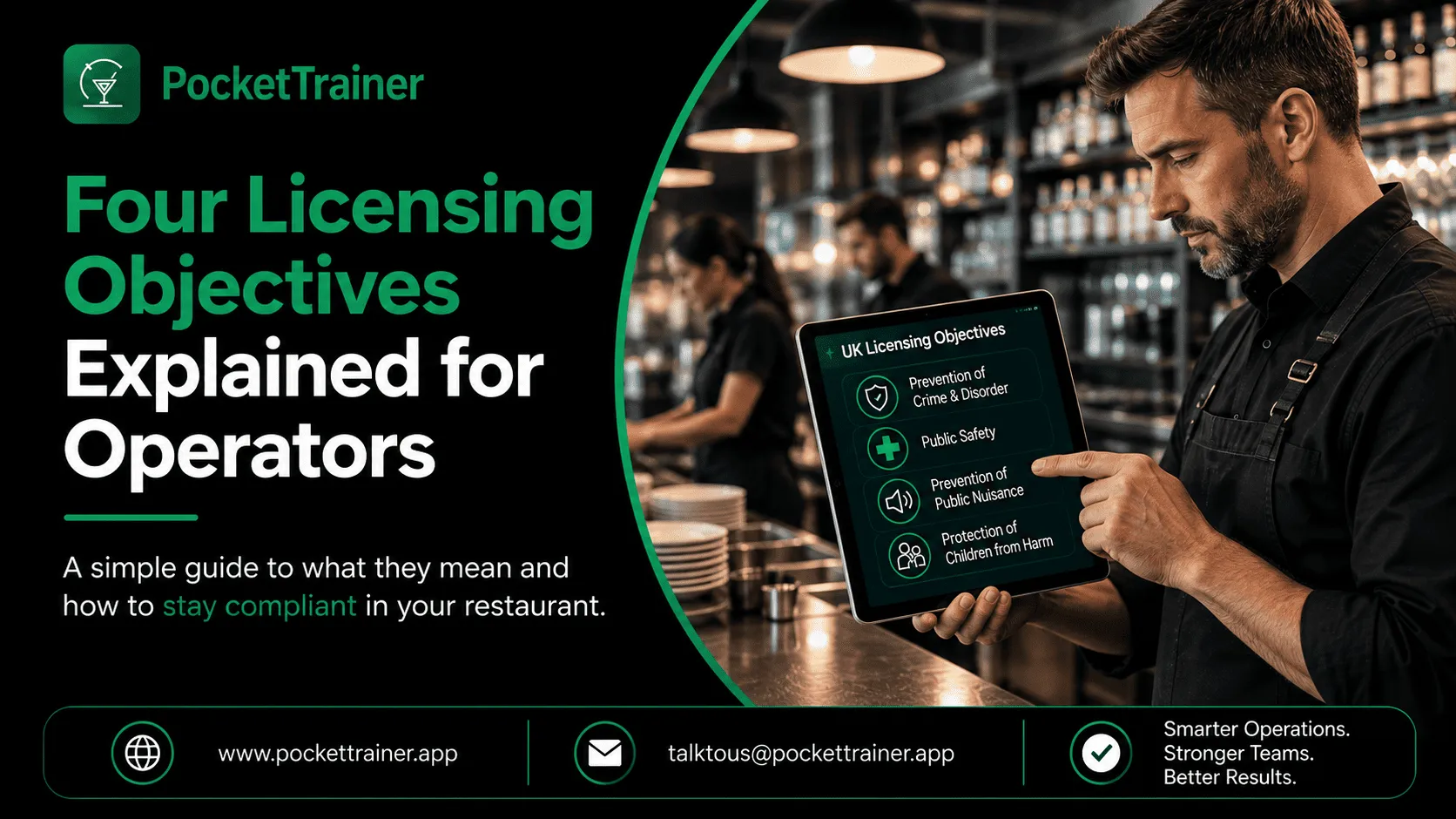
- The four licensing objectives are prevention of crime and disorder, public safety, prevention of public nuisance, and protection of children from harm.
- Every licensing decision in England and Wales is judged against them, there is no fifth objective and no ranking between them.
- For an operator, this makes them less a legal footnote and more the standard your team is measured by, on every shift, whether or not anyone has explained that.
- Each objective maps to something a specific team member does on the floor, which is what makes it trainable rather than theoretical.
- What survives a review is evidence, not intention: written policy, dated training records, refusals logs, and incident logs.
What to Train Staff On
Before a shift, make sure relevant team members know how to:
- Prevent crime and disorder: Recognise escalating situations, intervene early and know when to refuse service or call for support.
- Protect public safety: Keep exits clear, respond to spills and hazards, and follow the venue’s safety procedures.
- Prevent public nuisance: Manage noise, smoking areas and guest dispersal at closing time.
- Protect children from harm: Check ID correctly, follow age-verification procedures and handle refusals confidently. For broader responsible alcohol service training, see the Responsible Service Of Alcohol course.
- Record incidents and refusals: Know what needs to be recorded and where the venue keeps those records.
What Are the Four Licensing Objectives?
The four licensing objectives, set out under the Licensing Act 2003 and stated in Home Office guidance, are “the prevention of crime and disorder”, “public safety”, “prevention of public nuisance” and “the protection of children from harm.” They apply in England and Wales. Every application, condition and review is assessed against them: as the Section 182 statutory guidance puts it, licence conditions “must be appropriate for the promotion of the licensing objectives.” There is no fifth objective and no ranking between them.
Why They Matter More Than the Licence on the Wall
Most operators can point at the premises licence in the frame by the till. Far fewer can name the four things that licence is conditional on.
That gap matters because the objectives are not background reading. They are the test. When a licensing authority considers an application, a condition or a review, the objectives are the frame it decides within, and representations from residents or the police are only treated as relevant if they connect to one of the four.
Which means the objectives are not really a document. They are a description of how your venue is expected to behave, and the behaviour happens on the floor, at eleven at night, carried out by whoever is on shift.
What Does Each Objective Mean in Practice?
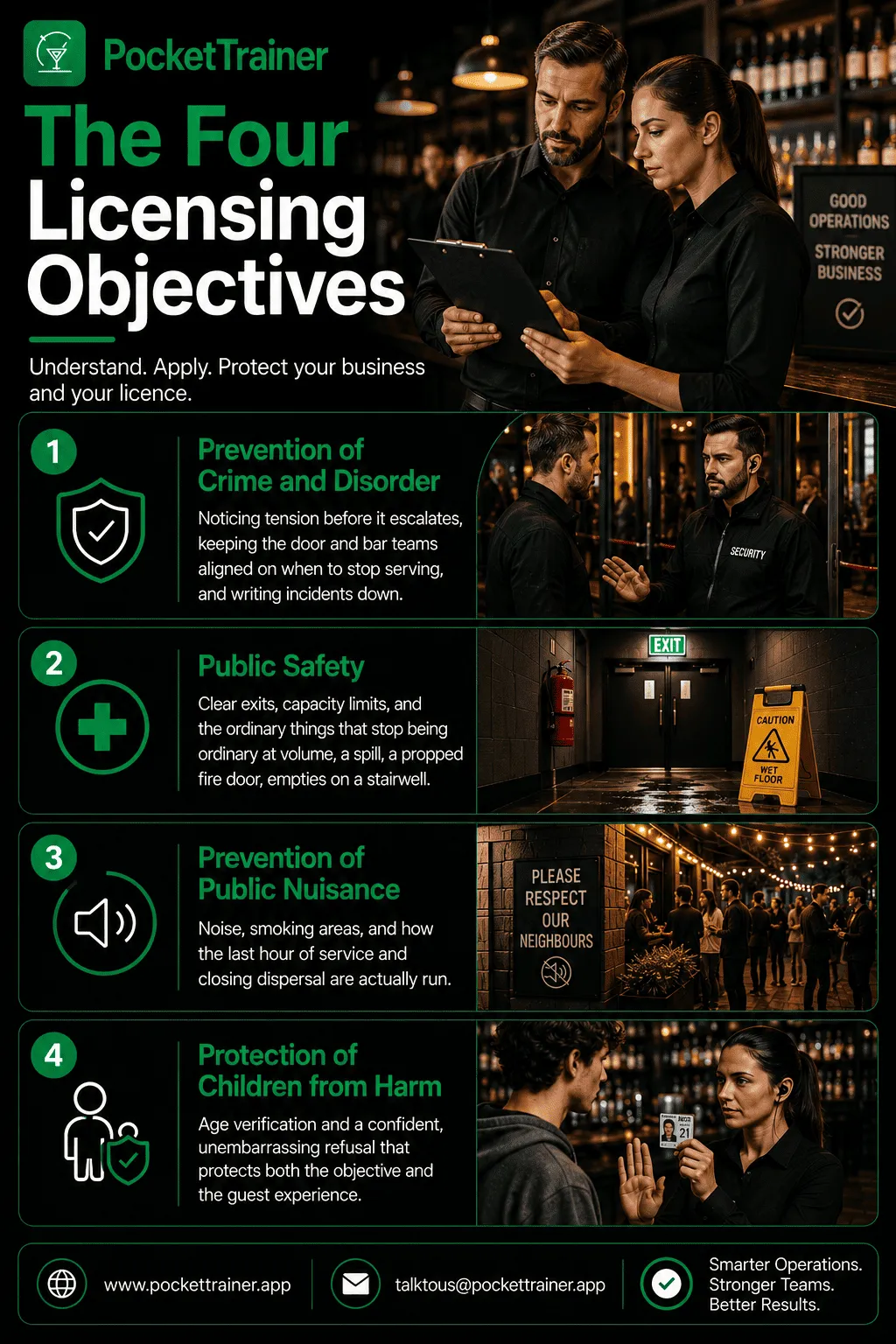
Each objective maps to something a team member does on a shift, which is what makes it trainable. Age verification and refusals sit under responsible service of alcohol; the public safety and crime objectives connect to counter terrorism awareness and to conflict resolution at the door.
The wording is broad by design. Here is the operational translation, which is the part nobody hands you.
Prevention of crime and disorder: In practice: what your team does when a group is getting loud, and someone is being provoked. Whether they intervene early or wait for it to become a problem. Whether the incident gets written down. Whether the door team and the bar team are working from the same understanding of when to stop serving. Most disorder is preventable twenty minutes before it happens, and it is prevented by a server who noticed rather than a policy that existed.
Public safety: Capacity, exits kept clear, glassware policy where it applies, and the state of the floor. It also covers the ordinary things that stop being ordinary at volume: a spillage in a corridor, a propped fire door on a warm night, a stack of empties on a stairwell. None of that is a licensing conversation until it is.
Prevention of public nuisance: Noise, smoking areas, and the twenty minutes after closing when your guests are on a residential street. This is the objective most often raised by neighbours, and it is largely determined by how the last hour of service is run. Dispersal is a training subject, not a signage subject.
Protection of children from harm: Age verification, obviously, but also where under-18s are permitted, what they can be served, and how a refusal is handled so it does not escalate. The refusal itself is the skill. A confident, unembarrassing no protects the objective and the guest experience at the same time. A hesitant one usually protects neither.
The Objectives Are a Staff Question, Not a Paperwork Question
Here is the practical problem with the four objectives: they are written for licensing authorities, and they are delivered by eighteen-year-olds on a Saturday.
A premises licence holder can read the objectives, understand them fully, and still be exposed, because the person actually making the decision at the moment it matters is a member of the team who may never have been told the objectives exist. Nobody promotes an objective they have not heard of.
So the useful translation is to stop treating them as legal text and start treating them as four questions every member of your team should be able to answer about their own shift.
- What do I do when it is getting tense?
- What do I do about the propped door?
- What do I do about noise at closing?
- What do I do when I think someone is underage and their friend is arguing with me?
The wider picture on responsible service of alcohol is covered separately, and the objectives sit underneath all of it.
Want to see what a licensing training record actually looks like?
Book a 15-minute demoHow Do You Show You Are Promoting the Licensing Objectives?
Through evidence rather than intention. That means a written policy that names the four objectives, training delivered to every member of staff who serves or supervises, completion records showing who was trained and when, an incident log that is actually filled in, and a refusals record. The distinction that matters is between what you believe your team would do and what you can show your team was taught. Only the second survives a review, because the first is not something a licensing authority can weigh.
What Actually Gets Asked at a Review
The questions are more practical than operators expect, and they are almost always about records rather than opinions.
- Who was on shift?
- What training have they had, and when?
- Can you produce it?
- Is there a refusals log and is it current?
- What does the incident log show for that night?
- Was the designated premises supervisor contactable?
- What changed after the last complaint?
Every one of those is answerable in about a minute if the records exist and are retrievable. Every one of them takes a day of searching if the training history lives in a folder in an office and the manager who kept it has left. That difference is the entire practical argument for keeping this material somewhere central rather than local, which is what a hospitality LMS is for, and it is the same reason our RoSPA-assured health and safety course is included rather than charged for.
The point worth holding onto is that none of this is exotic. It is the ordinary discipline of writing down what you did, applied to a subject where being unable to prove it is expensive.
The Takeaway
The four licensing objectives are short, plainly written and easy to find, and most teams have still never seen them. Print them, translate each one into what it means on your floor at your busiest hour, train the team on that translation rather than the legal wording, and keep the record of who was trained.
If you do one thing this week, ask three people on shift to name the four objectives. Whatever answer you get is your starting point, and it is usually more useful than any audit.
If your training records would not survive that conversation, it is worth twenty minutes.
Book a 15-minute demoFAQs
1 What are the four licensing objectives under the Licensing Act 2003?
The prevention of crime and disorder, public safety, prevention of public nuisance, and the protection of children from harm, as stated in Home Office guidance. They apply in England and Wales, and every licensing decision and condition must be appropriate for promoting them.
2 Do all staff need to know the licensing objectives, or just the premises licence holder?
The objectives are promoted or undermined by whoever is on the floor, so in practice anyone who serves alcohol, supervises service or works the door needs to understand them in operational terms. Knowing the legal wording matters far less than knowing what to do when a situation arises.
3 Is there a legal requirement to train staff on the licensing objectives specifically?
Requirements vary by nation and by the conditions attached to your own premises licence, and Scotland operates a separate statutory training regime. Check your licence conditions and take advice on your specific position. What is consistent everywhere is that being able to evidence training strengthens your position, and being unable to evidence it weakens it.
4 What records should we keep to show we are promoting the objectives?
A written policy naming the four objectives, dated completion records for every member of staff trained, a refusals log, an incident log, and a record of what changed after any complaint. Retrievable by name and date, and kept centrally so the history survives a change of manager.
5 How often should licensing training be refreshed?
Tie it to change rather than the calendar. New starters before they serve unsupervised, everyone whenever a licence condition changes, and the whole team after any incident that exposed a gap. An annual refresh with nothing in between tends to leave the newest staff, who are the most exposed, untrained for the longest.