
HACCP Training for Restaurant Managers: What UK Law Requires in 2026
By Janos Laszlo
- HACCP
- Training for Restaurant
- training and record management
Quick Summary
- Every UK restaurant must have a food safety management system based on HACCP principles, as required under Article 5 of assimilated Regulation (EC) 852/2004.
- HACCP helps identify, control, and monitor food safety hazards throughout food preparation and service.
- A formal HACCP qualification is not legally required, but managers responsible for food safety should have appropriate HACCP training to demonstrate competence.
- Restaurant managers are responsible for implementing, monitoring, and reviewing the HACCP food safety plan and maintaining accurate food safety records.
- Training records are an important part of demonstrating due diligence under the Food Safety Act 1990 if food safety issues arise.
- Digital HACCP training and record management make it easier to demonstrate compliance during Environmental Health inspections.
Every UK restaurant manager runs into HACCP sooner or later, usually as a word on an inspection form or a folder they inherited from the last manager. Fewer can say exactly what the law requires, what their own responsibility is, and whether their team is trained to the standard an environmental health officer expects. This guide explains HACCP for restaurants UK, including the legal requirements, management responsibilities, and role of training under UK law in 2026.
A food safety management system based on HACCP principles is a legal requirement for every food business in the UK, from a single café to a multi-site group. What varies is how complex your system needs to be and whether you can prove your managers and staff actually understand it. This is what the law requires, and how training fits in.
HACCP sits alongside two related duties covered elsewhere: food handler training law UK and is food hygiene training a legal requirement, but this guide focuses on the piece managers get wrong most often.
What is HACCP, and is it a legal requirement?
HACCP-based food safety procedures are a legal requirement for every UK food business, under Article 5 of assimilated Regulation (EC) 852/2004, regardless of size or type.
HACCP stands for Hazard Analysis and Critical Control Points. It is a preventative food safety management system designed to identify and control risks before they become food safety incidents. Rather than reacting to contamination after it occurs, HACCP focuses on preventing hazards throughout every stage of food handling, from receiving deliveries and storage to preparation, cooking, cooling, and serving customers.
For restaurants, HACCP provides a structured approach to protecting customers, maintaining legal compliance, and reducing the risk of foodborne illness.
Under Article 5, retained in UK law after Brexit and enforced through the Food Safety and Hygiene (England) Regulations 2013, every food business operator must put in place, implement and maintain permanent procedures based on HACCP principles. This applies regardless of size or type, including restaurants, cafés, takeaways, hotels, pubs, dark kitchens and mobile food businesses.
Enforcement is real, not theoretical. UK courts have issued fines ranging from thousands to hundreds of thousands of pounds for serious food safety failures, including cases where businesses failed to implement or maintain HACCP-based food safety procedures.
What HACCP Means for a Restaurant in Practice
For an operator who has never built one, HACCP stops being confusing the moment you stop treating it as a document and start treating it as a handful of decisions about your own menu, not a generic list borrowed from a template.
Start with your hazards, not the textbook’s. A sushi kitchen’s hazard list looks nothing like a pizza kitchen’s, so the exercise is walking your own menu, ingredient by ingredient, and asking where something could actually go wrong: raw fish held too long, a sauce cooled too slowly, an allergen carried on a shared board.
From there, decide which points genuinely matter. Not every step needs a control, only the ones where a failure would actually reach a guest: the point food finishes cooking, the point it starts cooling, the point an allergen dish leaves the pass. Treating every step as critical is how HACCP plans become unusable.
Each of those points needs a limit and a name: a temperature, a time, a visual check, whatever separates safe from unsafe, and a specific person whose job it is to check it on a specific shift, not “the kitchen” in general.
Then plan for the check failing, because it will. What happens to the food, who is told, and what changes so it doesn’t happen the same way twice, a plan with no failure procedure only works when nothing goes wrong.
Last, the records, not because paperwork is the point, but because a check that isn’t written down is indistinguishable, to an inspector, from a check that never happened. This is exactly the practical decision-making our HACCP for Managers course is built to train, not the theory, the actual choices a manager has to make about their own kitchen.
Is HACCP a Legal Requirement for Restaurants in the UK?
UK food law requires food business operators to put in place, implement and maintain a permanent procedure based on HACCP principles, which for most restaurants means a documented food safety management system proportionate to the business. The law does not require a specific HACCP certificate, but it does require that whoever is responsible for the system has received adequate training in applying those principles. In practice, an inspector will ask to see your procedure, ask the person responsible to explain it, and ask for the records that show it is being followed.
Is HACCP a Legal Requirement for Restaurants in the UK?
Yes. Under Article 5 of assimilated Regulation (EC) 852/2004, every food business in the UK must put in place, implement and maintain food safety management procedures based on HACCP principles. This applies to all food businesses regardless of size, from a small café to a large restaurant group, and is enforced by local authorities through environmental health inspections.
The legislation requires procedures based on HACCP principles rather than one standardised HACCP plan. This allows businesses to scale their food safety management system according to the complexity of their operation. Smaller businesses may use the Food Standards Agency’s Safer Food, Better Business (SFBB) pack, while larger restaurants typically require a more detailed HACCP food safety plan.
What the Law Asks of a Restaurant Manager
UK food safety law places legal responsibility on the food business operator, but day-to-day responsibility for HACCP usually falls to the restaurant or kitchen manager running the site.
Meeting legal requirements involves much more than keeping a HACCP folder on a shelf.
Managers should ensure the business has:
- A documented food safety management system based on the seven HACCP principles.
- Clearly identified Critical Control Points (CCPs).
- Safe temperature limits for cooking, chilling, reheating, and hot holding.
- Daily monitoring records and temperature logs.
- Corrective action procedures when limits are exceeded.
- Regular reviews whenever menus, suppliers, equipment, or food preparation processes change.
For example, introducing a new sous-vide menu, replacing refrigeration equipment or changing food suppliers should all trigger a review of your HACCP food safety plan to ensure new risks have been properly assessed.
None of this works if the manager responsible does not fully understand how the HACCP system operates. A copied template that no one understands is one of the most common reasons businesses struggle during Environmental Health inspections.
Does a Manager Need a HACCP Qualification?
This is one of the biggest misconceptions within the hospitality industry.
There is no legal requirement for a restaurant manager to hold a formal HACCP qualification or certificate before creating or managing a HACCP plan. The legislation requires businesses to operate an effective food safety management system, not to employ someone with a particular certificate.
However, legal compliance depends on competence.
Managers responsible for developing, implementing, and reviewing the HACCP system should understand hazard analysis, critical control points, monitoring procedures, and corrective actions. For this reason, Level 3 HACCP training is widely recommended for restaurant managers, kitchen managers, and food safety supervisors. Pocket Trainer’s full set of hospitality courses covers this training alongside every other compliance area a restaurant needs.
Environmental Health Officers are assessing far more than paperwork. They expect managers to confidently explain:
- Why does each Critical Control Point exist?
- How monitoring is carried out.
- What corrective actions are taken?
- How records are maintained.
- How the HACCP system is reviewed.
A trained manager demonstrates confidence and control. An untrained manager relying on an inherited HACCP folder rarely inspires the same confidence.
Pocket Trainer includes a HACCP for Managers course for the UK, assured by RoSPA Qualifications, specifically designed to help managers understand, implement and maintain HACCP systems across hospitality businesses.
Want your managers trained to the standard an inspector expects?
Book a 15-minute demoWhy Training Records Are Your Due Diligence Defence
The due diligence defence under the Food Safety Act 1990 lets a business avoid liability for a food safety offence by proving it took all reasonable precautions, and documented staff training is one of the clearest ways to prove that.
Training becomes particularly valuable when something goes wrong.
One of the strongest ways to demonstrate this is through documented staff training.
Training records show:
- Who completed HACCP training?
- When the training took place.
- What course was completed?
- That the business invested in staff competence.
Verbal assurances that staff “know the system” carry little weight during inspections or legal proceedings. Accurate training records provide objective evidence that reasonable precautions were taken.
Digital training platforms make maintaining these records significantly easier.
With Pocket Trainer, completed courses automatically generate certificates recording the employee’s name, workplace, completion date, time, and course details. Instead of relying on paper certificates that can be misplaced, businesses have accessible digital records across every site and every employee.
How Does HACCP Training Protect a Restaurant During an Inspection?
HACCP training protects a restaurant by giving managers the competence to run the food safety system properly and by providing documented evidence of due diligence. An Environmental Health Officer assesses whether the people responsible for food safety genuinely understand the system, so a trained manager who can explain their critical control points and produce monitoring records demonstrates control.
If a food safety issue ever leads to legal action, dated training records support the due diligence defence under the Food Safety Act 1990 by showing the business took reasonable precautions to train staff. Holding clear, accessible records of HACCP training is one of the strongest ways to demonstrate compliance during inspections.
The Takeaway
HACCP is a legal requirement for every UK restaurant: under Article 5 of retained Regulation (EC) 852/2004, you must have food safety management procedures based on HACCP principles, scaled to your operation and backed by records. A specific qualification is not legally mandated, but training is what makes a manager genuinely competent to run the system, and documented training is a core part of the due diligence defence that protects the business. The operators who pass inspection cleanly are the ones whose managers understand HACCP and can prove their team was trained.
You can also see the full set of hospitality courses included as standard.
Want your HACCP and food safety training delivered and documented across your team?
Book a 15-minute demoFAQs
1 Is HACCP training legally required for restaurant managers in the UK?
No, UK law does not require restaurant managers to hold a specific HACCP certificate. However, businesses must implement and maintain food safety procedures based on HACCP principles, and managers responsible for food safety should be competent to manage the system. HACCP training is the most effective way to demonstrate competence during Environmental Health inspections.
2 What is included in a HACCP food safety plan?
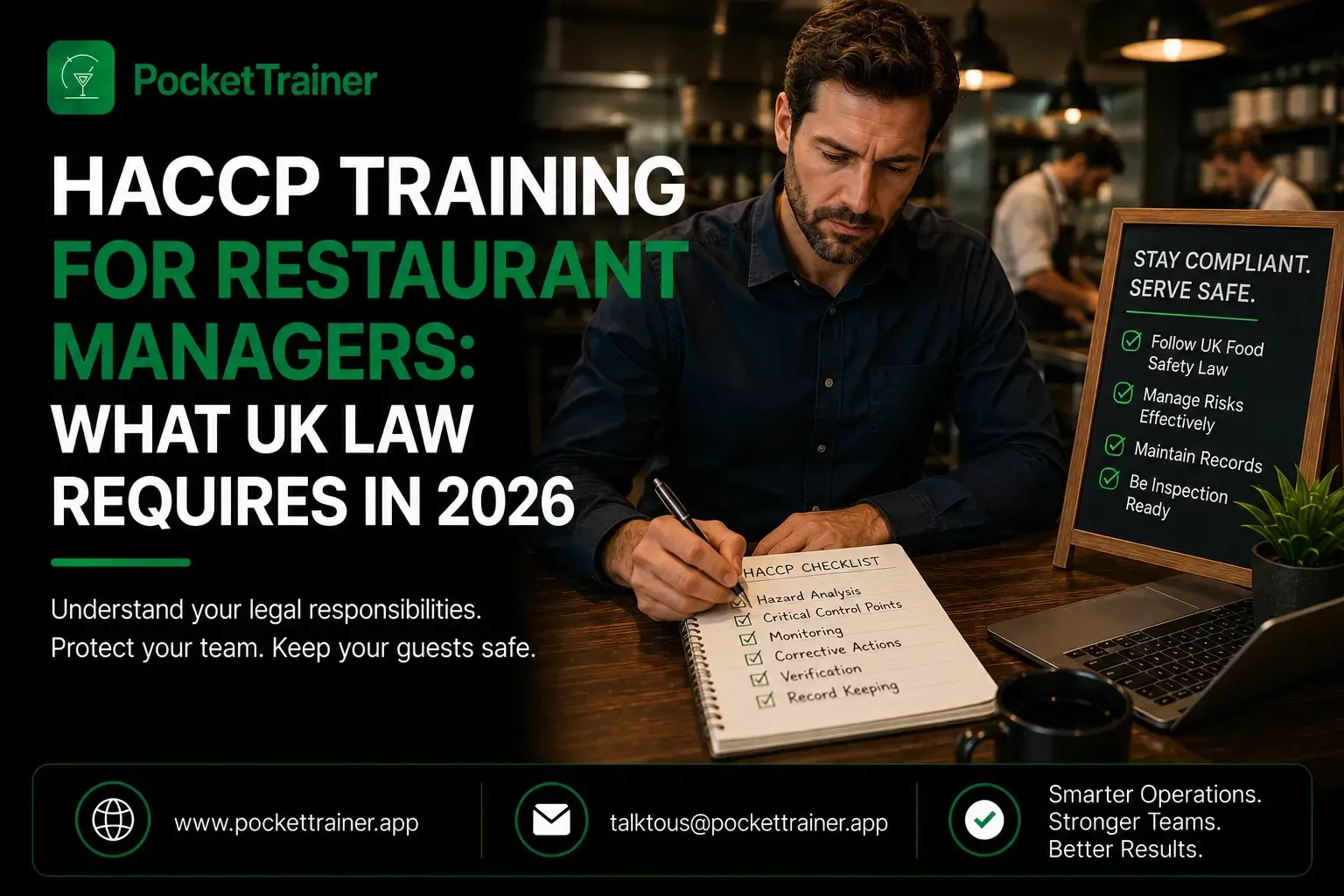
A HACCP food safety plan identifies potential food safety hazards and outlines the controls needed to prevent them. It typically includes hazard analysis, critical control points (CCPs), critical limits, monitoring procedures, corrective actions, verification activities, and record-keeping to ensure food is prepared and served safely.
3 Who should complete HACCP manager training?
HACCP manager training is recommended for anyone responsible for developing, implementing, or overseeing a restaurant’s food safety management system. This includes restaurant managers, kitchen managers, head chefs, executive chefs, food safety supervisors, and operations managers responsible for HACCP compliance.
4 How often should a restaurant review its HACCP plan?
A restaurant should review its HACCP plan whenever there are significant changes to its operations, such as introducing new menu items, changing suppliers, installing new equipment, modifying food preparation processes, or following a food safety incident. Even without major changes, regular reviews help ensure the plan remains effective and compliant with UK food safety regulations.