
Hospitality LMS or General Corporate LMS?
By Janos Laszlo
- hospitality LMS
- corporate LMS
- hospitality training platform
- LMS for restaurants
- hotel training platform
- restaurant training software
- hospitality training
- LMS comparison
Quick Summary
- A general LMS can work well for compliance, induction, and corporate training.
- A hospitality LMS is designed around menus, products, mobile teams, and venue-level training.
- If your business already uses a corporate LMS, both platforms may have a role.
- Test any platform using one real dish, one phone and one completion record.
A general corporate LMS can deliver training to hospitality staff. The more important question is whether it works well for the way restaurants, hotels and venues operate.
Hospitality teams work across shifts, often without desks, while menus, dishes, cocktails, allergens and service standards can change regularly. That creates a different training environment from a typical office.
So the decision is not simply about which LMS has more features. It is about whether the platform gives your most important and frequently changing content a practical place to live, update and access.
What the Two Things Actually Are
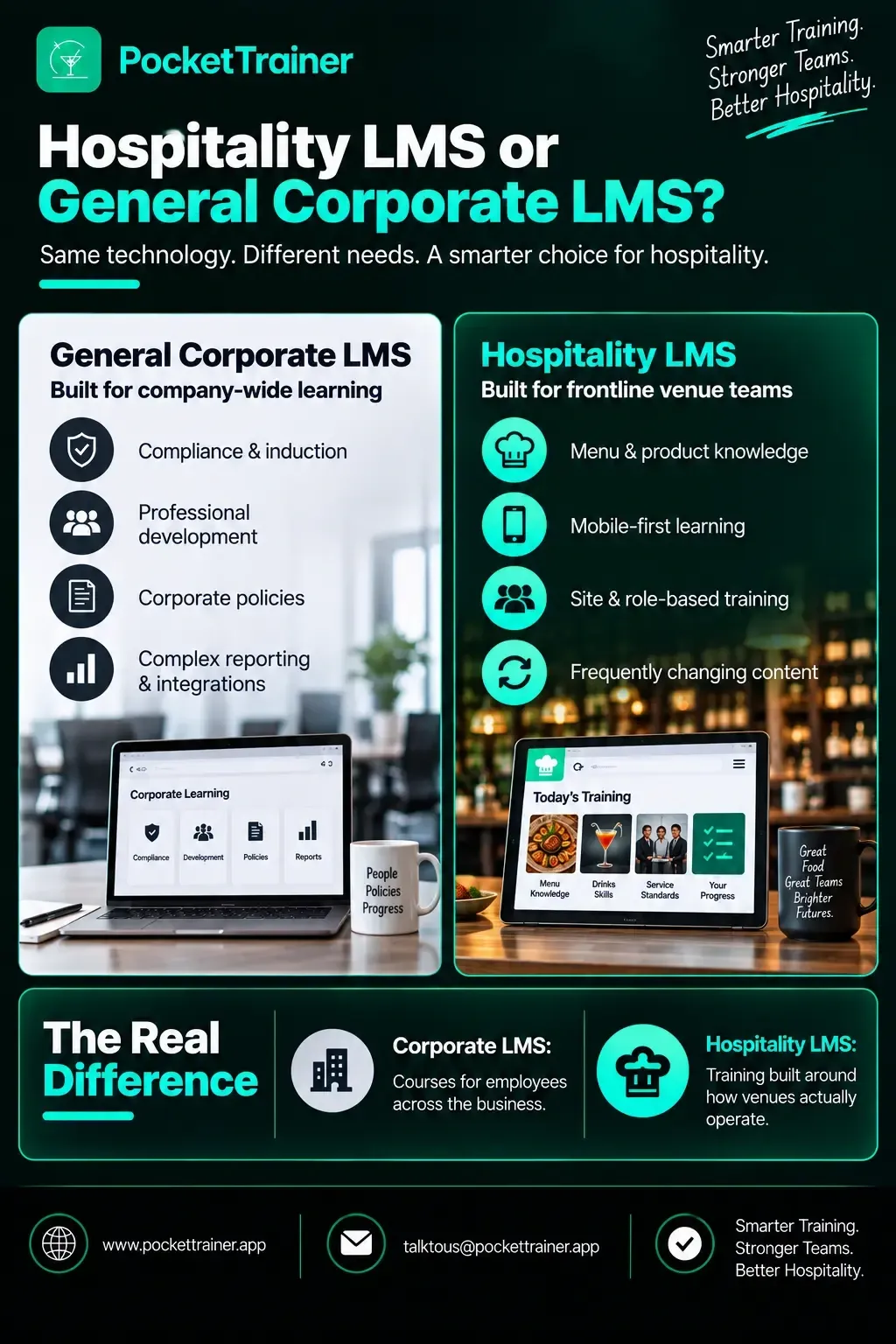
A general corporate LMS is built to deliver structured courses to employees across different industries. Common uses include onboarding, compliance, professional development and policy acknowledgement.
These platforms are often strong on configuration, reporting hierarchies, permissions, HR integrations and delivering standardised courses across large organisations.
A hospitality-specific platform is built around the operating pattern of a venue: a mobile workforce, shift-based availability, high staff turnover and operational knowledge that can change frequently. Both platforms deliver courses. The practical difference is what happens to everything that is not simply a course.
What Is the Difference Between a Hospitality LMS and a General LMS?
A general LMS is designed to deliver structured learning across different types of workforces and is often strong on configuration, reporting and corporate integrations.
A hospitality LMS is designed around what a venue needs to operate day to day: menu and product knowledge, mobile access, venue-specific standards and training records that can be reviewed by site and role. Both can support compliance training.
The practical question is whether your dishes, drinks, allergens and service standards have a structured, accessible home, or whether they remain in documents that are harder for frontline teams to access and maintain.
Where a General Platform Genuinely Wins
A useful comparison should acknowledge where the general option works well.
Breadth of Configuration
Corporate platforms can offer extensive flexibility around user hierarchies, permissions and approval workflows. If your business has a complex head office structure, that flexibility can be valuable.
Existing Integrations
If your HR system, payroll and single sign-on already connect to a corporate suite, adding another platform can introduce another integration to manage.
Integration requirements depend on both systems, so they should be assessed individually rather than assumed.
One Supplier for the Whole Company
If hospitality is one division within a larger organisation, having one learning platform and supplier across the business can simplify procurement and administration.
Professional Development at Management Level
Leadership programmes, finance training and company-wide professional development are common corporate learning requirements. A general LMS can be well suited to these use cases.
If these requirements describe your organization more closely than the hospitality-specific needs below, a general platform may already meet your requirements.
The Four Gaps That Show Up in a Venue
1. Nowhere Structured for Menu and Product Knowledge
This is often one of the biggest differences. A general platform can host a menu PDF. But hospitality teams may need more than a document.
They may need each dish or drink to have structured information such as:
- Ingredients
- Allergens
- Photos
- Tasting notes
- Preparation methods
The practical test is whether a chef can update that information when a dish changes and whether the updated information can quickly reach the team.
“If I need to check one dish, I can go straight on it, when I need, whenever I want, so, for the food knowledge it’s important, for the wine also, but also for the cocktail.” - Lisa Allietta, Sommelier, LPM Dubai
2. Desktop Assumptions
Some corporate learning platforms are designed around employees accessing training from computers and work accounts.
Hospitality teams may work differently.
A useful test is whether a new starter can find and complete something useful from their own phone, without needing an IT ticket or a manager to guide them through the process.
3. Reporting That Does Not Match the Operating Structure
Head office may need to know which sites or roles are behind with training.
A reporting structure designed mainly around departments and corporate hierarchies may require additional configuration to represent individual venues and operational teams.
The important question is whether managers can get the training information they actually need without creating unnecessary reporting work.
4. Content That Ages Weekly
Corporate policies may be reviewed periodically.
Hospitality content can change much more frequently. Menus, dishes, cocktails, ingredients, and service standards can all change as the operation evolves.
If updating training content requires a lengthy process or a head office ticket every time something changes, keeping the material current can become harder.
“Boring. We need something new, something interactive. It’s easy to have an app. You have everything in one place rather than spreadsheets and stuff like that.” - Ana Boncheva, Head Waitress, Sushisamba
Bring one dish and one site to the demo and see how the platform handles it rather than judging from a feature list.
Book a 15-minute demoHospitality LMS vs General LMS: Quick Comparison
| Requirement | General Corporate LMS | Hospitality LMS |
|---|---|---|
| Compliance training | Strong fit | Strong fit |
| Corporate learning | Strong fit | More limited |
| Menu knowledge | May require configuration | Built around it |
| Product knowledge | May require configuration | Built around it |
| Mobile frontline access | Depends on platform | Core requirement |
| Venue-level training | Depends on configuration | Core requirement |
| Frequently changing content | Depends on workflow | Designed for regular updates |
When the Answer Is Honestly Both
For some larger hospitality groups, this is not an either-or decision.
A practical split can be:
Corporate LMS
- Head office training
- Management development
- Company-wide policies
- Corporate compliance
Hospitality LMS
- Floor and kitchen training
- Menu and product knowledge
- Venue-specific standards
- Day-to-day operational communication
The argument against two systems is additional administration.
The argument for two systems is that the platform used by head office may not be the platform frontline teams find easiest to use.
The right approach depends on whether each system is actually being used for the job it is designed to perform.
“I really love the news, but also the leaderboard for quizzes and training.” - Judit Toth, then General Manager, INK Hotel Dubai
For a frontline hospitality workforce, the way training is presented can influence whether people engage with it.
How to Test It in Twenty Minutes
Run the same four tests on any platform, whether it is general or hospitality-specific. Use your own material rather than sample data.
The Dish Test
Load one real menu item with allergens and a photo. Change it.
Then see how quickly the updated information becomes available to a team member and how many people are needed to make the change.
The Phone Test
Ask a real team member, rather than a manager, to find one specific piece of information on their own phone without instructions.
The Record Test
Ask the vendor to produce a completion record filtered by site and role while you watch. This tests whether the reporting structure matches your operational needs.
The Update Test
Ask who is responsible for keeping the content current after implementation. If the answer is head office, consider whether the process is practical for weekly operational changes.
A platform that passes these tests deserves consideration regardless of whether it is marketed as a general LMS or a hospitality LMS.
Can We Use Our Existing Corporate LMS for Restaurant Staff?
Yes. Many hospitality groups can use an existing corporate LMS, especially when training focuses mainly on compliance, induction, and corporate learning.
The question is whether it also handles the operational content your venue teams need every day.
Test the existing platform with:
- A real menu item
- Mobile access
- Venue-level reporting
- A content update
If it performs well on those tests, there may be less reason to introduce another system. If it struggles specifically with menu content, mobile access, or venue-level training, those gaps may explain why a hospitality-specific platform is worth evaluating.
Where Pocket Trainer Sits
Pocket Trainer is focused on hospitality and is built around the idea that much of the content changing most often in a venue comes from the operator itself.
The digital food, cocktail, and wine bible gives dishes and drinks a structured home.
The hospitality LMS is mobile-first, while completion records can be filtered by site and role through training management.
The compliance side is supported through the hospitality course library, which includes courses covering areas such as food safety, HACCP, health and safety, and fire warden training.
Pocket Trainer can also help businesses move existing operational knowledge into structured training through custom content creation.
Scheduling, time and attendance, and employee net promoter surveys are not part of the platform. If your main requirement is workforce management rather than training, a different category of product may be more appropriate.
Final Thoughts
Choosing between a hospitality LMS and a general corporate LMS is less about the number of features and more about how your teams work.
A general LMS can be a strong fit for corporate learning, compliance, and structured professional development. A hospitality-specific platform focuses more closely on frontline access, menu and product knowledge, venue-level training, and frequently changing operational content.
If you already have a corporate LMS, test it before buying anything else.
Put one real dish into the system, hand the phone to a team member, update the content, and ask for the training record you actually need. The result will tell you more than a feature comparison.
Bring your own compliance requirement and ask to see the completion record produced live, filtered by site and role.
Book a 15-minute demoFAQs
Will we need to run both systems permanently?
Not necessarily. Some groups may use one platform across the business, while others keep a corporate LMS for head office and a hospitality platform for venue teams. The decision depends on whether the existing system meets the operational requirements of the venues.
Is a hospitality-specific platform harder to integrate?
Integration difficulty depends on the specific systems involved, not simply on whether a platform is hospitality-specific. Ask both vendors what data can be exchanged and how the connection would work.
Can a corporate LMS handle menu and product training?
It can host menu and product training, but the practical question is how easy that content is to structure, update and access. Test it with a real dish rather than relying on a sample demonstration.
What about multi-language hospitality teams?
Ask how each platform handles translation, content updates, and different language versions. In particular, check what happens when the original content changes and whether translated versions also need to be updated.
How do I know whether I need a hospitality LMS?
Start with the four tests: dish, phone, record, and update. If your existing LMS handles them comfortably with your real hospitality content, you may not need another platform. If it consistently struggles with the way your venues operate, investigate the specific gap rather than buying based on features alone.