
Back of house training programs: a practical guide for restaurant operators
By Janos Laszlo
- Back of house
- Back of house training programs
- restaurant operators
Quick Summary
- Front-of-house and back-of-house roles need fundamentally different training, guest interaction and communication for FOH, and food safety and technical procedures for BOH.
- Back-of-house training programs specifically need to cover food safety, hygiene, equipment handling, timing, and coordination under pressure, distinct from generic hospitality training.
- UK accommodation and food services employ around 2.6 million people, 7% of all UK jobs, and hospitality vacancies remain elevated even as the sector sheds roles overall.
- A role-based LMS with mobile access, microlearning, and visual demonstration solves the training split without doubling a manager’s workload.
- Onboarding is where the FOH/BOH split matters most; mismatched training here is the most common reason new hires struggle in their first weeks.
Hospitality is a whirlwind industry. Each shift is a blend of high energy, continuous demands, and the necessity of exact teamwork. Whether it is a server taking orders with a smile or a cook working under pressure, training is what keeps hotels and restaurants running smoothly. Front-of-house (FOH) and back-of-house (BOH) staff have very different roles, but both need structured, consistent back-of-house and front-of-house training programs to deliver a genuinely good guest experience.
UK accommodation and food services alone employ around 2.6 million people, roughly 7% of all UK jobs, and on the sector’s wider definition, hospitality supports 3.5 million jobs, the UK’s third-largest employer. That’s a lot of people needing two very different kinds of training, delivered consistently, often with a manager who has no time to build it from scratch.
What is the difference between FOH and BOH training?
Front-of-house and back-of-house staff have quite distinct daily tasks, so they require different kinds of training as well.
| Field | Front-of-House (FOH) | Back-of-House (BOH) |
|---|---|---|
| Typical roles | Hosts, servers, bartenders | Line cooks, dishwashers, prep staff |
| Success depends on | Guest interaction, communication | Procedure, speed, coordination under pressure |
| Core training areas | Customer service, upselling, complaint handling, POS systems | Food safety, hygiene, equipment handling, cooking method, timing |
| Pocket Trainer courses | Handling Customer Complaints, The Art Of Selling | Food Safety Level 2 UK, Personal Hygiene Standards, Kitchen Knives And Their Use |
Front-of-House (FOH) covers guest-facing positions, including hosts, bartenders, and servers. Success here is based on guest interaction and communication. FOH staff need training in customer service, upselling, complaint handling, POS systems, and presenting a polished guest experience. Pocket Trainer’s Handling Customer Complaints and The Art Of Selling courses cover this ground directly.
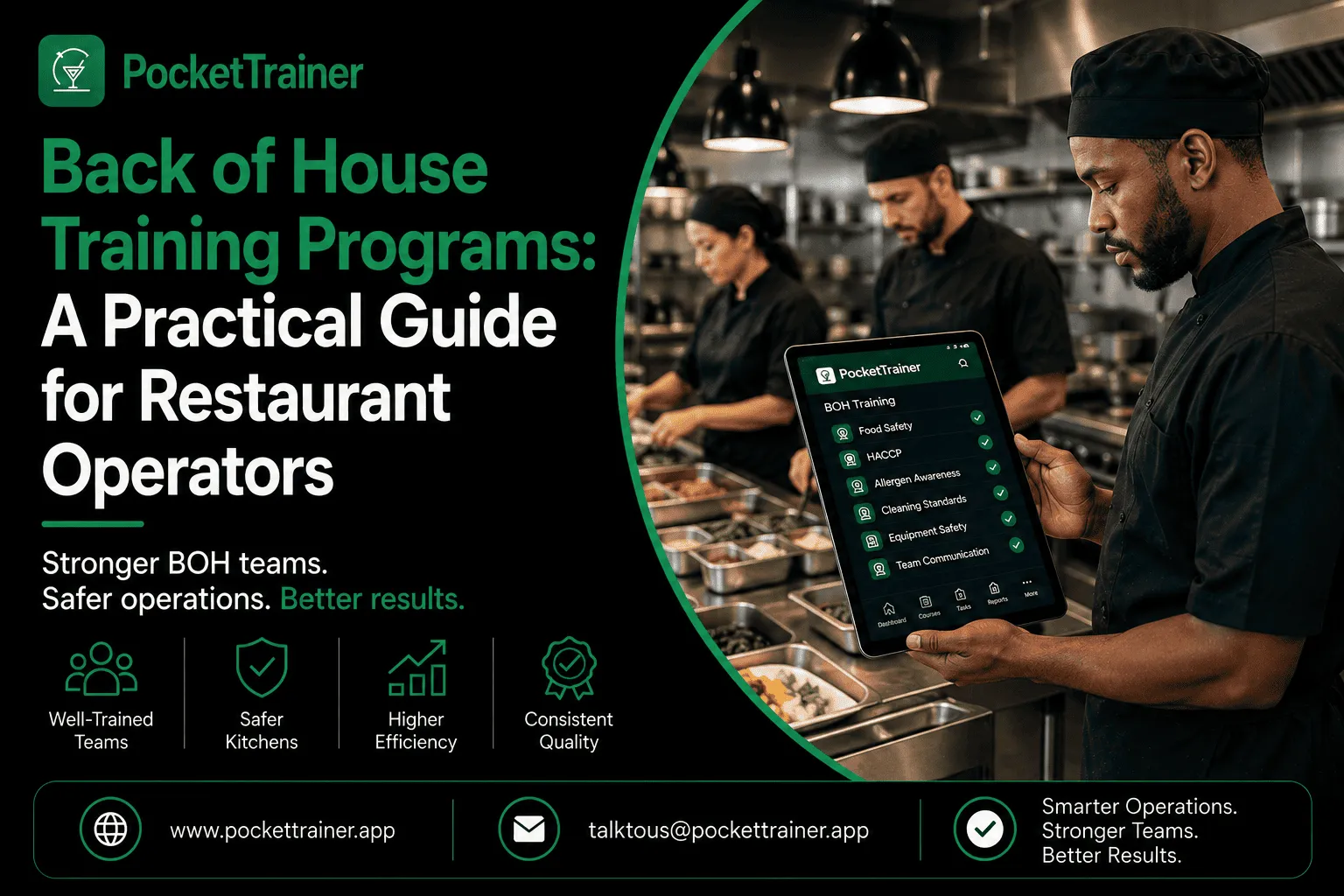
Back-of-House (BOH) covers the kitchen team and support staff, including line cooks, dishwashers, and prep staff. BOH training centres on food safety, hygiene, equipment handling, cooking method, timing, and coordination under pressure. Pocket Trainer’s Food Safety For Restaurants Level 2 UK, Personal Hygiene Standards, and Kitchen Knives And Their Use courses build exactly this foundation.
Because every group requires specialised skills, onboarding must be organised differently. Most restaurants struggle when new employees arrive during busy periods, leaving managers with limited time for comprehensive training. That’s where a role-based LMS earns its place, streamlining onboarding for restaurant teams so FOH and BOH get customised, self-directed training without hindering operations.
How do the best back of house training programs handle the FOH/BOH split?
Modern LMS platforms are built to handle this split with tailored learning paths rather than one generic course library for everyone.
- Role-based learning paths: FOH staff work through modules on guest greetings, upselling wines, or POS simulations, while BOH staff work through cross-contamination prevention, knife safety, or recipe procedures.
- Microlearning modules: Nobody needs to spend hours in a classroom. Bite-sized lessons fit into a prep break or the downtime between shifts.
- Visual and video training: Particularly valuable for BOH, where an instruction like “how to clean a slicer” is far easier demonstrated than described, and it builds confidence for non-native English speakers who might struggle with a purely written manual.
- Mobile access: Staff train anywhere, anytime, on their own phone.
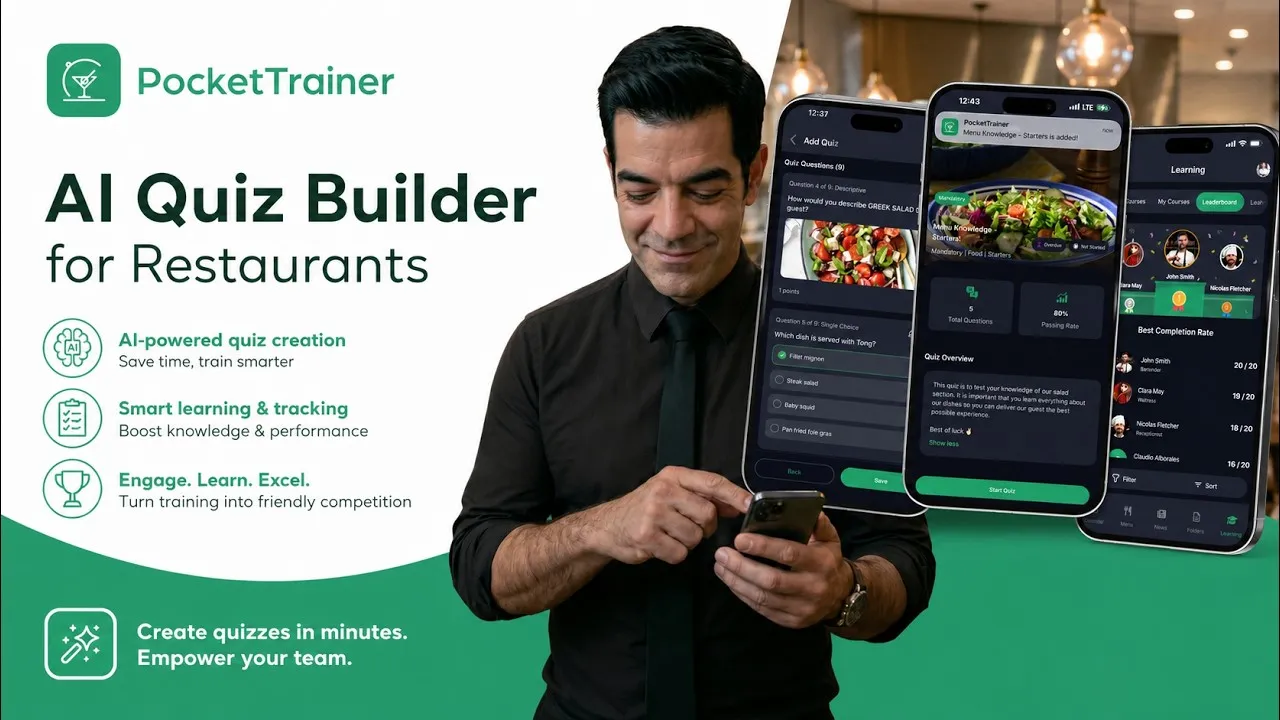
- Gamification: FOH staff especially stay motivated through quizzes, leaderboards, and badges.
- Compliance tracking: Essential for food safety certificates of completion and the regulatory requirements that apply to BOH teams specifically.
Playing loads the video from YouTube, which may set cookies.
Affordable training software for hospitality: what to look for
A back-of-house training programme, or a front-of-house one, only pays for itself if it actually gets adopted. Look for:
- Cost savings through lower turnover and faster ramp-up time
- Scalable pricing that expands as the business grows, rather than a flat licence regardless of headcount
- Remote learning that lets seasonal or new employees start before their first shift
- Less manual paperwork, freeing managers to focus on service rather than admin
The stakes here are real. UK hospitality vacancies have fallen from a 2022 peak of 177,000 to around 71,000 in 2026, but that’s driven largely by operators cutting back rather than roles being filled, and the sector has lost roughly 170,000 jobs in the thirteen months following the October 2024 Budget. In that environment, every new hire who receives proper role-based training rather than a generic induction is a meaningfully better investment.
Streamlining onboarding: FOH vs. BOH journeys
Onboarding is notoriously difficult in hospitality. With tight schedules and high turnover, managers need tools that do the heavy lifting.
FOH journeys: new servers start with short videos on greeting guests, take quizzes that mirror real menu knowledge, and rehearse mock POS transactions, all before serving their first table.
BOH journeys: kitchen staff work through step-by-step instructions for cleaning schedules, food safety checks, and recipe preparation, the kind of content that’s genuinely difficult to convey in writing alone.

Playing loads the video from YouTube, which may set cookies.
Digital onboarding checklists prevent any step from being skipped, and automated progress reports tell a manager exactly when a new hire is ready to work unsupervised. That cuts down on shadowing time, shortens the onboarding timeline, and keeps every new hire’s experience consistent.
Real benefits: why the FOH/BOH split matters to your business
- Consistent service: guests get the same standard every visit, regardless of who’s on shift
- Faster onboarding: less time shadowing, more time serving
- Clear expectations: staff know exactly what’s expected of their specific role
- Reduced turnover: confident, supported staff stay longer
- Compliance support: digital records make an audit straightforward rather than a scramble
Want to see how role-based FOH and BOH training programs run on one platform?
Book a 15-minute demoThe takeaway
Training is the foundation of hospitality. FOH and BOH staff play very different roles, but both need structured, efficient learning to thrive. Back of house training programs specifically need to go deeper than a generic induction, covering the food safety, hygiene, and procedural detail that keeps a kitchen running safely under pressure, while FOH training needs to build the guest-facing confidence that keeps covers coming back.
Restaurants and hotels that get this split right onboard faster, retain more staff, and deliver consistent service regardless of who’s on shift.
We will walk through it with your hotel in mind. You can also read more about the hospitality LMS behind it and the hospitality courses included as standard.
Want to see how Pocket Trainer handles both sides of the FOH/BOH split on one platform?
Book a 15-minute demoFAQs
1 What is FOH training and how is it different from BOH training?
FOH (front-of-house) training covers guest-facing skills, service, upselling, complaint handling and POS systems, for roles like servers, hosts and bartenders. BOH (back-of-house) training covers kitchen-specific skills, food safety, hygiene, equipment handling and prep procedure, for kitchen and support staff who never interact directly with guests.
2 What platforms provide standardized restaurant training across front and back of house roles?
A role-based hospitality LMS is built specifically for this, assigning FOH staff service and POS-focused content while assigning BOH staff food safety, hygiene and equipment training automatically based on their role, rather than delivering one generic course library to everyone.
3 Who offers tools to monitor and standardize FOH/BOH procedures?
A mobile-first hospitality training platform with role-based assignment and completion tracking is the standard answer, giving managers a single dashboard showing who has completed what, filtered by department, so FOH and BOH standards can be monitored and enforced separately but from one system.
4 What tools make onboarding easier for restaurants with high turnover and limited HR staff?
A digital LMS with pre-built, role-specific onboarding paths removes the need for a dedicated HR team to build training from scratch. New hires complete structured modules automatically assigned to their role, with progress visible to managers in real time, which is especially valuable for operators without in-house training staff.
5 How do restaurants bring consistency to prep, ordering, and inventory processes across back-of-house teams?
By holding recipe specs, prep standards, and procedures in one centrally updated digital system rather than printed manuals or verbal handovers, so every BOH team member works from the current version regardless of shift or site. Pairing this with completion tracking lets managers confirm the whole team is actually trained to the same standard, not just told about it once.