
Hospitality Training Software: What Does a Quote Include?
By Janos Laszlo
Quick Summary
- A hospitality training software quote should explain the licence, included courses, content work, onboarding and support separately. A price per employee means little until you understand what your team must do alongside it.
- Ask how seasonal headcount affects billing, rather than comparing headline rates alone.
- Take one real menu update and one training requirement into the buying conversation. Ask who would build, approve and maintain each item.
- Agree the full first-year scope before approving a subscription.
Two quotes arrive for your UK restaurant or hotel. Both offer courses, reporting and mobile access. One looks cheaper. The missing detail is what happens after you sign: who prepares your material, helps your managers, changes the content and answers questions when service is busy?
Hospitality training software is a system for organising, delivering and tracking learning. The subscription buys access to that system. Depending on the agreement, it may also include courses, implementation work or ongoing support. Those are separate buying decisions, even when they appear on the same proposal.
Start with the work your business needs done. Then compare how each supplier proposes to do it. This makes the budget conversation more useful for operations, HR and finance, because everyone can see the responsibilities behind the price.
What Should Hospitality Training Software Include?
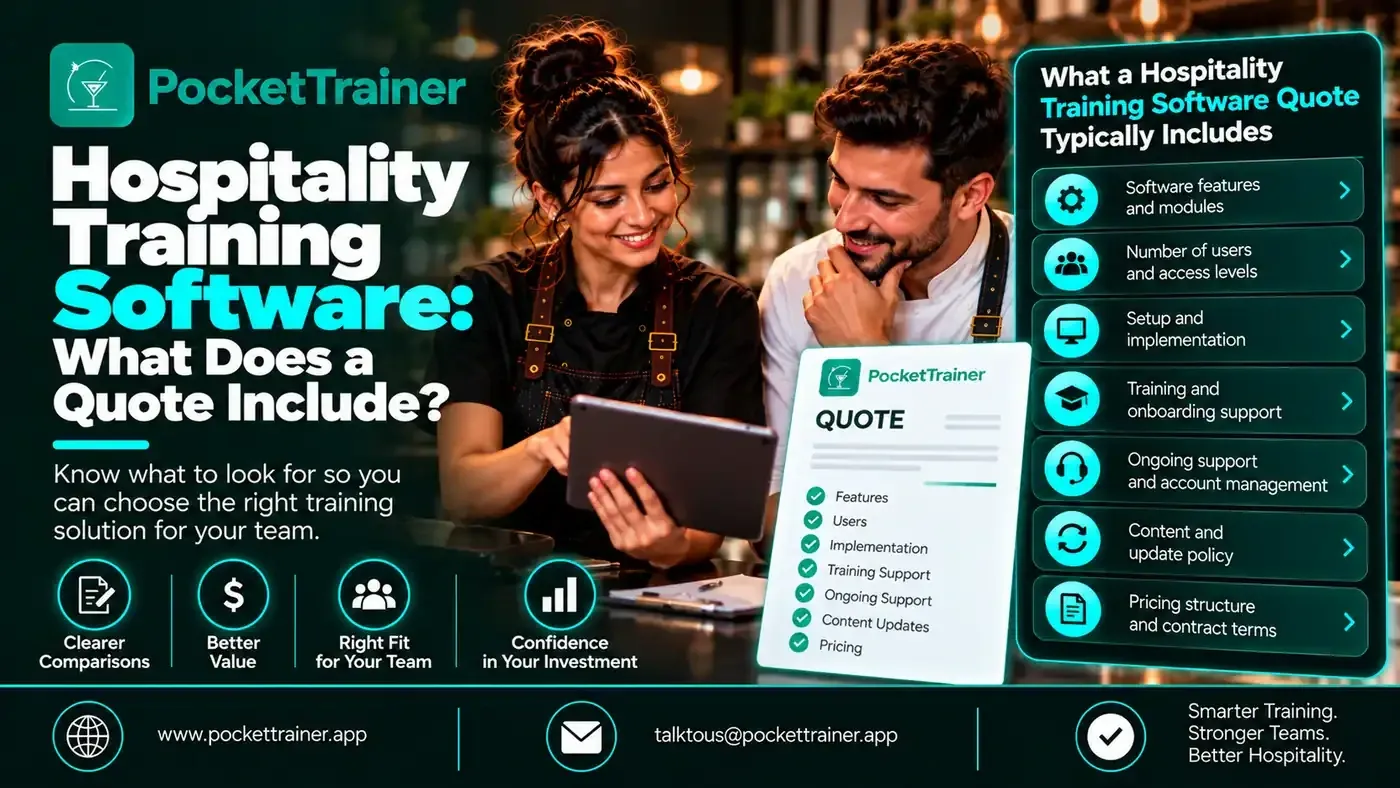
A useful quote describes the service in enough detail for somebody outside the sales meeting to understand it. Ask for a written breakdown of the licence, training content and implementation. If something appears as an optional extra, ask what happens if you do not buy it.
For example, access to a course builder does not mean a supplier will turn your induction pack into finished courses. A library of food safety courses does not mean your own allergen procedure has been uploaded. Technical support does not automatically include help rewriting a confusing SOP.
Ask the supplier to separate these items:
- Platform access and the employee count used for billing.
- Included courses and any separately charged course collections.
- Uploading existing material and creating new content.
- Management onboarding, support and future changes.
Then identify your internal contribution. Somebody still needs to approve the service standards, supply current menus and decide who should receive which learning. A quote that makes those tasks visible is easier to implement than one that leaves them for later.
How Do You Compare Hospitality Training Software Quotes?
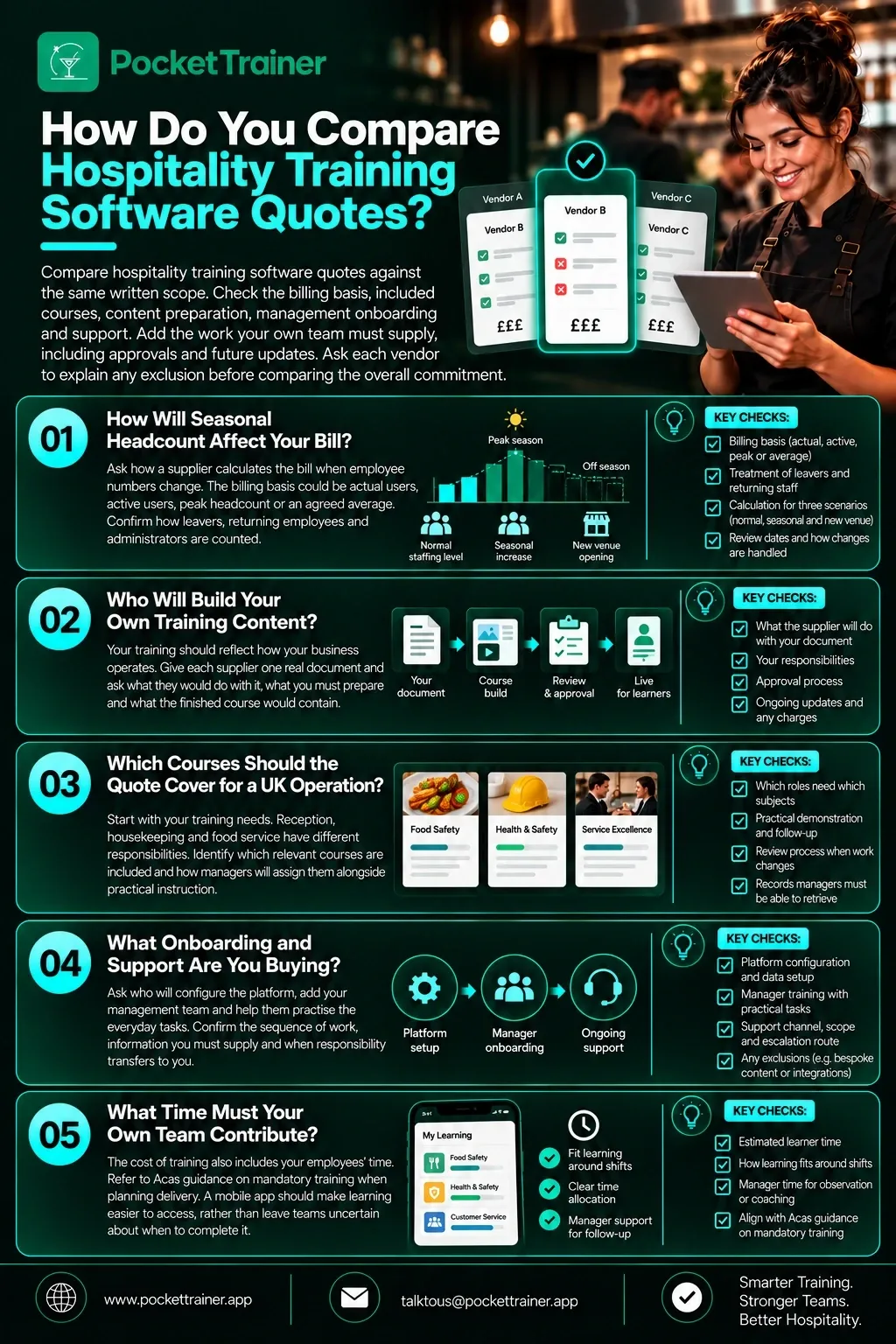
Compare hospitality training software quotes against the same written scope. Check the billing basis, included courses, content preparation, management onboarding and support. Add the work your own team must supply, including approvals and future updates. Ask each vendor to explain any exclusion before comparing the overall commitment.
How Will Seasonal Headcount Affect Your Bill?
A UK coastal hotel and a city restaurant may have different staffing patterns. Even two sites in the same group can recruit at different times. Ask how a supplier calculates the bill when employee numbers change, and get the answer into the agreement.
The important distinction is the billing basis: actual users, active users, peak headcount or an agreed average. Also check how leavers, returning employees and administrators are counted. Do not assume that two proposals using the phrase per employee use the same calculation.
Pocket Trainer uses an average employee count, as described in its client commercial guidance. Discuss how that average would be agreed for your operation. The aim is to understand the basis of the quote, rather than infer savings before the supplier has calculated your circumstances.
Ask finance to test three scenarios against each proposal:
- Your normal staffing level.
- A seasonal increase followed by departures.
- The opening of another venue during the agreement.
Request the calculation, the review dates and the treatment of changes. Avoid making the decision on an example that covers only the quietest month of the year.
Who Will Build Your Own Training Content?
A hospitality employee training platform needs to hold the way your business operates. A generic service course can provide background, but your team also needs the current menu, your complaint process and your opening standards.
Give each supplier one real document. Ask what they would do with it, what you must prepare and what the finished course would contain. Include the review process: who checks an incorrect ingredient, who approves wording and how a changed procedure reaches learners.
Compare the content work through a simple responsibility list:
- Supply the original material: your business.
- Structure and build the course: name the responsible party.
- Approve the operational details: your nominated owner.
- Maintain future changes: agree an owner and any charge.
Pocket Trainer can create courses from a client’s own material and offers custom training content as a service. Ask which work belongs in your particular proposal. Do not read an available service as an unlimited inclusion.
If you want to understand the work involved in digitising your hospitality training materials and what it means for your quote, bring one of your existing SOPs to
Book a 15-minute demoWhich Courses Should the Quote Cover for a UK Operation?
Start with your training needs rather than the size of the library. Reception, housekeeping and food service have different responsibilities. The quote should identify which relevant courses are included and how managers will assign them alongside practical instruction.
The HSE training guide provides a useful reference for planning training. Use it to inform your requirements, rather than treating the supplier’s catalogue as the complete answer. Your own workplace procedures still need an owner.
Pocket Trainer includes a UK compliance course library. Nine specific courses are assured by RoSPA Qualifications; that assurance applies to those courses. Ask to see the relevant course details when assessing your requirements and keep the wording precise.
Review these questions with your department leads:
- Which roles need which subjects?
- What practical demonstration follows the online learning?
- Who reviews the learning when work changes?
- What records must managers be able to retrieve?
An impressive catalogue is useful only if the relevant material is current, accessible and assigned appropriately. A smaller, well-maintained learning plan is easier to manage than a long list nobody owns.
What Onboarding and Support Are You Buying?
Ask who will configure the platform, add your management team and help them practise the everyday tasks. Request the sequence of work, the information you must supply and the point at which responsibility transfers to you.
Management onboarding should involve real work. Ask a manager to change a course, find a completion record and assign learning. If they can follow the process during onboarding, you can identify questions before everyone starts using the system.
For support, establish the channel, scope and escalation route. Do not assume that support includes bespoke content work or new integrations. Pocket Trainer’s integration work depends on the other system and both parties, and is usually a paid service. Agree any required connection separately.
What Time Must Your Own Team Contribute?
The cost of training also includes your employees’ time. Refer HR to Acas guidance on mandatory training when planning delivery. A mobile app should make learning easier to access, rather than leave teams uncertain about when to complete it.
What Should Hospitality LMS Software Onboarding Achieve?
Hospitality LMS software onboarding should leave managers able to run the agreed learning plan. They should know how to maintain content, organise access and retrieve reporting. The business should also know what support covers and who owns each ongoing task. Agree these outcomes before choosing a launch date.
What Should Finance Approve Before You Sign?
Prepare one shared comparison sheet. Put the supplier’s written answers next to your requirements, and include costs that fall to your own team. Label an estimate as an estimate and keep assumptions visible.
Your decision sheet should cover:
- The agreed billing basis and first-year commitment.
- Implementation work, content responsibilities and internal time.
- Included learning, support boundaries and future changes.
- Contract term, notice dates and arrangements for your content.
For food operations, include the practical training responsibilities described in the Food Standards Agency’s training and supervision resource. Software should support the operating process rather than obscure it.
Use the Pocket Trainer hospitality LMS conversation to test that same written scope. A useful sales discussion should help you understand the proposal well enough to explain it to the person approving the budget.
If you want to see how Pocket Trainer fits your employee structure, training content and management responsibilities, bring your requirements toand discuss how they can be reflected in your proposal.
Book a 15-minute demoFrequently Asked Questions
Is Hospitality Training Software Priced Per Site?
Billing models differ. Ask which unit the supplier charges for, how employee changes are treated and which implementation costs sit outside the licence. Pocket Trainer uses an average employee count; your written proposal should explain the agreed calculation.
Does Buying Software Include Creating All Our Courses?
Not automatically. Course creation tools, uploading material and producing finished learning are different services. Ask who does each task and how changes are charged before comparing proposals.
Can a UK Compliance Library Replace Our Own Procedures?
Your venue still needs its own procedures and practical instruction. Use included hospitality courses alongside material that reflects your roles, equipment and service standards.
What Should We Bring to a Supplier Meeting?
Bring employee numbers, seasonal changes, one current SOP and your main operational problem. Include an operations lead and the person who will maintain the learning, so the proposal reflects how the platform will be used.