
Customer Service Training for Restaurant Staff: Handling Difficult Customers(Updated)
By Janos Laszlo
- Customer service training
- restaurant staff
- training for restaurant staff
Quick Summary
- Difficult customer situations are easier to manage when restaurant staff have a clear complaint-handling framework.
- Customer service training for restaurant staff should cover listening, empathy, appropriate apologies, resolution, escalation, and incident recording.
- Scenario-based training gives employees an opportunity to practise realistic complaints before they face them during a busy service.
- De-escalation training should cover calm communication, personal space, warning signs and when to seek help.
- UK restaurants also need to consider health and safety responsibilities where employees may face violence or aggression at work.
- Food safety and allergen complaints require separate role-specific procedures and training.
What is the best way to handle a difficult customer in a restaurant?
The best approach is to give staff a simple framework they can remember and adapt to the situation.
A practical five-step model is:
- Hear the customer out.
- Empathise with their experience.
- Apologise where appropriate.
- Resolve the issue within the employee’s authority.
- Document the incident and any follow-up required.
The aim is not to give employees a rigid script. It is to give them a consistent process they can use when a complaint becomes difficult.
Staff should also understand when they can resolve an issue themselves and when they need to involve a manager.
For example, replacing an incorrect dish may fall within a server’s normal authority, while a serious food safety concern, threatening behaviour, or an issue requiring management investigation may need immediate escalation.
Why structured customer service training matters
Customer complaints are part of restaurant operations. The challenge for managers is making sure employees know how to respond professionally when a complaint becomes emotional or confrontational.
This is particularly important for new starters and employees with limited experience handling difficult situations.
The UK Employer Skills Survey 2024 found that 15% of employers in the Hotels and Restaurants sector reported at least one skills gap. The sector also had the highest skills-gap density of any sector surveyed, at 6.2% of employees. These figures cover the wider Hotels and Restaurants sector, so they should not be presented as restaurant-only statistics.
For restaurant operators, structured customer service training for restaurant staff can help turn complaint handling from something employees improvise into a process they can practise, understand and improve.
What are the most common difficult customer situations?
Not every difficult customer interaction requires the same response. Restaurant staff should first recognise what is happening and then follow the appropriate procedure.
| Situation | What the employee should focus on | When to escalate |
|---|---|---|
| Wrong order or missing item | Listen, acknowledge the problem, and explain the available solution | If the issue cannot be resolved within their authority |
| Long wait | Acknowledge the delay, check the status, and give the customer an accurate update | If the delay requires manager intervention or compensation outside the employee’s authority |
| Food quality complaint | Listen, record the concern, and follow the restaurant’s service procedure | If there is a potential food safety issue |
| Allergen concern | Stop and verify the correct allergen information through the approved procedure | Immediately, if there is a suspected allergen risk or reaction |
| Angry or aggressive customer | Stay calm, maintain appropriate distance and avoid arguing | If behaviour becomes threatening or unsafe |
| Intoxicated or disruptive customer | Follow the restaurant’s safety and escalation procedure | When staff safety or other customers’ safety may be affected |
The frustrated customer
This customer may have a genuine issue, such as a wrong order, a missing item, a long wait, or an incorrect bill.
The priority is to listen, acknowledge the issue, and explain what can be done.
The angry or aggressive customer
A customer may become verbally aggressive, raise their voice, or behave in a threatening way.
This is different from a normal complaint.
Staff should not be expected to argue with an aggressive customer or manage a potentially unsafe situation alone. They should know the restaurant’s escalation procedure and when to involve a manager.
HSE guidance recommends assessing risks from violence and aggression at work and putting appropriate controls in place where such risks exist.
The customer who does not complain directly
Some customers may not raise an issue during their visit.
Staff should therefore be trained to provide appropriate service and check whether customers need help, without assuming that every quiet or reserved customer is dissatisfied.
The repeatedly dissatisfied customer
Some customers may raise several complaints during the same visit.
Employees do not need to label the customer’s personality. Instead, they should stay professional, focus on the specific issue, and follow the restaurant’s complaint and escalation procedure.
The intoxicated or disruptive customer
An intoxicated customer may create a situation that goes beyond ordinary complaint handling.
Training should explain how staff should respond, who to contact, and when to step away from the interaction.
The HEARD framework for handling restaurant complaints
A framework gives restaurant employees something practical to remember during a difficult interaction.
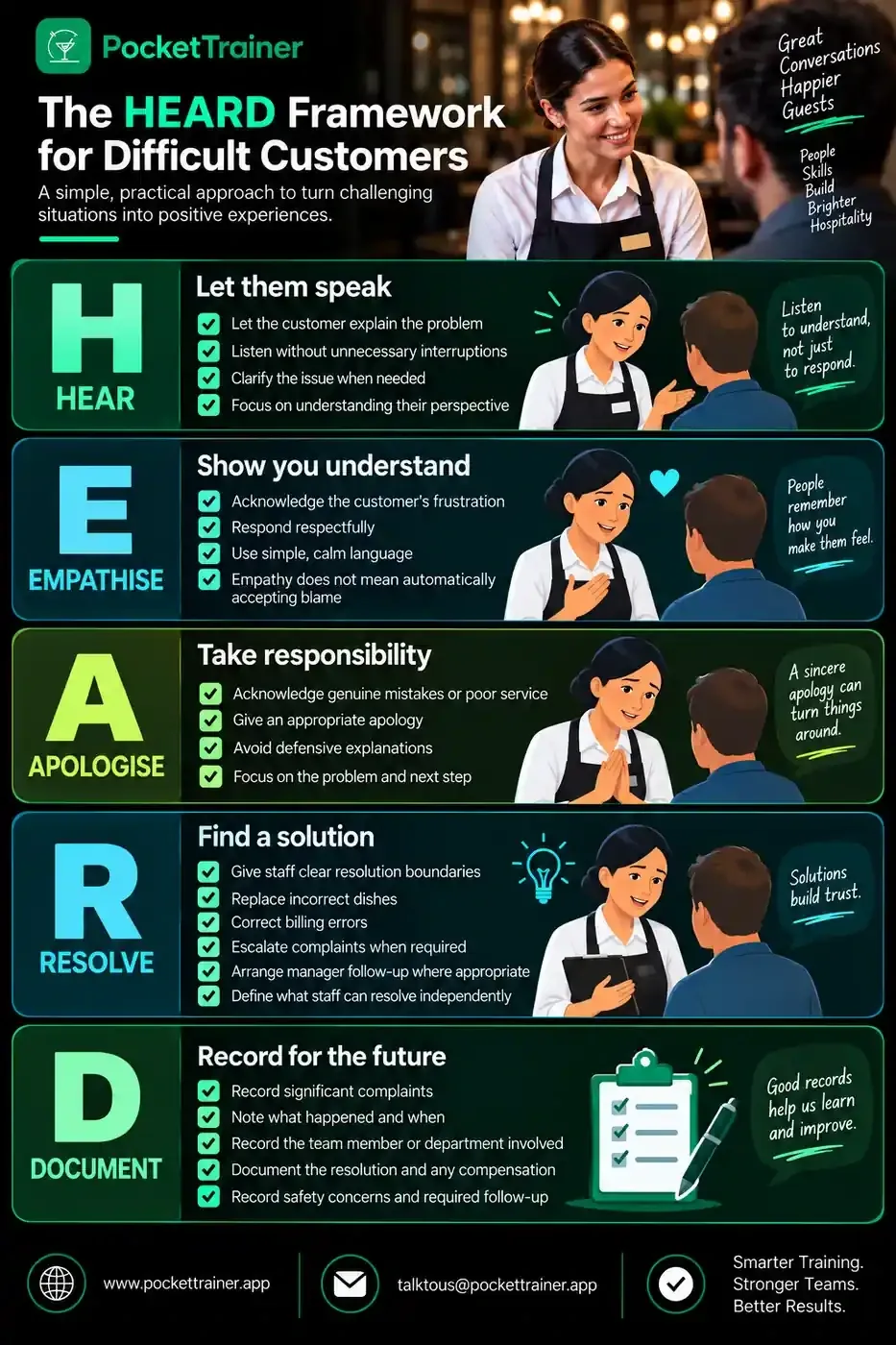
H: Hear the customer out
Let the customer explain the problem before jumping immediately to a solution.
Staff should listen carefully, avoid unnecessary interruptions, and clarify the issue if needed.
The objective is not to agree with every statement. It is to understand what happened from the customer’s perspective.
E: Empathise
Show that the customer’s concern has been heard.
Simple language can work well:
- “I can see why that was frustrating.”
- “I understand why you are unhappy with the wait.”
- “Let me see what I can do to put this right.”
Empathy does not mean accepting blame for something that has not been established. It means responding respectfully to the customer’s experience.
A: Apologise
Where the restaurant has made a mistake or the customer has experienced poor service, an appropriate apology can acknowledge the problem.
Avoid defensive explanations that blame the kitchen, other staff, or how busy the restaurant is.
The immediate priority should be understanding the problem and explaining the next step.
R: Resolve
Give employees clear boundaries around what they can do.
Depending on the restaurant’s policy, this might include:
- replacing an incorrect dish
- correcting a bill
- arranging a manager callback
- moving a table where appropriate
- escalating a complaint
- recording the issue for follow-up
Employees should not be given unlimited authority. Managers should define which resolutions staff can offer independently and which require approval.
D: Document
Record significant complaints according to the restaurant’s procedures.
Useful information can include:
- what happened
- when it happened
- which department or team member was involved
- how the issue was resolved
- whether compensation was provided
- whether further action is required
- whether the incident involved a safety concern
Incident records can help managers identify recurring operational problems and review whether existing procedures and training are working.
How to build customer service training for restaurant staff
A complaint-handling framework is only useful if employees know how to apply it.
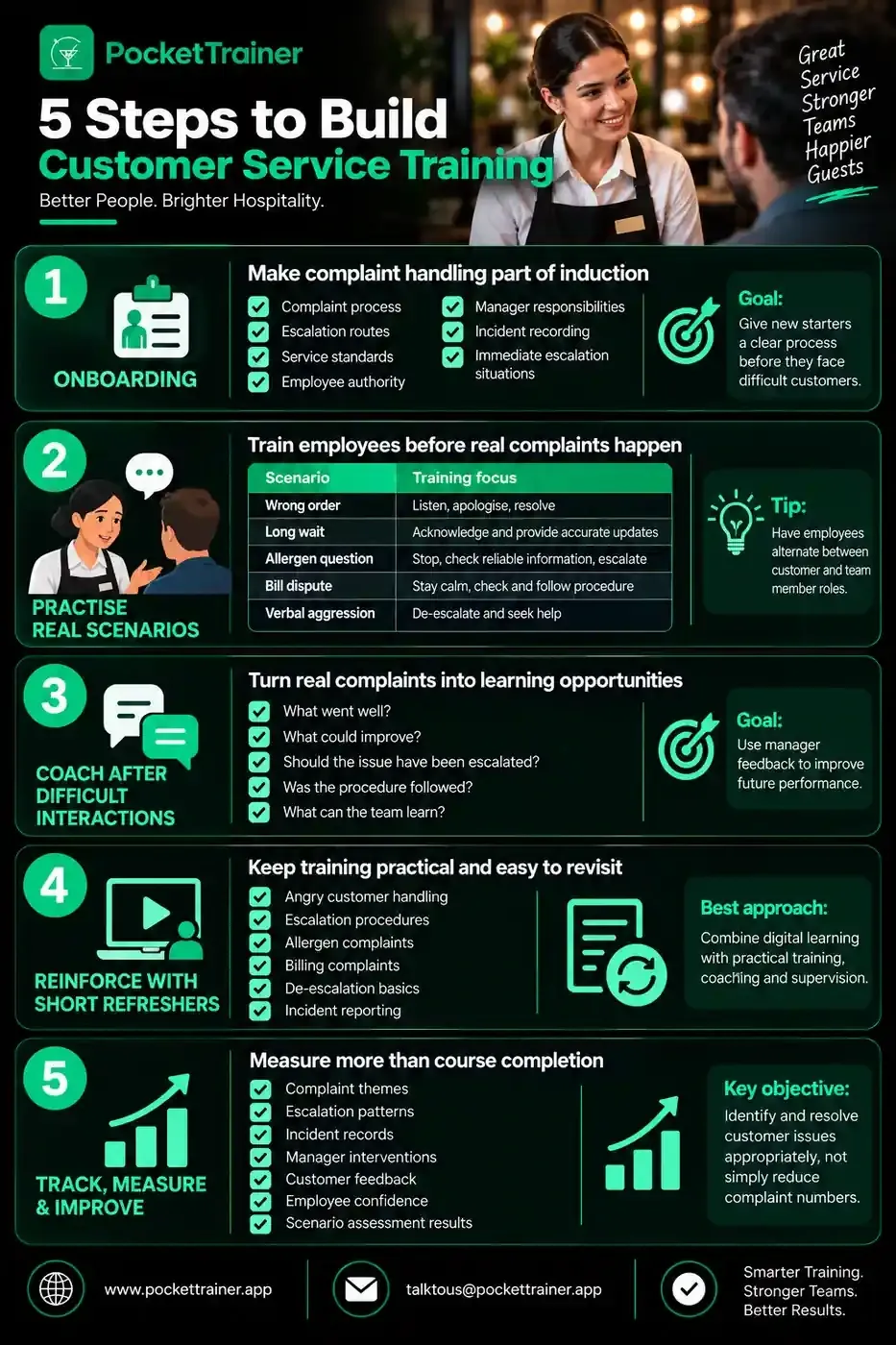
Step 1: Include complaint handling in onboarding
New employees should learn how the restaurant expects complaints to be handled as part of their induction.
Training can cover:
- the complaint process
- escalation routes
- service standards
- employee authority
- manager responsibilities
- incident recording
- situations requiring immediate escalation
This gives new starters a clear reference point before they encounter a difficult customer.
A wider restaurant staff training guide can also help managers structure onboarding and refresher training around different roles and responsibilities.
Step 2: Use realistic customer complaint scenarios
Scenario-based training allows employees to practise communication and decision-making before they face a difficult situation during service.
Build scenarios around problems your restaurant actually experiences.
| Customer complaint scenario | Training objective |
|---|---|
| Wrong order | Practise listening, apology and practical resolution |
| Long wait for food | Practise acknowledging the problem and giving an accurate update |
| Customer questions an allergen | Practise stopping, checking reliable information and escalating when necessary |
| Customer disputes the bill | Practise staying calm, checking the bill and following the escalation process |
| Customer becomes verbally aggressive | Practise de-escalation and knowing when to seek help |
Have employees take turns playing the customer and team member. After each scenario, discuss what worked, what could be improved, and whether the correct escalation point was identified.
Step 3: Train managers to coach employees
Managers should not only intervene when a complaint becomes serious.
After a difficult interaction, a short coaching conversation can help the employee understand:
- what they handled well
- what could have been handled differently
- when they should have escalated
- whether the procedure was followed
- what the team can learn from the incident
This turns real service situations into learning opportunities.
Step 4: Reinforce learning with short refreshers
Restaurant teams are busy, so training should be practical and easy to revisit.
Short refreshers can cover:
- handling an angry customer
- when to escalate
- allergen complaint procedures
- managing a billing complaint
- de-escalation basics
- incident reporting
Short digital learning can complement practical training, coaching and supervision.
For restaurants that need a wider range of ready-made learning topics, PocketTrainer’s hospitality training courses include service, compliance, management and other hospitality-specific subjects.
Step 5: Track, measure and improve
Course completion alone does not prove that employees can handle difficult customers effectively.
Managers can review:
- complaint themes
- escalation patterns
- incident records
- manager interventions
- customer feedback
- employee confidence
- scenario assessment results
The objective is not simply to reduce the number of complaints. A restaurant should also assess whether issues are being identified and resolved appropriately.
De-escalation techniques every front-of-house team member should know
De-escalation should be a practical part of restaurant customer service training where employees may encounter aggressive or threatening behaviour.
HSE guidance identifies training in warning signs, communication, working procedures, control measures and incident reporting as relevant where workers face violence and aggression. It also recommends basic de-escalation techniques such as using a clear, calm voice and relaxed posture.
Stay calm and speak clearly
Employees should avoid matching a customer’s volume or becoming argumentative.
A calm, clear response can help prevent the conversation from escalating further.
Give the customer appropriate space
Staff should maintain a safe distance and avoid unnecessarily blocking or crowding a customer.
Personal safety should take priority over resolving the complaint immediately.
Listen without arguing
The objective is to understand the problem and decide what action is appropriate.
Employees do not need to prove that the customer is wrong.
Offer realistic options
Where appropriate, give the customer a clear next step.
For example:
“I can replace the dish, or I can ask my manager to speak with you.”
The options should stay within the employee’s authority.
Know when to escalate
Employees should know when a complaint has moved beyond normal customer service.
Escalation may be appropriate where there is:
- threatening behaviour
- physical aggression
- repeated abusive behaviour
- a serious food safety concern
- an allegation requiring management investigation
- a situation the employee does not feel safe handling
If a worker feels unsafe, employee safety takes priority over continuing the conversation.
Handling customer complaints in UK restaurants: compliance considerations
Customer complaint handling is not, by itself, a specific legal training requirement for every restaurant.
However, restaurants have wider health and safety and food safety duties that can become relevant during difficult customer situations.
Violence and aggression at work
Where violence or aggression is a foreseeable work-related risk, employers need to assess the risk and put appropriate controls in place.
HSE guidance identifies training as one possible control, alongside appropriate working practices, reporting procedures and other measures based on the risk assessment.
This means restaurant managers should consider the circumstances in which employees may encounter aggressive customers and make sure staff know the relevant procedures.
RIDDOR
Not every argument, complaint or verbal abuse incident is reportable under RIDDOR.
Certain work-related incidents involving violence can be reportable where they result in a specified injury, death or another reportable outcome.
Restaurants should therefore assess individual incidents against the applicable RIDDOR requirements rather than assuming every difficult customer interaction must be reported.
Food safety and allergens
Food-related complaints need particular care.
GOV.UK states that staff who handle food must have appropriate training in food hygiene and safety, including allergens, before they start work. Businesses must also provide accurate allergen information and appropriately train staff to manage allergens.
If a customer raises an allergen concern, employees should follow the restaurant’s approved allergen procedure and check reliable information before answering.
Staff should never guess whether a dish is safe for someone with an allergy.
Common mistakes in restaurant customer service training
Training once and stopping
A single induction session may not be enough to maintain consistent complaint-handling skills as teams change.
Use refreshers, coaching, and scenario practice where appropriate.
Giving employees scripts instead of principles
Scripts can help with basic language, but difficult conversations rarely follow a predictable sequence.
A framework gives employees structure without requiring them to sound robotic.
Failing to define employee authority
Staff should know which problems they can resolve themselves and which require manager approval.
Without clear boundaries, employees may either overstep their authority or escalate every minor issue.
Treating aggression as a normal part of the job
Where violence or aggression presents a foreseeable work-related risk, it should be assessed and controlled.
Employees should know that threatening behaviour is a safety concern, not simply something they are expected to tolerate.
Ignoring what happens after the complaint
A complaint can reveal a wider operational problem.
If customers repeatedly complain about waiting times, incorrect orders or communication, managers should investigate the underlying process rather than treating each complaint as an isolated event.
How Pocket Trainer helps you build and deliver this training
Building a customer service training programme from scratch takes time. Maintaining it, updating it and making sure every team member completes it takes even more.
Pocket Trainer provides hospitality training tools that can support short learning modules, knowledge checks and training records.
For example, the Handling Customer Complaints course covers common restaurant complaints, resolving service and food issues, difficult situations, escalation, professional body language and tone.
For a broader programme, PocketTrainer’s Training Management service covers training needs analysis, programme design, content creation, implementation, monitoring and reporting.
For restaurant operators, training can be structured around topics such as:
- complaint handling
- customer service
- de-escalation
- service standards
- allergen awareness
- incident procedures
The platform should support the restaurant’s existing procedures rather than replace operational policies, manager supervision, or role-specific compliance training.
Bring your own compliance requirement and ask to see the completion record produced live, filtered by site and role.
Book a 15-minute demoFinal thoughts
Difficult customers are an unavoidable part of restaurant operations, but employees should not be expected to improvise every time a complaint becomes challenging.
A clear framework, realistic customer complaint scenarios, practical de-escalation training and well-defined escalation procedures can give restaurant teams greater confidence when handling difficult situations.
For UK restaurants, customer service training should sit alongside the relevant health and safety, food safety and allergen requirements. The objective is not simply to resolve complaints faster. It is to help employees respond professionally while knowing when a situation requires specialist support or escalation.
Bring your own compliance requirement and ask to see the completion record produced live, filtered by site and role.
Book a 15-minute demoFAQs
What is the best training for restaurant staff dealing with difficult customers?
The most useful training combines a clear complaint-handling framework with realistic scenarios, de-escalation techniques, escalation procedures, and manager coaching.
How should restaurant staff handle an angry customer?
Staff should remain calm, listen without arguing, acknowledge the concern, offer an appropriate solution within their authority and escalate the situation when required. If the situation becomes threatening or unsafe, employee safety takes priority.
What are useful customer complaint scenarios for restaurants?
Useful scenarios include wrong orders, long waits, billing problems, food quality concerns, allergen concerns, and customers who become verbally aggressive. Scenarios should reflect the restaurant’s actual operations.
Is de-escalation training required for UK restaurant staff?
There is no general rule requiring every restaurant employee to complete a course specifically called “de-escalation training”. However, where work-related violence or aggression presents a foreseeable risk, employers need to assess the risk and put appropriate controls in place. Training can form part of those controls.
Does customer service training replace food safety training?
No. Customer service training does not replace food hygiene, food safety or allergen training. Staff who handle food need appropriate training for their role, including training relevant to allergens.