
Kitchen safety: the four hazards HSE actually names
By Janos Laszlo
- kitchen safety
- HSE
- food safety
- manual handling
Key Takeaways
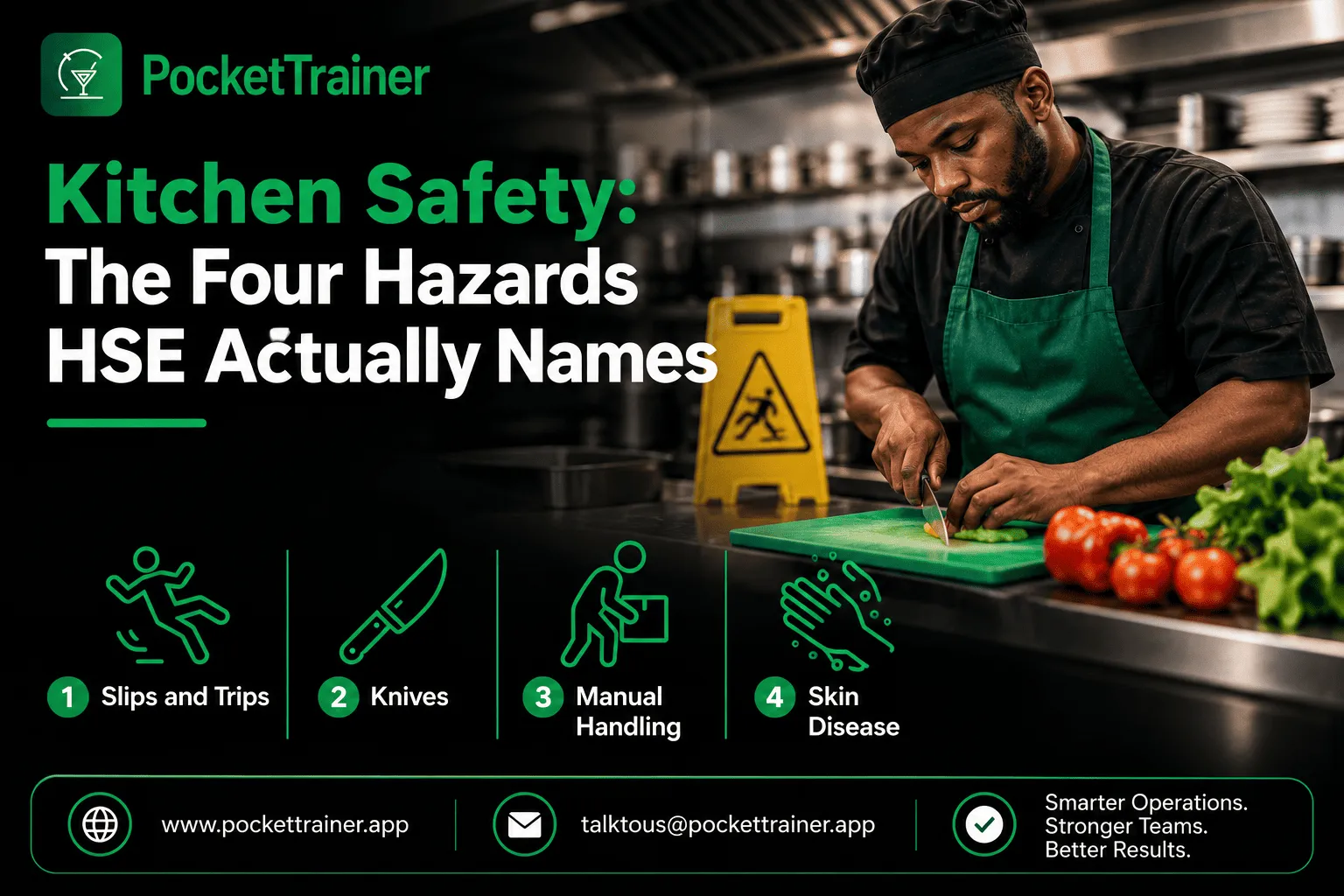
- HSE names four hazards for catering and hospitality: slips and trips, knives, manual handling, and skin disease.
- Most kitchens train only knives and assume the other three look after themselves, the wrong way round.
- Slips and trips are the single most common cause of major injury across UK workplaces, and kitchen assistants and chefs are among the occupations most affected.
- Manual handling and skin disease produce no dramatic incident; they just produce people quietly leaving the trade.
- Training the decision, not just the rule, is what holds up when a kitchen is under pressure.
What Are the Main Kitchen Safety Hazards?
The Health and Safety Executive names four for catering and hospitality: slips and trips, knives, manual handling, and skin disease. Burns and scalds matter too, but those four are the categories HSE organises its guidance around. Slips are the most serious of them by frequency of major injury, which surprises most operators, because knives feel like the obvious danger in a kitchen and are not the one causing the worst outcomes.
Why are slips and trips the most dangerous kitchen hazard?
HSE puts it plainly: “Slips and trips remain the single most common cause of major injury in UK workplaces,” and it names kitchen assistants, chefs and waiting staff as the occupations most affected.
The causes are unglamorous and entirely familiar. HSE states that “spills from food or cooking are among the main causes of slips in kitchens” and that “most slips happen on wet or dirty floors.” Add overflowing sinks, a leak on a smooth floor, damaged flooring, and boxes, bags and cables left where people walk.
What makes this a training problem rather than a cleaning problem is timing. Every kitchen knows a spill should be cleaned. The question is whether it gets cleaned at 20:40 on a Saturday when the person who spilled it is three tickets behind. That decision is cultural, and culture is the standard you enforce when it is inconvenient. A team that has been told, specifically, that the spill gets dealt with before the next plate goes up will behave differently from a team that has been handed a policy.
The other half is the floor itself. HSE’s guidance is direct: damaged flooring should be flagged and fixed straight away, not left until it causes an injury. Damaged flooring is a capital problem masquerading as a safety one, and it is the item most often deferred.
Knives, and the Two Moments That Cause Most Cuts
Knife training tends to focus on technique, which is the part chefs already have. The cuts happen elsewhere.
The first moment is washing up. A knife in a sink of water is invisible, and someone reaching in finds the blade. Every kitchen knows this and most still do it, because the alternative requires a discipline that has to be taught and then held: knives never go in the sink; they get washed individually and put away.
The second is the handover. Passing a knife, carrying one through a busy pass, or leaving one on a board at the edge of a bench where a passing arm meets it. None of that is technique. All of it is habit, and habits are what induction is for.
The practical test for whether knife safety is trained in your kitchen is not whether people can dice an onion. It is whether a new commis knows, without asking, what to do with a dirty knife when both hands are full. Pocket Trainer’s Kitchen Knives And Their Use course covers exactly this, handling and storage, not just technique.
What kitchen safety hazards do restaurants forget to train?
These are the quiet ones. Neither produces a dramatic incident, and both produce people leaving the trade.
Manual handling in a kitchen means deliveries, stockpots, sacks and the walk-in. The injuries accumulate rather than happen, which is exactly why they are undertrained: nobody connects a back that hurts in year three to the way they were lifting in year one. Pocket Trainer’s Manual Handling course addresses this directly.
Skin disease is the one most operators have never considered as a training topic at all. Hands in water, hands in detergent, hands in and out of gloves, all shift, every shift. Occupational dermatitis is common in catering, and it ends careers quietly. The controls are ordinary, which is the point: drying hands properly, using the right gloves for the right task, and treating early signs as a problem rather than an inconvenience.
Want to see how safety completion records look across a group?
Book a 15-minute demoThe Other Family of Hazard: Contamination
A note on scope, because kitchen safety reasonably means two different things and this piece has so far covered one.
Everything above is workplace safety: the hazards that injure the people working in the kitchen, which is the family HSE organises its catering guidance around. The second family is food contamination, the hazards that reach the guest. Those are conventionally grouped as microbiological (bacteria such as Salmonella or E. coli from raw meat or poor hygiene), chemical (cleaning products and pest control substances), physical (glass, packaging, hair) and allergenic (cross-contact with nuts, dairy, gluten and the rest of the fourteen).
The two families need different training and different controls, and conflating them is a common reason kitchen safety training feels thorough and still leaves gaps. A team can be excellent on knife handling and cross-contaminate a board on the same shift. The allergenic category is where the two families meet: the FSA’s best practice guidance for the out-of-home sector, updated in March 2025, recommends allergen information be easily available in writing and underpinned with a conversation, which is a documentation duty as much as a handling one.
Contamination is covered in its own right elsewhere: our guides to restaurant training courses and compliance regulations, HACCP training for managers, and allergen training after Natasha’s Law go into each in full. This piece stays with the workplace-safety family, because that is the half most kitchens train least.
How Do You Train Kitchen Safety So It Holds on a Busy Service?
Train the decision, not the rule. A rule says clean spills promptly; a decision says the spill gets dealt with before the next plate goes up, and names who does it when the person responsible is mid-service. Cover all four HSE hazards rather than only knives, because slips cause more major injury and are the least trained. Deliver it before a new starter works unsupervised, keep a completion record against each name and date, and refresh whenever the kitchen layout, the equipment or the cleaning chemicals change.
Weekly Kitchen Safety Manager Check
Three things, none of which needs a project.
- Walk the floor at your busiest hour rather than in the morning. Kitchen safety looks fine at ten. Look at where people actually walk when the pass is stacked, where boxes end up during a delivery, and whether the route from the sink to the store is clear.
- Ask one commis what they do with a dirty knife when both hands are full. The answer tells you whether knife safety is trained or assumed.
- Check whether you could produce, today, a list of who has completed safety training and when. Not whether they were trained, but whether you can show it. The wider back-of-house training picture is covered separately, and safety is the part of it where being unable to evidence the training is most expensive.
For manager-level kitchen safety training, see Pocket Trainer’s Health & Safety For Managers UK (RoSPA Assured) course, covering risk assessment, equipment, fire safety, COSHH, manual handling and ongoing staff safety.
The Takeaway
Kitchen safety is not a poster problem. The four hazards HSE names are ordinary, well understood, and mostly untrained beyond knives. Slips cause the most major injury and get the least attention. Manual handling and skin disease end careers without ever producing an incident report.
Cover all four, train the decision rather than the rule, and keep the record. Colour-coded boards and similar visual systems do a disproportionate amount of work here, because they survive language barriers and busy services in a way written procedures do not.
If your safety records live in a folder and the manager who kept them has left, that is worth twenty minutes.
Book a 15-minute demoFAQs
1 What are the main hazards in a commercial kitchen?
HSE names four for catering and hospitality: slips and trips, knives, manual handling and skin disease. Burns and scalds are also significant. Slips and trips are the most common cause of major injury in UK workplaces according to HSE, with kitchen assistants and chefs among the occupations most affected.
2 Why are slips more dangerous than knives in a kitchen?
Not more dangerous exactly, more consequential in aggregate. Knife injuries are frequent and usually minor. Slips produce a smaller number of far more serious injuries, and HSE identifies them as the single most common cause of major injury across UK workplaces. Most happen on wet or dirty floors, which makes them preventable.
3 Is kitchen safety training a legal requirement?
Employers have duties around assessing risk and taking reasonable precautions, and HSE guidance sets out what that means in a catering context. The specific obligations that apply to your business depend on your setup and are worth confirming with a competent adviser. What is consistent is that training you cannot evidence is difficult to rely on if something goes wrong.
4 How often should kitchen safety training be refreshed?
Tie it to change rather than a date. New starters before they work unsupervised, everyone when the layout, equipment, or cleaning chemicals change, and the whole team after any incident that showed a gap. A calendar refresh with nothing in between leaves the newest people, who are the most exposed, untrained for the longest.
5 What is the most overlooked kitchen safety topic?
Skin disease. Hands are in water, detergent, and gloves all shift; occupational dermatitis is common in catering, and almost nobody trains it. The controls are simple: drying hands properly, the right gloves for the task, and treating early signs seriously rather than working through them.