
Kitchen Staff Training: The Complete UK Restaurant Guide
By Janos Laszlo
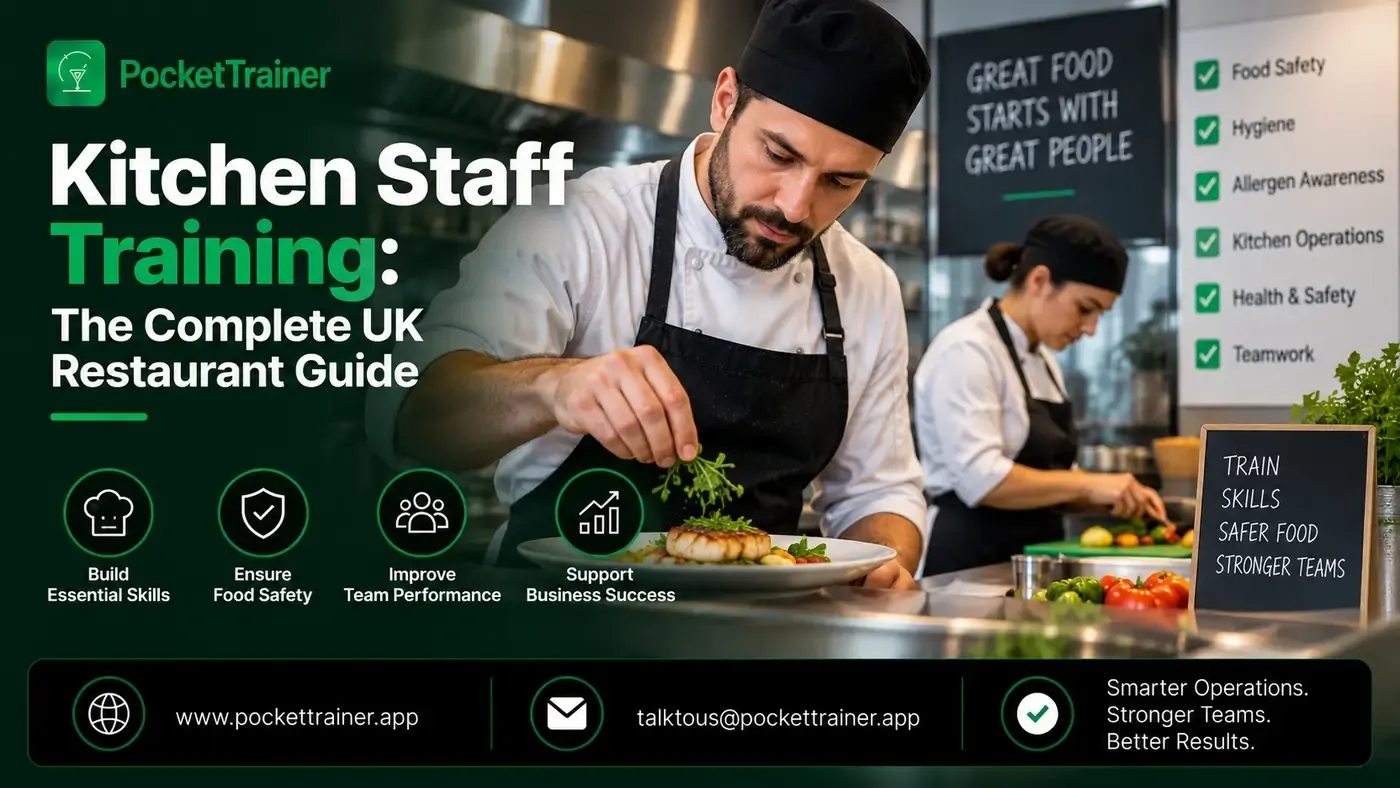
Most restaurant owners understand the importance of a well-trained front-of-house team. Servers learn the menu, hosts learn how to welcome guests, and managers are trained to handle complaints and keep service moving.
But what happens in the kitchen?
Too often, new kitchen staff receive a quick tour, a recipe folder and a few shadowing shifts before being expected to cope with a busy service. That approach can leave employees unsure of their responsibilities, stations operating inconsistently and managers constantly correcting the same mistakes.
A structured kitchen staff training programme changes that.
Effective training combines food safety, allergen awareness, station skills, recipe execution, communication, cleaning, equipment safety, cross-training and ongoing development. It also gives restaurants a practical way to build a more flexible kitchen team.
For UK restaurants, training needs to support the business’s legal responsibilities around food safety, allergens and workplace health and safety.
What does kitchen staff training cover?
Kitchen staff training should cover everything an employee needs to perform their role safely, consistently and confidently.
Depending on the role, this can include:
- Food safety and hygiene
- Allergen management
- HACCP procedures and food safety controls
- Personal hygiene
- Cleaning and disinfection
- Safe use of kitchen equipment
- COSHH awareness where relevant
- Manual handling
- Fire and emergency procedures
- Recipe and menu training
- Mise en place and station setup
- Portion control and plating
- Stock rotation and storage
- Kitchen communication
- Ticket and pass procedures
- Waste reduction
- Cross-training across stations
- Performance feedback
- Career development
The exact training should reflect the employee’s responsibilities. A kitchen porter, commis chef, chef de partie and head chef will not require identical training.
The key principle is that training should be appropriate to the work being carried out**.** FSA guidance states that food handlers should be supervised and instructed and/or trained in food hygiene matters that are commensurate with their work activity.
That means a restaurant should focus on whether employees are genuinely competent to perform their duties safely, rather than treating a certificate as the entire training system.
For restaurants building a broader learning programme, hospitality courses for restaurant teams can provide a useful starting point for organising role-specific learning.
Why kitchen staff training matters
Kitchen training is sometimes treated as something that happens naturally during a shift.
It does not.
A new employee watching someone prepare a dish once is not the same as being taught the restaurant’s required method, practising it under supervision and receiving feedback.
Without a structured approach, restaurants can end up with:
- Different preparation methods between shifts
- Inconsistent portion sizes
- Recipe variations
- Poor station organisation
- Avoidable food waste
- Communication problems during service
- Gaps in allergen knowledge
- Unsafe equipment practices
- Employees who do not understand what good performance looks like
The problem becomes even greater when experienced employees leave. Knowledge that existed informally in one person’s head can disappear with them.
A documented training system helps turn that knowledge into a repeatable process.
What are the legal training requirements for kitchen staff in the UK?
There is an important distinction between legal training requirements and formal training certificates.
Food handlers must receive appropriate supervision, instruction and/or training in food hygiene matters relevant to their work. However, UK food law does not universally require every food handler to hold a formal Level 2 food hygiene certificate.
The Food Standards Agency has explained that there is no general legal requirement for food business employees to attend a formal food hygiene course or obtain a specific qualification. Businesses can meet their training obligations through appropriate supervision, instruction and on-the-job training, formal courses, qualifications, or a combination of approaches.
This is an important distinction for restaurant managers.
A Level 2 course can be a useful way of providing structured food safety training and demonstrating knowledge, but the certificate itself should not be presented as the legal requirement for every food handler.
A sensible kitchen training programme should combine formal learning where appropriate with practical instruction, supervision, competency checks and training records.
Food safety and hygiene
Kitchen employees need training appropriate to the food activities they perform.
This can include:
- Personal hygiene
- Preventing cross-contamination
- Safe food storage
- Temperature control
- Safe preparation and cooking
- Cleaning and disinfection
- Food safety procedures
- Food safety management systems
- HACCP principles where relevant
The FSA’s guidance states that food handlers should be trained or instructed in matters appropriate to their work, while people responsible for developing and maintaining HACCP procedures should receive adequate training in HACCP principles.
For a restaurant looking for a structured learning pathway, Food Safety for Restaurants Level 2 UK can complement practical, on-the-job instruction.
Allergen training
Allergen management deserves its own section in every kitchen training programme.
Food businesses have legal responsibilities around allergen information, and staff need to understand how those requirements apply to the food they prepare and serve. FSA guidance also recommends training staff on allergens and food hypersensitivity.
Kitchen employees should understand:
- The 14 regulated allergens
- How allergens can enter dishes
- How to prevent allergen cross-contact
- How recipe and ingredient changes affect allergen information
- How to respond when a customer reports an allergy
- When to escalate an allergen query
- Why staff should never guess about ingredients
The last point is particularly important. Allergen information needs to be accurate and supported by appropriate business procedures.
A dedicated food allergen awareness course for UK restaurants can sit alongside the restaurant’s own recipes, ingredient records and allergen procedures.
Natasha’s Law and PPDS food
If your restaurant prepares food that falls within the prepacked for direct sale (PPDS) category, relevant employees also need to understand the applicable labelling requirements.
Since 1 October 2021, PPDS food has required a label showing the name of the food, a full ingredients list and emphasised allergens within that list.
This matters because kitchen employees may be involved in preparing, packing or labelling PPDS food.
Training should therefore explain how your business identifies PPDS products and how ingredient or recipe changes are communicated.
Health and safety training
Restaurant kitchens contain a range of workplace hazards, including hot surfaces, sharp equipment, wet floors, manual handling risks, chemicals and machinery.
The Health and Safety at Work etc. Act 1974 requires employers to provide the information, instruction and training necessary to protect employees’ health and safety so far as reasonably practicable. HSE guidance also identifies training as particularly important when people start work and when they face new or increased risks.
Depending on the workplace, training may include:
- Safe equipment operation
- Manual handling
- Fire safety
- COSHH
- Slips, trips and falls
- Burns and scalds
- Knife safety
- Emergency procedures
- Personal protective equipment
- Accident and incident reporting
Where employees use work equipment, additional requirements can apply. For example, PUWER places duties on employers to ensure users receive adequate information, instruction and training where appropriate.
Kitchen staff training checklist for UK restaurants
A useful training programme should take employees through a sequence rather than attempting to teach everything during one induction.
Phase 1: Before the first shift
Before the employee arrives, prepare:
- Job description and role expectations
- Shift information
- Uniform requirements
- Employee handbook and relevant policies
- Basic workplace information
- Training schedule
- Required compliance training
- Details of who will supervise the new starter
This gives the employee a clear idea of what to expect before their first service.
Phase 2: Day-one kitchen induction
The first day should focus on safety, orientation and the basics.
Cover:
- Kitchen layout
- Staff areas
- Equipment locations
- Emergency exits
- First-aid arrangements
- Accident reporting
- Personal hygiene
- Food safety basics
- Allergen procedures
- Cleaning arrangements
- Waste procedures
- Team structure
- Service communication
- Core expectations
Do not attempt to teach every recipe and station on day one.
The objective is to make the employee safe, welcomed and clear about what happens next.
Phase 3: First two weeks, station and skills training
This is where practical kitchen training becomes central.
New employees can begin learning:
- Mise en place
- Station setup
- Recipe execution
- Portion control
- Plating standards
- Prep lists
- Stock rotation
- Food storage
- Cleaning schedules
- Ticket management
- Kitchen terminology
- Service communication
Pairing a new starter with an experienced employee can make this stage more effective, provided the trainer is following the restaurant’s approved procedures.
Phase 4: Weeks three to six, building independence
Once employees understand the basics, gradually reduce supervision.
Training should now focus on:
- Speed
- Consistency
- Quality control
- Station organisation
- Service awareness
- Problem-solving
- Communication
- Decision-making
- Covering additional tasks
This is also an ideal point to introduce cross-training.
Cross-training kitchen staff: a practical rotation plan
Cross-training means teaching employees to perform duties across more than one station or area of the kitchen.
It should not mean moving people randomly between stations.
A structured rotation might look like this:
| Week | Primary focus | Secondary training |
|---|---|---|
| Week 1 | Main station | Kitchen orientation |
| Week 2 | Main station | Prep support |
| Week 3 | Main station | Adjacent station |
| Week 4 | Main station | Adjacent station practice |
| Week 5 | Secondary station | Main station maintenance |
| Week 6 | Secondary station | Service cover |
| Ongoing | Role development | Rotation based on competency |
The exact rotation should depend on the size and structure of the kitchen.
The important point is to define what competent means before moving someone to another station.
For example, an employee might need to demonstrate that they can:
- Set up the station correctly.
- Complete the required mise en place.
- Follow recipes accurately.
- Maintain safe food-handling practices.
- Communicate effectively during service.
- Maintain cleaning standards.
- Complete the station within the restaurant’s expected service standards.
This creates a much more useful restaurant cross-training kitchen** staff rotation plan** than simply asking employees to learn another station.
It also creates resilience. If someone is unexpectedly absent, the restaurant has more employees who can provide meaningful cover.
Mid-programme training CTA
Once a restaurant has a structured training programme, the next challenge is proving that the right people have actually completed the right training.
Bring your own compliance requirement and ask to see the completion record produced live, filtered by site and role.
Book a 15-minute demoOngoing kitchen staff training
Training should not end when onboarding finishes.
Kitchen teams need ongoing learning whenever something changes.
That can include:
- Menu changes
- New ingredients
- Supplier changes
- New equipment
- Updated recipes
- Allergen changes
- New food safety procedures
- Changes to cleaning processes
- Seasonal menus
- New technology
- Promotion to a new role
FSA HACCP guidance recommends ongoing training and says refresher and update training should be programmed. It also highlights the importance of reviewing food safety systems when significant changes occur, including new ingredients, suppliers, equipment, processes, products or significant staff changes.
That makes ongoing training more than a calendar exercise. It should be connected to operational change.
The kitchen training areas restaurants often overlook
1. Communication
Kitchen employees need more than technical skills.
They need to know how to communicate during service.
Training can cover:
- Calling orders
- Repeating information back
- Communicating unavailable dishes
- Escalating problems
- Communicating allergen requests
- Giving and receiving feedback
- Handling disagreements professionally
Clear communication reduces the chance that small issues become service problems.
2. Guest experience
Kitchen employees may not interact directly with customers, but their work is central to the guest experience.
Training should connect kitchen standards to what the customer actually receives.
That means explaining why:
- Portion consistency matters
- Presentation matters
- Timing matters
- Temperature matters
- Accurate allergen information matters
- Recipe consistency matters
When employees understand the reason behind a standard, they are more likely to treat it as part of their role rather than another box to tick.
3. Waste reduction
Kitchen training should also address food waste.
Employees can be trained on:
- Stock rotation
- Storage
- Portioning
- Prep quantities
- Trim utilisation
- Waste recording
- Correct disposal
- Using ingredients efficiently
FIFO can be useful as an operational stock-control principle, but it should sit within the restaurant’s wider food safety procedures.
For managers developing stronger operational skills, cost control and waste reduction training can complement practical kitchen procedures.
4. Career development
A kitchen training programme should not only teach employees how to perform today’s job.
It can also show them what they need to learn to progress.
For example:
Kitchen porter → Commis chef → Chef de partie → Sous chef → Head chef
The exact pathway will vary between businesses, but each step can have clear competencies attached to it.
A chef de partie might need to demonstrate:
- Strong menu knowledge
- Station ownership
- Consistent recipe execution
- Food safety competence
- Stock awareness
- Effective communication
- Ability to support junior team members
That gives employees something tangible to work towards.
How to deliver kitchen training effectively
A training programme can be excellent on paper and still fail if employees cannot realistically complete it.
Keep learning short and regular
Busy restaurants rarely have the luxury of removing an entire team from service for long classroom sessions.
Short, focused learning can be easier to integrate into operations.
For example:
- 10-minute pre-service briefings
- Short mobile learning modules
- One station skill per session
- Weekly menu updates
- Monthly competency checks
- Targeted refresher training
The objective is not to make every training session short for the sake of it. It is to match the learning format to the skill being taught.
Demonstrate, practise and give feedback
Kitchen skills are practical.
A useful sequence is:
Explain → demonstrate → practise → observe → give feedback → repeat
For a new plating standard, showing an employee the required result and then watching them reproduce it is more useful than simply handing them a written instruction.
Keep training records
Training records should make it possible to understand:
- Who has completed training
- What they have completed
- When it was completed
- What remains outstanding
- Which employees need refresher training
- Which competencies have been signed off
The FSA’s guidance supports keeping appropriate training records, while HSE guidance also recommends keeping records and reviewing whether training has achieved its intended outcome.
For multi-site businesses, centralising those records can make it easier for managers to identify gaps across locations.
Pocket Trainer’s hospitality LMS can help organise training content and completion information across hospitality teams.
How to make kitchen training accessible
Restaurant teams can include people with different levels of experience, language ability, literacy and preferred ways of learning.
Training should therefore be practical and accessible.
Useful formats can include:
- Short written instructions
- Visual guides
- Demonstrations
- Videos where appropriate
- Mobile learning
- Quizzes
- Practical competency checks
- Shadowing
- One-to-one feedback
HSE guidance recognises that different training formats may be appropriate, including formal courses, coaching, on-the-job training, written instructions and online information. It also advises employers to consider language and literacy needs when organising training.
The goal is not to replace human training with technology.
It is to give managers another way to make training consistent and accessible, particularly when teams work different shifts or across multiple locations.
Managing kitchen staff training across multiple restaurants
Training becomes significantly more difficult when a business operates several sites.
One restaurant may train a new chef one way while another location uses a completely different process.
That can create problems with:
- Food preparation
- Recipes
- Service standards
- Allergen information
- Compliance training
- Onboarding
- Equipment use
- Management expectations
A centralised training system can help businesses create one approved standard and distribute it across locations.
Managers can then monitor completion, update content and identify training gaps without relying entirely on paper folders or spreadsheets.
This is particularly useful for groups that need to maintain consistency while allowing individual restaurants to retain their operational identity.
What should a kitchen staff training programme include?
A strong programme should cover the following areas:
| Training area | What it should cover | When to use it |
|---|---|---|
| Food safety | Hygiene, storage, preparation, cross-contamination | Onboarding and ongoing |
| Allergen management | Allergens, cross-contact, information procedures | Onboarding and when procedures change |
| HACCP | Food safety controls and employee responsibilities | Role-dependent and when systems change |
| Health and safety | Workplace hazards and safe working procedures | Onboarding and when risks change |
| Equipment | Safe operation and relevant precautions | Before independent use |
| Station training | Mise en place, recipes, plating and service | Role onboarding |
| Cross-training | Additional stations and cover skills | After core competency |
| Communication | Calls, tickets, escalation and feedback | Onboarding and ongoing |
| Waste reduction | Storage, portioning and waste procedures | Onboarding and ongoing |
| Menu training | Recipes, ingredients and changes | Every relevant menu change |
| Career development | Competencies and progression | Regular reviews |
There is no single legally prescribed frequency that applies to every one of these subjects. Training frequency should reflect the employee’s role, the risks involved, changes to the operation and the restaurant’s food safety and health and safety arrangements.
How to know whether kitchen training is working
Completion rates alone do not prove that training has worked.
Managers should also look for operational evidence.
Useful measures can include:
- Food safety incidents
- Allergen-related errors or near misses
- Recipe consistency
- Waste levels
- Station competency
- Time taken to reach independent working
- Cross-training coverage
- Training completion
- Staff turnover
- Internal promotion rates
- Guest complaints relating to food quality or consistency
This gives managers a better picture of whether training is changing behaviour rather than simply generating certificates.
Final thoughts
Kitchen staff training is more than an induction exercise or a compliance checkbox.
A strong programme combines food safety, allergen management, practical station skills, communication, health and safety, cross-training and career development. It also gives managers a structured way to respond when menus, ingredients, equipment, processes or teams change.
For UK restaurants, it is particularly important to distinguish between what the law requires and what a business chooses to use as evidence of competence.
The goal is not simply to produce more certificates. It is to build a kitchen team that knows what to do, can demonstrate that competence, and can maintain standards when the pressure of service starts.
Bring your own compliance requirement and ask to see the completion record produced live, filtered by site and role.
Book a 15-minute demoFrequently asked questions
Is kitchen staff training a legal requirement in the UK?
Food handlers must receive appropriate supervision, instruction and/or training in food hygiene matters relevant to their work. However, UK food law does not universally require every food handler to hold a formal food hygiene certificate. The training provided should reflect the person’s role and responsibilities.
Does every kitchen employee need a Level 2 food hygiene certificate?
No. A Level 2 certificate is commonly used to provide structured food hygiene training, but it is not a universal legal requirement for every food handler. Businesses must instead ensure employees receive appropriate training, instruction and supervision for their work.
How often should kitchen staff receive refresher training?
There is no single UK legal refresher interval that applies to every kitchen employee and every training subject. Refresher and update training should be programmed according to the role, risks, competency and operational changes. FSA HACCP guidance specifically recommends ongoing refresher and update training.
What should a restaurant cross-training plan include?
A cross-training plan should identify the stations employees need to learn, define the competencies required at each station, provide supervised practice and record when employees are competent to work independently. Rotation should be based on capability rather than simply moving employees between stations on a fixed schedule.
What records should restaurants keep for staff training?
Records can include completed courses, dates, training topics, competency sign-offs, refresher training and outstanding requirements. The exact records needed will depend on the restaurant’s procedures and legal responsibilities. Keeping clear records can help demonstrate what training and instruction has been provided and help managers identify gaps.