
LMS for Restaurants: Standardising Training Across Every Location
By Janos Laszlo
- LMS for restaurants
- multi-site training
- restaurant chains
- training standardisation
- hospitality LMS
- restaurant groups
Quick Summary:
-
Beyond a single site, the real training question shifts from “is it good?” to “is it the same everywhere?”
-
A restaurant LMS solves this by holding the group’s training centrally and pushing one standard to every location at once.
-
Content can flex by market or role while the core standard stays centrally controlled.
-
Multi-site reporting shows completion and performance filtered by site, region, or department, so gaps are visible before they reach a guest.
-
The case for a restaurant LMS strengthens with every venue added, since consistency by effort alone stops scaling past a handful of sites.
Running training for one restaurant is hard enough. Running it across ten, or fifty, or across several countries, is a different problem entirely. The moment a group grows beyond a single site, the central question stops being “is our training good?” and becomes “is our training the same everywhere?” A standard that lives in one strong manager’s head does not travel. The second site does it slightly differently, the third improvises, and before long, the brand means something different depending on which door a guest walks through.
An LMS for restaurants exists to solve exactly this. This guide sets out how multi-location restaurant training works at scale on a restaurant LMS: how groups push a single standard to every site, keep it consistent as they grow, and actually see how each location is performing. It is written for groups and chains, not single sites, because standardization is a problem you only have once you have more than one venue.
Why Is Training Consistency Hard for Multi-Location Restaurant Groups?
A single-site operator can walk the floor and correct a standard in person. A multi-site group cannot. The head office is not in the room, and the standard has to hold across venues that may be in different cities or different countries, run by different managers, staffed by people who never meet each other.
This is where consistency quietly breaks. Not because anyone is careless, but because without a single shared source of the standard, each site drifts towards its own version.
“To organize trainings, to get everyone together is already very difficult. To deliver the same standards and same trainings in different countries, as we have nine venues, is the hardest part.” Sany Bacsi, Global Bar Manager, COYA
Same standard, every country, every venue: that is the multi-site brief, and it is not solved by good intentions or a shared drive full of documents. How COYA got staff to actually use its training is what that discipline looks like in practice, across nine venues.
What is an LMS for Restaurants?
An LMS, or learning management system, for restaurants is a platform that delivers staff training and tracks completion across one or many venues. For a multi-location group, its core value is standardisation: it holds the group’s training in one place and pushes the same courses, standards and updates to every site, so a new hire in one location learns exactly what a new hire in another does. It also gives head office visibility, showing who has completed what across the whole group, filtered by site, department or region.
In short, a restaurant LMS turns training from something each venue runs its own way into a single, consistent standard the group controls centrally.
How Does a Restaurant LMS Standardise Training Across Locations?
The mechanics of standardisation come down to two things: pushing one standard out, and seeing what comes back. A good restaurant training system that multi-site groups rely on does both.
On the delivery side, central control is the point. Administrators can push courses and quizzes across multiple sites at once, so when the group sets or updates a standard, it lands everywhere at the same time rather than being re-explained venue by venue. A new compliance course, a new menu, a revised service sequence: created once centrally, delivered to every site instantly. The standard stops depending on whether each local manager remembered to pass it on.
That central content can still flex where it needs to.
“This is something super cool that we can do in the platform, we can customise the courses and the content as much as we want.” Tomas Vega, Regional Training Manager, LPM
A group can hold a core standard everywhere and still tailor content by market or role where that genuinely matters, without losing central control. LPM’s approach to building a training culture that its staff actually use shows what that balance looks like day to day.
How Do Restaurant Chains Track Training Across Multiple Locations?
Pushing a standard out is only half of it. Standardisation is not real until you can see whether it actually landed, and this is where multi-site reporting earns its place.
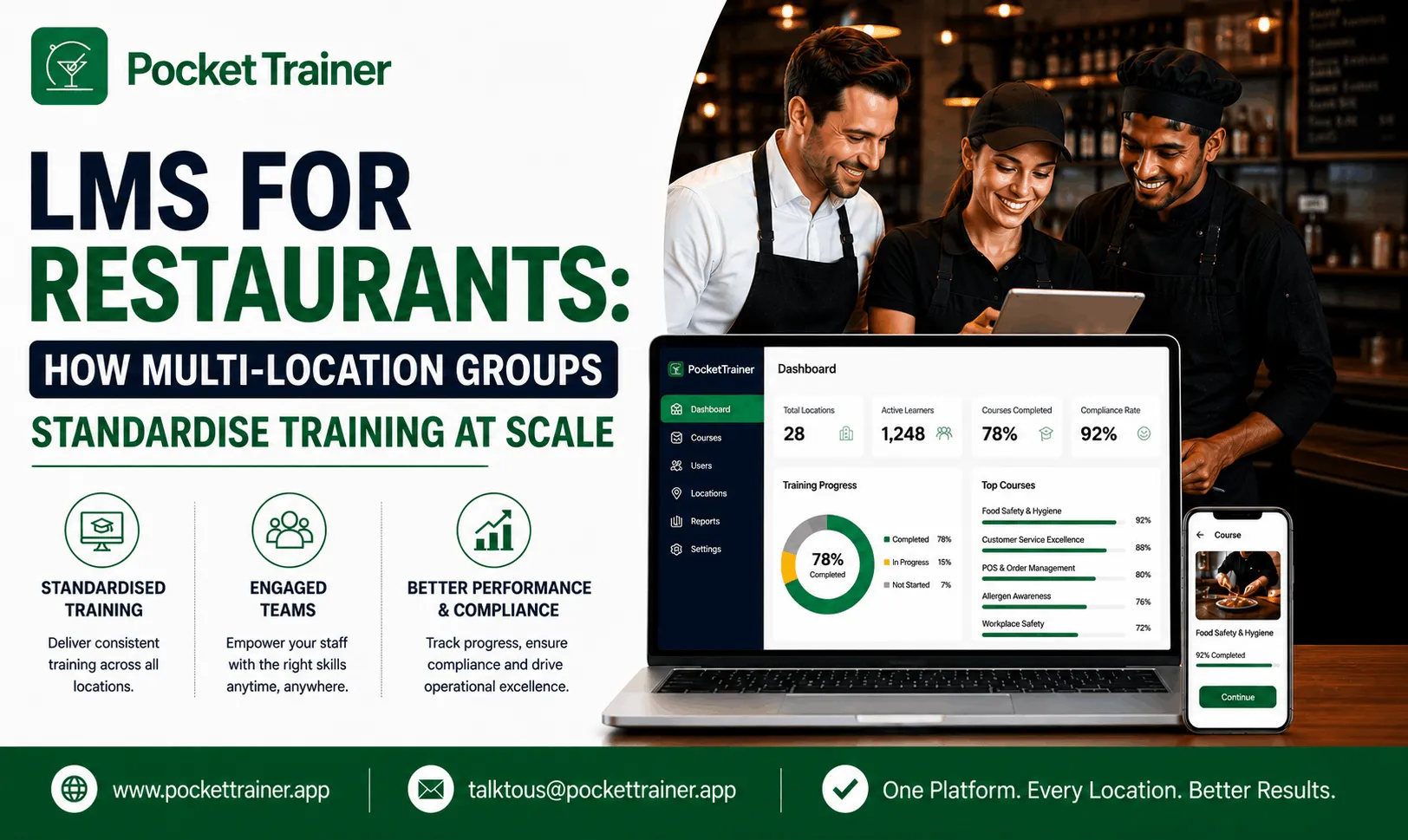
A restaurant LMS gives the head office full visibility across the group. Reporting, leaderboards, and all user and learning data can be filtered by site, by department, by region or country, so you can see completion and performance at any level from the whole group down to a single team. Crucially, you can compare site by site: which locations are on top of their training and which are falling behind, which regions are compliant and which need attention. Training attendance, quiz results, and completion become a dashboard you can actually act on, rather than a stack of separate reports from separate venues.
For a group, that visibility changes the management conversation. Instead of assuming every site is trained and finding out otherwise when something goes wrong (a risk that compounds when compliance training is one of the standards being tracked), head office can see the gaps and address them before they reach a guest or an inspector. Standardisation becomes measurable, not hopeful.
If you want to see multi-site reporting and central content control in action, book a 15-minute demo, and we will walk through it with your group in mind.
Is a Restaurant LMS Worth It for a Small Multi-Site Group?
The case for the best LMS for restaurant chains strengthens with every site you add. At two venues, you might hold consistency by effort. At ten, or across countries, effort is not enough, and the cost of inconsistency compounds: every new site is a fresh chance for the standard to drift. Running a 30-day onboarding plan every site follows is one of the clearest examples of a standard that only holds if it is centrally delivered, not locally interpreted.
This is why serious multi-location groups run on a platform rather than a patchwork. Global groups like LPM and COYA, and other international brands such as La Maison Ani, operate across multiple countries where holding one standard by hand would be impossible. A platform is what lets a brand scale without its standard thinning out, so the tenth venue and the fiftieth deliver what the first one did. Choosing a focused, capable platform is not a small-operator decision; it is how large groups protect the consistency their reputation depends on.
How do Restaurant Chains Keep Training Consistent Across Locations?
Restaurant chains keep training consistent by centralising it on an LMS, so every location trains from the same source rather than its own version. Head office creates the courses, standards, and updates once, then pushes them to every site simultaneously, ensuring a new hire in any location learns the same thing. Group-wide reporting then shows completion and performance filtered by site, region, or department, so head office can see which locations are meeting the standard and which need support. This combination of central delivery and full visibility is what turns a consistent standard from an aspiration into something the group actively controls and measures.
The Takeaway
For a multi-location restaurant group, the training challenge is not quality; it is sameness: making sure every site, in every city or country, delivers the same standard. An LMS for restaurants solves this by pushing one standard to every location centrally, letting it flex where needed, and giving head office site-by-site visibility of who is trained and who is not. As a group grows, that central control is what stops the brand from fragmenting across its own venues. It is how the biggest global groups keep their hundredth site as sharp as their first.
If you want to standardise training across your group and see every site in one place, book a 15-minute demo and we will walk through it with your operation. You can also read more about the hospitality LMS behind it, the training management tools that support it, and the hospitality courses included as standard.
FAQ
1 What should restaurant group training software let the head office do?
Restaurant group training software should let head office create and push training centrally to every site at once, then report on completion and performance filtered by site, department, or region. Without both of those, a group either loses central control of the standard or loses visibility into whether it landed.
2 Can content still be customised per site on a multi-location restaurant LMS?
Yes. A core standard can be held centrally while individual courses or modules are tailored by market, role, or venue where that genuinely matters, without losing central control of the overall standard. This lets groups adapt to local menus or regulations without each site drifting on its own.
3 Is a restaurant LMS only useful for very large chains?
No, though the case for one strengthens with every site added. Even a group with just a handful of locations benefits from a single source of training truth rather than relying on informal consistency, which becomes harder to maintain as soon as a group grows past one site.
4 How does a restaurant LMS help with compliance across multiple sites?
It gives head office a single dashboard showing which sites and staff have completed required compliance training, rather than relying on a stack of separate records from each venue. This makes it possible to spot and address a compliance gap at one location before it reaches an inspection or a guest.
5 What is the difference between an LMS for restaurant managers and one built for general businesses?
An LMS for restaurant managers is built around hospitality-specific needs such as menu content, food safety and allergen compliance, mobile-first delivery for frontline staff, and multi-site reporting suited to restaurant group structures. A general-purpose LMS typically requires far more setup to cover these needs, since they are not built in by default.