
Menu Engineering: The Four Quadrants, And What To Do Next
By Janos Laszlo
- menu engineering
- menu costing
- restaurant profitability
- menu training
Key Takeaways
- Menu engineering sorts every dish by two numbers: gross profit and how often it sells, then acts differently on each group. It’s a costing and merchandising discipline, not a design exercise.
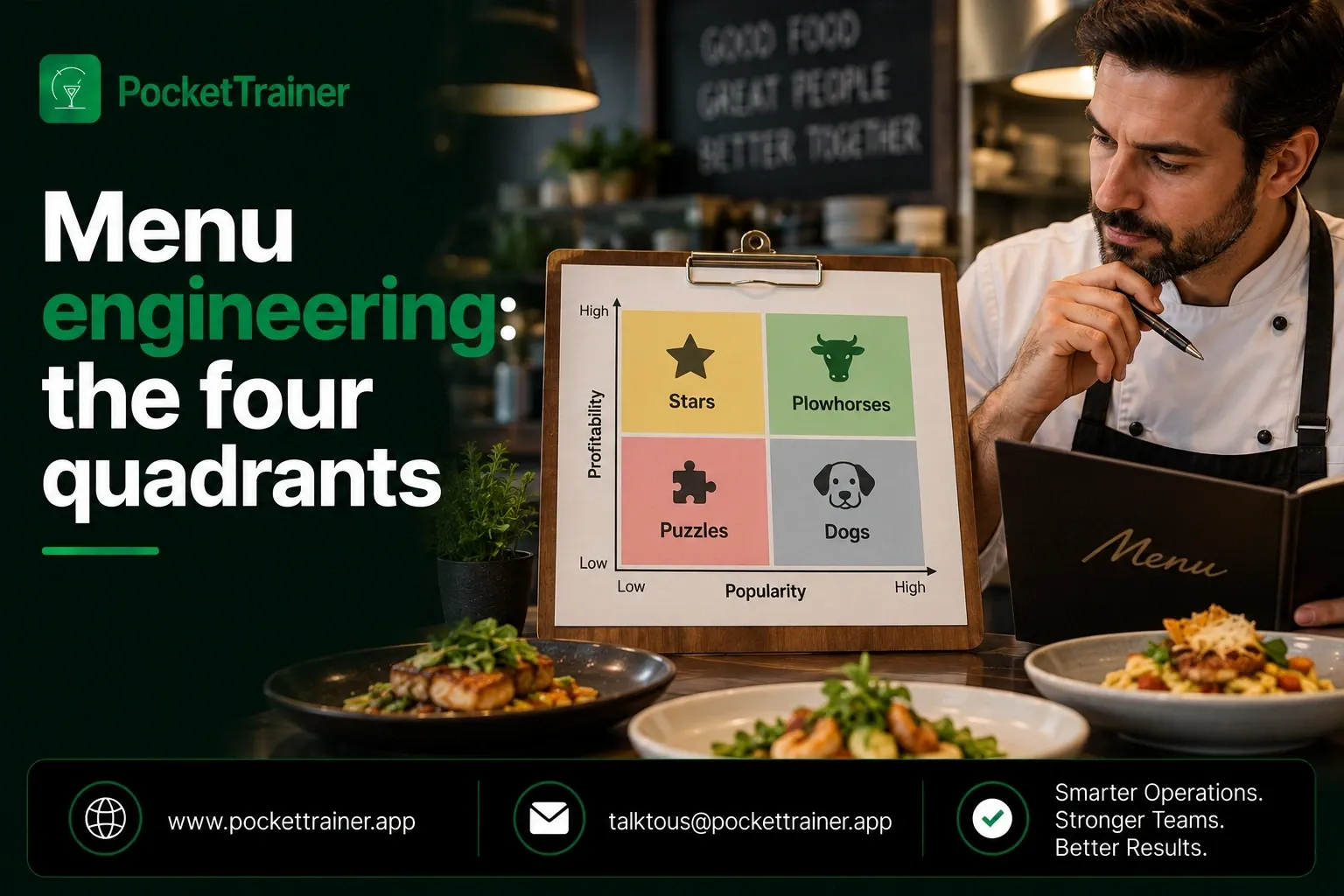
- The four groups have unglamorous names: stars sell well and make money, plough horses sell well and make little, puzzles make money and rarely sell, dogs do neither.
- The intervention that changes results fastest is rarely a price rise. It’s usually fixing what the team says about a puzzle.
- Accurate dish costings and honest sales mix data come before any of this works. Guessing at either produces confident decisions on false numbers.
- Rerun it after every menu change and every significant supplier price move, not once a year.
Most restaurants treat their menu as a fixed document and their pricing as a once-a-year decision. Menu engineering treats it as data: every dish has a margin and a popularity, and the two together tell you exactly what to do with it, protect it, fix its cost, fix how it’s described, or cut it. This guide walks through the method, the four quadrants, and the part almost every operator gets wrong, which has nothing to do with the menu itself.
What Menu Engineering Actually Is
Menu engineering categorises every dish by contribution margin and popularity, then applies a different action to each category rather than treating the whole menu the same way.
Menu engineering is a structured way of deciding which dishes deserve promotion, which deserve rework, and which deserve to go.
The method is simple enough to run in a spreadsheet. For every dish on a menu, calculate its contribution margin, which is the selling price minus the cost of the ingredients, and count how many you sold in a defined period. Then plot each dish against the average for both.
That gives four groups. What makes the discipline worth doing is that the correct action for each group is different, and doing the same thing to all four is how a menu gets worse while everyone feels busy.
It is worth separating this clearly from menu training, which is about whether the team knows the dishes. Menu engineering is about whether the dishes are worth knowing. The two are connected, and the connection is the part most operators miss.
What Is Menu Engineering?
Menu engineering is the practice of categorising every dish by contribution margin and popularity, then applying a different action to each category. Dishes that sell well and carry strong margin get protected and promoted. Dishes that sell well on thin margins get their costs reworked. High-margin dishes that rarely sell usually need better description and recommendation rather than a price change.
Dishes that fail on both are candidates for removal. It requires accurate ingredient costings and real sales mix data for a defined period, and it is rerun after every menu change rather than annually. Pocket Trainer’s Menu Engineering Essentials course covers this method in full for managers building it for the first time.
The Two Numbers You Need Before You Start
Neither is difficult. Both are commonly wrong.
Contribution margin per dish: Selling price minus the true cost of the ingredients, including the parts people forget: garnish, oil, the bread that arrives with it, trim and yield loss on proteins. A costing that ignores yield on a whole fish is not a costing.
Units sold in a defined period: Long enough to be meaningful and short enough to be current. Four to eight weeks of trading suits most menus. Exclude anything distorted by an event or a supply failure and note why you excluded it.
Two cautions worth applying before you trust the output.
Use gross profit in currency, not percentage, when you rank. A dish at 78% margin selling at nine pounds contributes less than a dish at 62% selling at twenty-six. Percentage flatters small plates and misleads on mains.
And decide in advance how to treat items that exist for a reason other than profit. A children’s dish or a vegan option may be a strategic necessity. Mark them before you analyse so they do not get cut by arithmetic.
The Four Quadrants and the Right Action for Each
| Quadrant | Margin | Popularity | What to Do |
|---|---|---|---|
| Stars | High | High | Protect: keep the recipe and specification stable, train new starters on them first |
| Plough Horses | Low | High | Rework the cost (portion accuracy, garnish, supplier) before raising the price |
| Puzzles | High | Low | Fix the description and staff recommendation; the most neglected, most valuable quadrant |
| Dogs | Low | Low | Remove, after confirming a fair run and no strategic purpose |
Stars: high margin, high popularity. Protect them. Keep the recipe stable, keep the specification tight, and make sure a new starter is trained on them first. The most common way to damage a star is to let its execution drift because everyone assumes it looks after itself.
Plough horses: low margin, high popularity. These carry your covers and starve your margin. The instinct is to raise the price, and the better first move is to rework the cost: portion accuracy, garnish, a supplier conversation, or a small specification change that guests will not notice. Price is available afterwards, in smaller steps than you think. Pocket Trainer’s Cost Control And Waste Reduction course covers exactly this kind of margin recovery.
Puzzles: high margin, low popularity. The most valuable quadrant and the most neglected. A dish that makes real money and rarely sells is usually not a bad dish. It is a badly explained one, badly placed on the page, or one the team does not recommend because they have never tasted it.
Dogs: low margin, low popularity. Candidates for removal, with one honest check first. Ask whether it is genuinely failing or simply new, seasonal, or never mentioned. Then cut without sentiment, and be aware that removing a dog frees prep time and fridge space as well as menu real estate.
Menu Engineering Operator Worksheet
Use this for each menu-engineering review.
Set the period
- Define the sales period being analysed.
- Check that the period is long enough to be meaningful.
- Note any events, supply problems or unusual trading periods that could distort the data.
Check each dish
- Selling price recorded.
- True ingredient cost recorded.
- Contribution margin calculated.
- Units sold recorded.
- Strategic items, such as dietary options, identified before classification.
Place each dish
- Star — high margin / high popularity
- Plough Horse — low margin / high popularity
- Puzzle — high margin / low popularity
- Dog — low margin / low popularity
Decide the actio
- Stars: protect recipe, specification and training.
- Plough Horses: investigate portion, garnish, supplier and other cost drivers.
- Puzzles: improve description and staff recommendation.
- Dogs: confirm they have had a fair run and have no strategic purpose before removing.
Turn the analysis into training
- Identify the three or four dishes that need stronger staff recommendation.
- Give the team the description, key ingredients and guest-facing recommendation.
- Check that staff can explain the dishes confidently.
- Review the result after the next relevant menu or trading change.
Why the Team Is the Lever Most Operators Ignore
The fastest available upside in a menu engineering exercise almost always sits in the puzzles quadrant, and the fix is almost never on the menu itself.
Here is the finding that surprises operators running this for the first time. The quadrant with the fastest available upside is almost always puzzles, and the fix is almost never on the menu.
A high-margin dish that does not sell is usually a dish nobody talks about. The server has not tasted it, cannot describe it, and defaults to recommending the thing they know. That is a knowledge problem sitting on top of a margin opportunity, and it is fixable in days rather than in a menu print cycle.
“My favourite is the food guide, since I’m very passionate of the recipes of the food we serve. We are kind of food ambassadors as well of the restaurant, so we need to know exactly what we deliver to the table, how it gets prepared, where it comes from.” - William Mc Inally, Floor Manager, LPM Dubai
The practical move after a menu engineering exercise is therefore not only a redesign. It is a short, specific push on the three or four puzzles worth rescuing: what it is, why it is like that, what to say to a guest who asks, and what it goes with. Assigning that to the floor team by role rather than sending it to everyone is what Pocket Trainer’s training management service is for.
“This technology gives you everything; you see the picture, you see the ingredients, they can learn easily.” - Dinky Ray Bico, then Floor Supervisor, CMP Bar & Grill, Dubai
This is exactly what a digital food bible is built to solve, holding the picture, the ingredients, and the story for every dish in one current place, rather than in a spec sheet nobody opens.
“Boring. We need something new, something interactive. It’s easy to have an app. You have everything in one place rather than spreadsheets and stuff like that.” - Ana Boncheva, Head Waitress, Sushisamba
Want to fix your highest margin dishes nobody recommends? Bring three of them.
Book a 15-minute demoHow Often to Rerun It
Annually is too slow for most operations. The useful triggers are events rather than dates.
- After every menu change, because the averages move and yesterday’s star may now be mid-table.
- After a significant supplier price move. A protein moving ten per cent can flip a star into a plough horse without anything else changing.
- Seasonally, if your covers swing. Sales mix in August is not sales mix in February, and treating them as one dataset averages away the thing you are looking for.
- Before any price review, so the decision is made per dish rather than as a blanket percentage.
The operators who get the most from this treat it as a recurring routine of half a day rather than a project. The first run is the slow one because the costings need building. After that, it is maintenance.
Which Menu Items Should You Remove First?
Start with dishes that are low margin and low popularity, but check three things before cutting. Confirm the dish has had a fair run rather than being new or seasonal, since a fortnight of data proves nothing. Confirm it is not serving a strategic purpose such as a dietary requirement your guests expect. And confirm the team can actually describe it, because a dish nobody recommends will always underperform regardless of quality. If it fails on margin and popularity after those checks, remove it and reclaim the prep time and fridge space as well as the space on the page.
The fastest return from menu engineering is usually getting three descriptions into the hands of the team the same week.
Bring your highest margin underperformer
Book a 15-minute demoFrequently Asked Questions
Do I need software for menu engineering?
No. A spreadsheet handles the analysis perfectly well. What software helps with is the part afterwards: getting the revised descriptions and specifications to the people who have to say them out loud.
How many covers do I need for the data to mean anything?
Enough that each dish has sold a meaningful number of times rather than a headline total. A dish with four sales in the period is not evidence of anything, and it should be flagged rather than classified.
Should drinks be included?
Run them separately. Beverage margin structures differ enough that mixing them distorts both averages, and the actions available on a cocktail list are not the same as on a food menu.
What if a chef objects to cutting a dish?
That objection is often worth listening to, because it usually means the dish is a puzzle rather than a dog. Test the description and the recommendation for a fortnight before deciding.