
Service Excellence Training for Hospitality Teams
By Janos Laszlo
- service excellence training
- hospitality training
- hospitality service standards
- restaurant staff training
- hotel staff training
- customer service training
- hospitality LMS
- service training
- guest experience training
- hospitality team training
Quick Summary
- Service excellence training should turn broad service standards into observable behaviours.
- Teams need realistic practice, manager coaching, and regular refreshers, not just an induction course.
- Training should follow the guest journey, from arrival and recommendations to service recovery and farewell.
- Completion data should be reviewed alongside manager observations and relevant guest-feedback themes.
- Digital learning can support consistency and visibility, but it does not replace coaching on shift.
Service excellence training works when hospitality teams know the standard, practise it in realistic situations, receive coaching on shift and revisit it regularly.
The goal is not to make every guest interaction sound scripted. It is to give employees enough product knowledge, judgement and confidence to respond consistently while still sounding human.
For operators, that means connecting training to the guest journey and everyday shift routines rather than treating service training as a one-off course.
What Is Service Excellence Training in Hospitality?
Service excellence training is a structured way to teach, practise and reinforce the behaviours that create a reliable guest experience.
It connects brand standards with real moments such as welcoming a guest, explaining a menu, making a recommendation, handling a delay, and closing an interaction.
Effective programmes combine:
- Clear expectations
- Short, usable learning
- Realistic practice
- Manager observation
- Feedback
- Regular refreshers
The result should be a team that can apply the standard under pressure, rather than simply recall it in a quiz.
Definition: Service Excellence
Service excellence is the consistent delivery of service behaviours that meet an organisation’s standards while responding appropriately to the guest and the situation.
This definition matters because “excellent service” can otherwise mean something different to every manager.
A useful service standard must be observable.
Instead of telling someone to “be attentive”, define what that means:
- Acknowledge a waiting guest
- Check understanding
- Confirm the next step
- Return with an update
- Escalate when the situation is outside their authority
This approach is consistent with the way current Skills England hospitality standards describe customer service, including recognising customer needs, communicating effectively, following business standards and acting on feedback. The older ST0233 Hospitality Team Member standard has now been retired, so it should be treated as historical context rather than a current apprenticeship standard. Current food and beverage and hospitality accommodation standards provide the more relevant reference point.
Why Do Hospitality Service Standards Break Down?
Most service failures are not caused by a total absence of training.
They often happen because the standard is difficult to find, too generic to use, taught too far from the moment of need, or not reinforced by the manager running the shift.
Common gaps include:
- People know the policy but have not practised the judgement it requires
- Product or menu knowledge changes faster than the training material
- New starters receive too much information during induction and little follow-up afterwards
- Different managers coach the same situation in different ways
- Completion is tracked, but behaviour on shift is not
- Guest feedback is collected without being translated into the next training priority
A UK Government hospitality strategy published in 2021 also identified lower training participation among customer-facing hospitality employees compared with workers in other roles. That is an older sector snapshot rather than a current performance measure, but it supports the broader point that structured skills development has been an established sector issue.
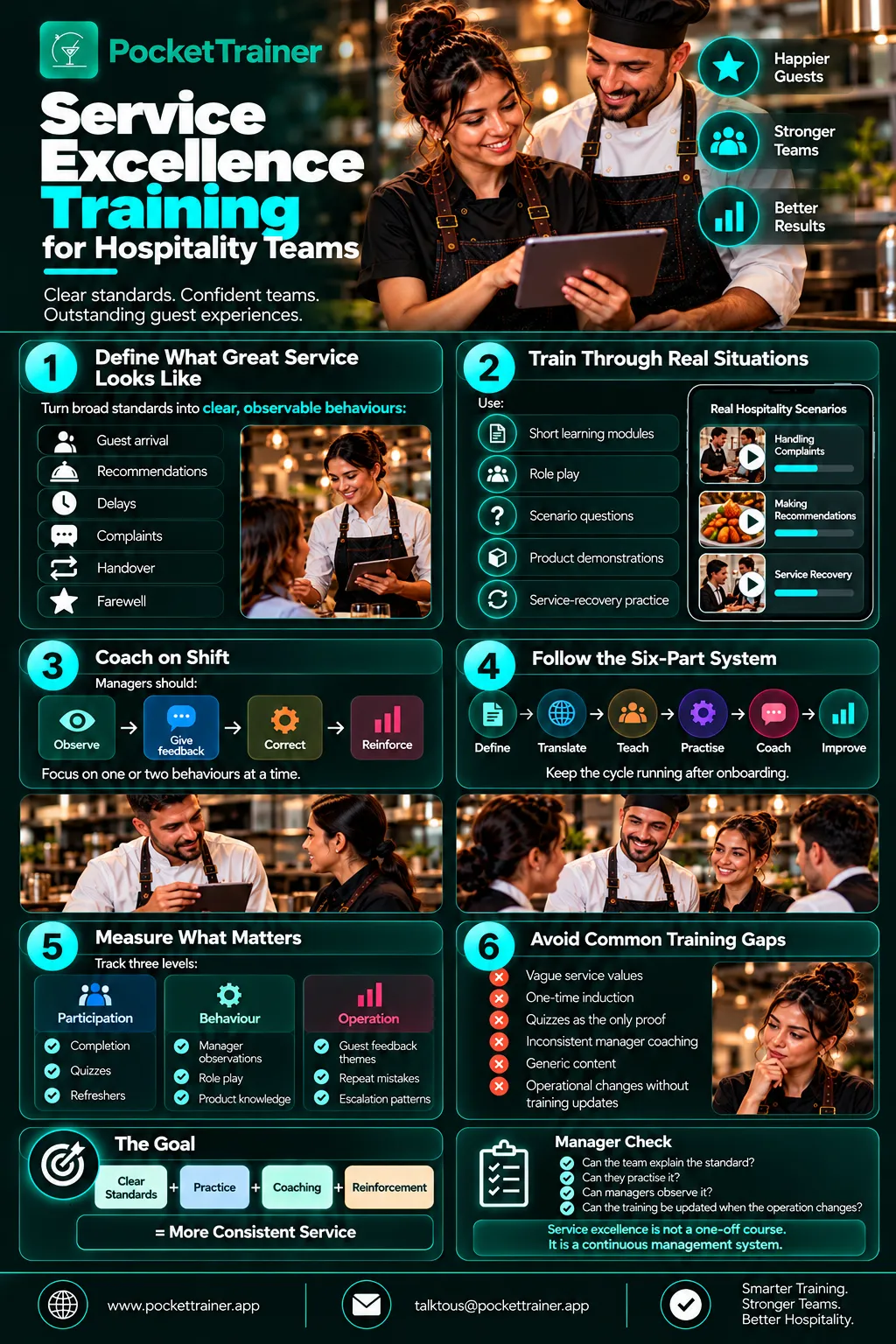
The Six-Part Service Excellence Training System
A practical service excellence programme can be built as a continuous loop.
Each part answers a different operational question. Removing one creates a predictable gap.
1. Define the Moments That Matter
Map the guest journey and identify the interactions with the greatest effect on trust, comfort, or service recovery.
Examples include:
- Arrival
- The first product recommendation
- Menu or allergen questions
- Room readiness
- A delayed order
- A complaint
- A handover between departments
- The final farewell
Start with the moments that matter most rather than trying to train every possible interaction at once.
2. Translate Standards Into Observable Behaviours
Write each standard so a manager can observe it.
Keep the language direct.
State:
- What to do
- What good looks like
- When to escalate
- Who owns the next step
- Where local judgment is allowed
For example:
Too vague:
“Give every guest excellent service.”
More useful:
“Acknowledge the guest promptly, explain what will happen next, and return with an update if there is a delay.”
The second version gives both the employee and manager something they can practise and observe.
3. Teach in Short, Usable Units
Break content into one situation, one standard or one product family at a time.
Short modules make it easier to:
- Fit learning around shifts
- Refresh specific knowledge
- Update individual topics
- Assign learning by role
- Revisit weak areas without repeating an entire course
The objective is not to make every module as short as possible. It is to make every module focused enough to produce a clear learning outcome.
4. Practise Realistic Situations
Use role play, scenario questions, demonstrations and short practice exercises.
Include ordinary service moments as well as recovery situations.
For example:
- A guest asks for a recommendation
- A table has been waiting too long
- A guest says their order is incorrect
- A customer asks about an allergen
- A room is not ready at the expected time
- A request needs to be handed to another department
The aim is not theatre.
It is to let employees make decisions before a real guest is waiting.
5. Observe and Coach on Shift
The manager is the bridge between completed learning and changed behaviour.
Give managers a compact observation prompt.
Feedback should:
- Identify the behaviour
- Explain its effect
- Agree the next action
Avoid turning every coaching moment into a formal assessment.
A useful coaching comment is specific enough to apply during the next interaction.
Instead of:
“Be warmer.”
Try:
“Acknowledge the guest before checking the booking, then explain what you are doing so they know what happens next.”
6. Reinforce and Improve
Service training should continue after onboarding.
Revisit weak areas, update changed standards and use recurring guest-feedback themes to decide what needs attention next.
A useful loop is:
Train → Practise → Observe → Coach → Refresh → Update
The programme becomes stronger when the learning content reflects what managers are actually seeing during service.
Bring your own compliance requirement and ask to see the completion record produced live, filtered by site and role.
Book a 15-minute demoWhat does service excellence look like from an operator’s perspective?
This section is optional, but the quote fits the article because it reinforces the connection between staff capability and guest experience.
“In my experience, to invest the money in this kind of platform is very important because I have a clear formula: happy staff, happy guest. - Levon Aivaziants”
The quote should be treated as an operator perspective rather than evidence that training technology alone creates guest satisfaction.
How Do You Build Service Training Around the Guest Journey?
Start with the operation, not the course catalogue.
Walk through a real guest journey with managers from the departments involved.
Record:
- Where ownership changes
- Where information can be lost
- Where the guest may need reassurance
- Where product knowledge matters
- Where a delay or mistake can occur
- Where another department needs to take over
Then connect each moment to four elements:
| Guest moment | Observable standard | Practice method | Manager check |
|---|---|---|---|
| Arrival | Acknowledge promptly and explain the next step | Two-minute arrival scenarios | Observe clarity and ownership |
| Recommendation | Ask a relevant question before suggesting an option | Menu or product matching exercise | Check accuracy and confidence |
| Delay | Give a clear update and agreed return time | Service-recovery role play | Check follow-through |
| Handover | Pass the request with context and confirm ownership | Cross-department scenario | Check that the guest need is not repeated |
| Farewell | Confirm satisfaction and close naturally | Peer practice | Check personal, unforced language |
For each moment, separate knowledge from behaviour.
A person may know the menu but struggle to ask a useful question.
They may understand a recovery policy but fail to return when promised.
Training should address the precise gap.
How Can Managers Reinforce Service Training on Shift?
A manager does not need another large administrative process.
They need a repeatable rhythm that works during a busy week.
A practical rhythm could include:
Before shift:
Name one service moment and ask the team what good looks like.
During shift:
Observe one or two agreed behaviours without trying to score everything.
After shift:
Recognise one specific example, correct one gap, and choose the next practice point.
Weekly:
Review recurring questions, feedback themes and learning that needs updating.
Monthly:
Compare sites or departments carefully, then investigate context before drawing conclusions.
The key is consistency.
A five-minute coaching conversation that happens every week can be more useful than a long training session that happens once a year.
For more difficult interactions, managers can connect the relevant service module to the practical guide on handling difficult customers in hospitality rather than overloading a general service lesson.
What Should Hospitality Service Training Measure?
Measure service excellence training at three levels:
- Participation
- Demonstrated behaviour
- Operational signals
Completion and quiz results show whether people engaged with the learning.
They do not, by themselves, prove consistent performance on shift.
Add structured manager observations and review relevant guest-feedback themes, repeat mistakes and recovery patterns.
Use the combined picture to decide what to reinforce, rewrite or retire.
| Level | Examples | Decision supported |
|---|---|---|
| Participation | Completion, quiz attempts, refresher activity | Who needs access, time or follow-up? |
| Behaviour | Manager observation, role-play check, product explanation | Can the person apply the standard? |
| Operation | Feedback themes, repeat errors, escalation patterns | Which standard or process needs improvement? |
Choose a small set of measures before launch.
Each measure should answer a decision, rather than simply decorate a report.
Also avoid presenting movement in a guest score as proof that training alone caused it.
Staffing, demand, product availability, systems, and local operating conditions can all affect the result.
Treat operational data as a prompt for investigation and coaching.
For more on the relationship between learning systems and guest outcomes, see how hospitality LMS platforms can support guest satisfaction.
Bring Your Service Training Into One Operating System
Pocket Trainer can keep an organisation’s own standards, product knowledge and short assessments together in a mobile-first hospitality learning management system.
The platform can support short learning modules, quizzes, training records and manager visibility. Managers still own coaching, judgement and operational follow-through.
For service excellence programmes, the useful distinction is simple:
- The platform supports the system.
- Managers reinforce the behaviour.
- The operation provides the evidence.
Common Service Excellence Training Mistakes
1. Writing Values Instead of Standards
“Delight every guest” may be a useful ambition, but it does not tell a team what to do during a delay, handover or complaint.
Translate values into observable behaviours.
2. Making Induction Carry the Whole Programme
People need reinforcement as they encounter new products, situations and responsibilities.
Do not expect one induction session to carry the full service standard indefinitely.
3. Using Quizzes as the Only Proof
A correct answer shows recall.
Observation and practice reveal whether someone can use the knowledge.
4. Ignoring Manager Capability
Managers need prompts and practice too.
Inconsistent coaching quickly becomes inconsistent service.
5. Copying Generic Content Without Local Detail
Hospitality service depends on the organisation’s concept, standards, products and escalation routes.
Generic principles should be translated into the operation’s reality.
6. Updating the Operation but Not the Training
When menus, policies or service sequences change, old learning can become a source of error.
If your standards are spread across documents, slides, and messages, custom hospitality training content can help turn approved operational knowledge into structured learning.
Content still needs an owner and a review date.
Final Thoughts
Service excellence is not a launch event or a handbook that sits in a manager’s office.
It is a management system that keeps standards clear, gives people realistic practice, and turns everyday observations into the next useful piece of learning.
- Start with one high-value guest moment.
- Define the behaviour.
- Practise it.
- Coach it on shift.
- Measure what matters.
Then improve the training based on what the operation is actually seeing.
That is how service excellence becomes a repeatable hospitality standard rather than a vague promise.
Bring your own compliance requirement and ask to see the completion record produced live, filtered by site and role.
Book a 15-minute demoFrequently Asked Questions
How often should service excellence training be refreshed?
Refresh training when a standard, product, or process changes, and when observation or guest feedback shows a recurring gap. For stable topics, use short spaced reminders rather than repeating a full course by default.
Should service training be the same for every hospitality role?
Keep a shared core for the guest promise, communication, and service-recovery principles. Then add role-specific moments, product knowledge and escalation routes so the learning remains relevant to each team.
Can digital learning replace manager coaching?
No. Digital learning can make standards accessible, consistent and measurable, but people still need realistic practice, observation and feedback in the operation.
What belongs in a hospitality service standard?
Include the situation, expected behaviour, useful language where needed, ownership, escalation point, and any product or policy knowledge required to act correctly.
How long should a hospitality training module be?
Use the shortest format that fully teaches one usable outcome. A complex recovery scenario may need more time than a product update. Relevance and practice matter more than an arbitrary duration.