
Top 10 Restaurant Compliance Mistakes & How to Avoid Them
By Janos Laszlo
- Restaurant Compliance Mistakes
- How to Avoid
- fix Mistakes
Quick Summary
- A poor hygiene rating, a failed inspection, or a food safety incident rarely happens because an operator doesn’t care; it happens because the system that would have prevented it wasn’t in place.
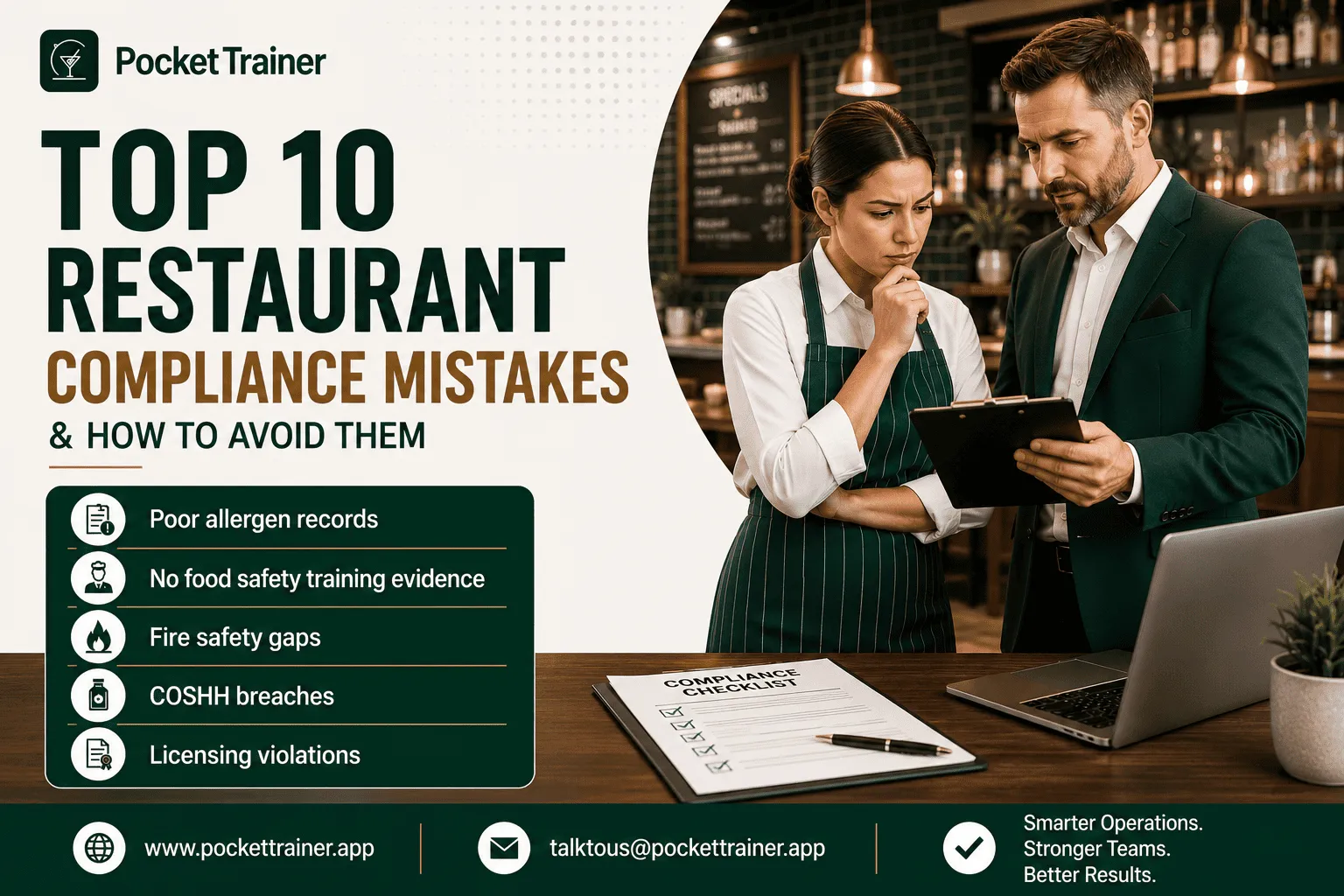
- The most common gaps span allergen documentation, temperature records, staff training evidence, HACCP, fire safety, COSHH, right-to-work checks, licensing, hygiene ratings, and keeping pace with regulatory change.
- Small restaurants without a dedicated HR function are especially exposed to labour law mistakes, wage deductions, holiday pay, and record-keeping that go beyond food safety.
- A new single enforcement body, the Fair Work Agency, launches in April 2026 with expanded powers to investigate wage and holiday pay compliance specifically.
A poor hygiene rating, a failed inspection, or a food safety incident does not happen because an operator does not care. It happens because the systems that prevent it were not in place. These are the ten compliance mistakes UK and GCC restaurant operators make most often, plus one growing risk area many operators, especially small restaurants without an HR department, don’t see coming.
What are the most common restaurant compliance mistakes in the UK?
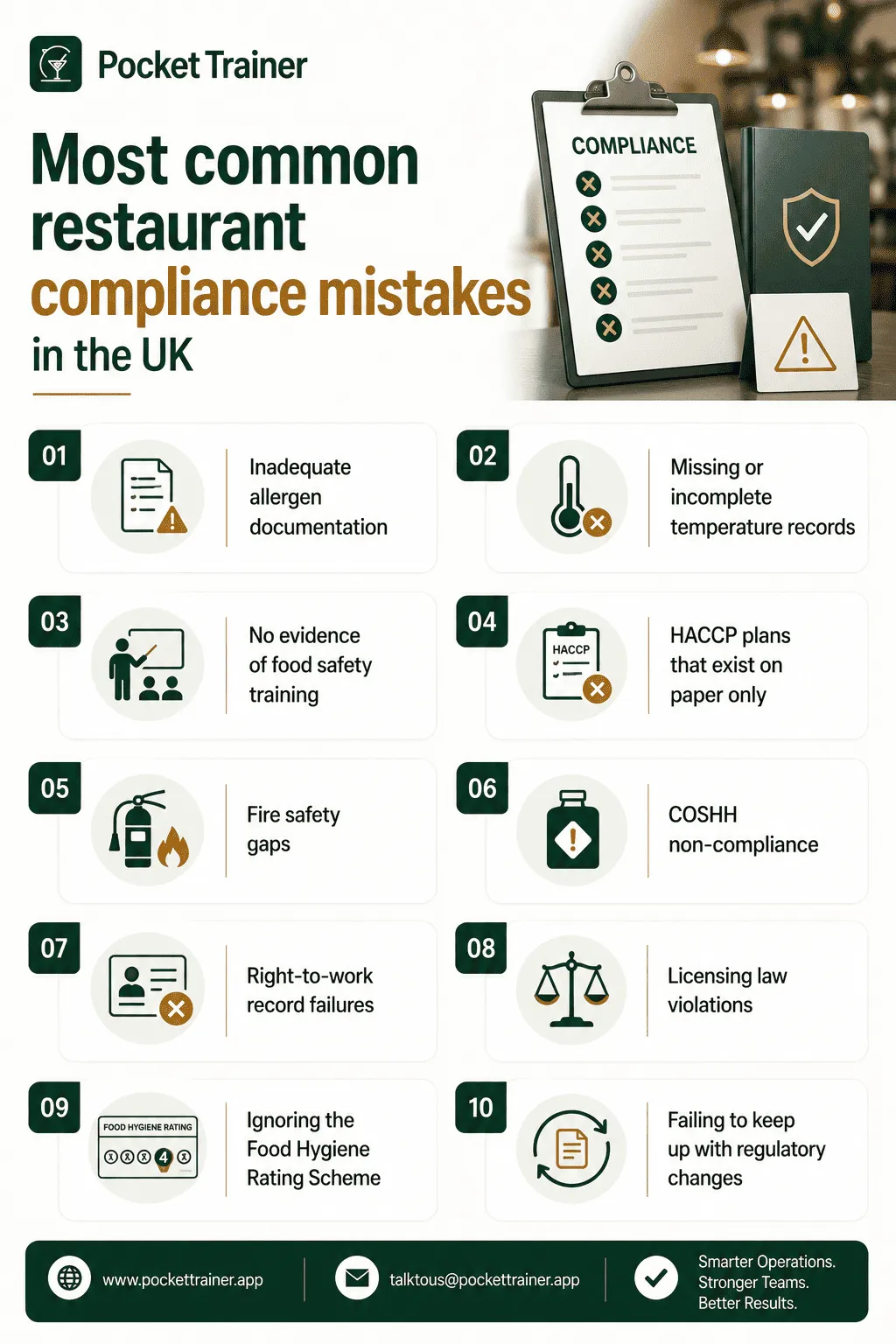
The most common restaurant compliance mistakes are inadequate allergen documentation, missing temperature records, untrained staff with no certificates on file, poor HACCP implementation, and fire safety gaps. Most are not the result of ignorance. They are the result of busy operations where compliance work gets deprioritised until an inspector arrives. By then it is too late.
1. Inadequate allergen documentation
Since Natasha’s Law came into force in 2021, operators must provide full ingredient lists on prepacked for direct sale food. Many still have inconsistent allergen matrices, verbal-only processes at the pass, and no written record of how allergen requests are handled. This is the compliance area most likely to result in a serious incident.
Fix: Write a documented allergen protocol covering how guest requests are captured, communicated to the kitchen, and confirmed at service. Train every team member on it. Keep a record of who completed that training and when.
Pocket Trainer’s Food Allergen Awareness For Restaurants UK course covers every requirement under the Food Information Regulations 2014, and our allergen training guide goes into the detail behind Natasha’s Law specifically.
2. Missing or incomplete temperature records
The FSA expects documented temperature checks for deliveries, storage, cooking, and cooling. In practice, many restaurants have a probe somewhere in the kitchen and no consistent system for using or recording it. A remote inspection under the FSA’s updated Food Law Code of Practice can now request digital records at short notice.
Fix: Implement a daily temperature log with named ownership per shift. Move it digital so records are accessible from head office and cannot be lost or backdated.
3. No evidence of food safety training
Every food handler must receive adequate training under the Food Safety Act 1990. The FSA recommends Level 2 Food Safety in Catering as the minimum standard. What inspectors increasingly find is that training happened, but there is no certificate, no record, and no way to prove it.
Fix: Hold a current certificate for every food handler on file, alongside the date it was completed and when it needs refreshing. Three years is the recommended maximum between refreshers.
Pocket Trainer’s Food Safety For Restaurants Level 2 UK course is RoSPA assured and issues a digital certificate automatically on completion.
4. HACCP plans that exist on paper only
Every food business must have a HACCP-based food safety management system. Most do. The problem is the plan was written once, filed somewhere, and never updated when the menu changed, a new supplier came on board, or a new piece of equipment was introduced.
Fix: Treat your HACCP plan as a live document. Review it whenever anything operational changes. Assign a named owner at each site responsible for keeping it current.
Pocket Trainer’s HACCP for managers course and our HACCP training guide cover what a live system actually requires.
5. Fire safety gaps
Under the Regulatory Reform (Fire Safety) Order 2005, all non-domestic premises in England and Wales must carry out a fire risk assessment and keep it up to date. In restaurants, fire risks change constantly: new equipment, layout changes, different chemicals in use. Many operators complete the initial assessment and never revisit it.
Fix: Schedule an annual fire risk assessment review. Ensure all staff complete fire safety training on hire and annually thereafter.
Pocket Trainer’s Fire Safety For Restaurants course covers the legal requirements and practical procedures for restaurant teams.
6. COSHH non-compliance
Restaurants use a range of hazardous substances: cleaning chemicals, descalers, sanitisers. Under the Control of Substances Hazardous to Health Regulations 2002, employers must assess the risks, implement controls, and train staff on safe use. Most restaurants have the chemicals but not the COSHH assessments or the training records.
Fix: Create a COSHH inventory for every site, complete an assessment for each substance, and train staff on correct dilution, storage, and PPE requirements.
Pocket Trainer’s COSHH For Restaurants course covers everything your team needs to know.
7. Right-to-work record failures
Every employer in the UK must check and record the right to work of every employee before they start. In busy restaurants, this step is frequently rushed or skipped entirely. Civil penalties for employing someone without the right to work are up to £60,000 per worker.
Fix: Make right-to-work checks a non-negotiable step in your onboarding process, completed and documented before the first shift. Keep copies of the documents checked.
8. Licensing law violations
If your restaurant serves alcohol, your Premises Licence and Designated Premises Supervisor obligations apply every shift. Common failures include serving alcohol to someone who is visibly drunk, failing to conduct Challenge 25 checks consistently, and staff not knowing the conditions of the licence.
Fix: train every member of front-of-house staff on the conditions of your premises licence. This is not a one-off briefing. It should be part of induction and refreshed annually. Our guide to serving alcohol responsibly covers the Scotland vs. England and Wales split and what Challenge 25 actually requires.
9. Ignoring the Food Hygiene Rating Scheme
A poor hygiene rating is not just a legal signal. It directly affects covers. Research consistently shows that a visible 1 or 2 rating reduces bookings, particularly on delivery platforms where the score is prominently displayed. Many operators treat a poor rating as a one-off event rather than a symptom of a system problem.
Fix: Treat your rating as a live performance indicator. If your rating drops, investigate the root cause and address it systematically, not just in the days before a revisit.
10. Failing to keep up with regulatory changes
UK food law is not static. Allergen rules are extending. The Terrorism (Protection of Premises) Act 2025 (Martyn’s Law) is commencing through 2026. The FSA updates its guidance regularly. Operators who rely on what they knew three years ago are exposed to rules they do not know have changed.
Fix: Subscribe to FSA updates, UKHospitality communications, and your local authority’s food safety newsletter. Assign someone at head office responsibility for tracking regulatory changes and communicating them to site managers.
Beyond the ten above, one growing risk area deserves its own spotlight, especially for small restaurants without a dedicated HR function: labour law compliance. It’s a different category of mistake entirely, less about food, more about payroll and records, and it’s where operators are most likely to be caught out without realising it.
Bonus: The Labour Law Blind Spot Most Small Restaurants Miss
Unlike food safety, labour law compliance failures rarely come from a single dramatic error. They come from small, technical miscalculations that compound quietly until an inspection or a tribunal claim surfaces them.
Minimum wage deductions: Uniform costs, unpaid training time, and accommodation offsets are the most common ways pay accidentally drops below the National Minimum Wage or National Living Wage. Voluntary tips and service charges paid through a tronc system do not count toward NMW calculations, a distinction many small operators get wrong. Mandatory training time must be paid at least minimum wage, even if it happens outside normal hours.
Holiday pay miscalculation for irregular-hours staff: With split shifts, zero-hours contracts, and variable weeks common in hospitality, holiday pay is one of the most frequently misapplied areas of UK employment law. Errors here expose a business to unlawful deduction of wages claims that are often not limited to a single holiday year.
Missing the new record-keeping requirement. From April 2026, UK employers must retain detailed holiday pay and annual leave records for a minimum of six years, bringing annual leave documentation in line with existing NMW record-keeping standards. Restaurants managing leave manually or informally are exposed here.
A new, single enforcement body: From April 2026, the Fair Work Agency (FWA) becomes the UK’s unified labour rights regulator, consolidating HMRC’s National Minimum Wage enforcement team, the Employment Agency Standards Inspectorate, and the Gangmasters and Labour Abuse Authority into one body with expanded investigative and civil penalty powers. It covers NMW underpayment, holiday pay failures, sick pay compliance, and agency worker protections, exactly the areas small restaurants are least likely to have formal systems for.
Fix: for a restaurant without a dedicated HR function, the highest-leverage step is auditing pay deductions and holiday pay calculations against current NMW and Working Time Regulations rules, then putting a digital, dated record-keeping system in place before April 2026 rather than after an FWA inspection prompts it.
Final thoughts
Compliance is not a project you complete. It is a system you maintain. The operators who stay audit-ready are not doing more work than everyone else. They have better systems: documented, digital, and tracked, across food safety and, increasingly, labour law too.
If you want to run training across every department and property from one mobile platform, book a 15-minute demo and we will walk through it with your hotel in mind. You can also read more about the hospitality LMS behind it and the hospitality courses included as standard.
FAQs
1 How can a small restaurant avoid labour compliance mistakes with no HR department?
Start by auditing pay deductions (uniforms, training time, tips through a tronc system) against current National Minimum Wage rules, and put a digital record-keeping system in place for holiday pay and hours worked. These two areas account for the majority of accidental labour law violations in small hospitality businesses, and both are fixable without hiring dedicated HR staff.
2 What is the Fair Work Agency and when does it launch?
The Fair Work Agency is the UK’s new single labour rights enforcement body, launching in April 2026 and consolidating National Minimum Wage enforcement, the Employment Agency Standards Inspectorate, and the Gangmasters and Labour Abuse Authority into one regulator with expanded powers. It will investigate wage underpayment, holiday pay failures, and sick pay compliance across hospitality and other sectors.
3 Do tips count toward the National Minimum Wage in restaurants?
No. Voluntary tips and service charges paid through a tronc system do not count toward National Minimum Wage calculations. Only compulsory service charges paid through payroll can be counted, a distinction that catches many operators calculating pay informally.
4 What is the most common food safety compliance mistake in UK restaurants?
Inadequate allergen documentation is the compliance area most likely to result in a serious incident, typically inconsistent allergen matrices, verbal-only processes at the pass, and no written record of how guest allergen requests were handled and confirmed.
5 How long do UK restaurants need to keep holiday pay records from 2026?
From April 2026, UK employers must retain detailed holiday pay and annual leave records for a minimum of six years, bringing annual leave documentation in line with existing National Minimum Wage record-keeping standards.