
Training a Kitchen Where Nobody Shares a First Language
By Janos Laszlo
- multilingual training
- kitchen training
- allergen communication
- hospitality training
- team communication
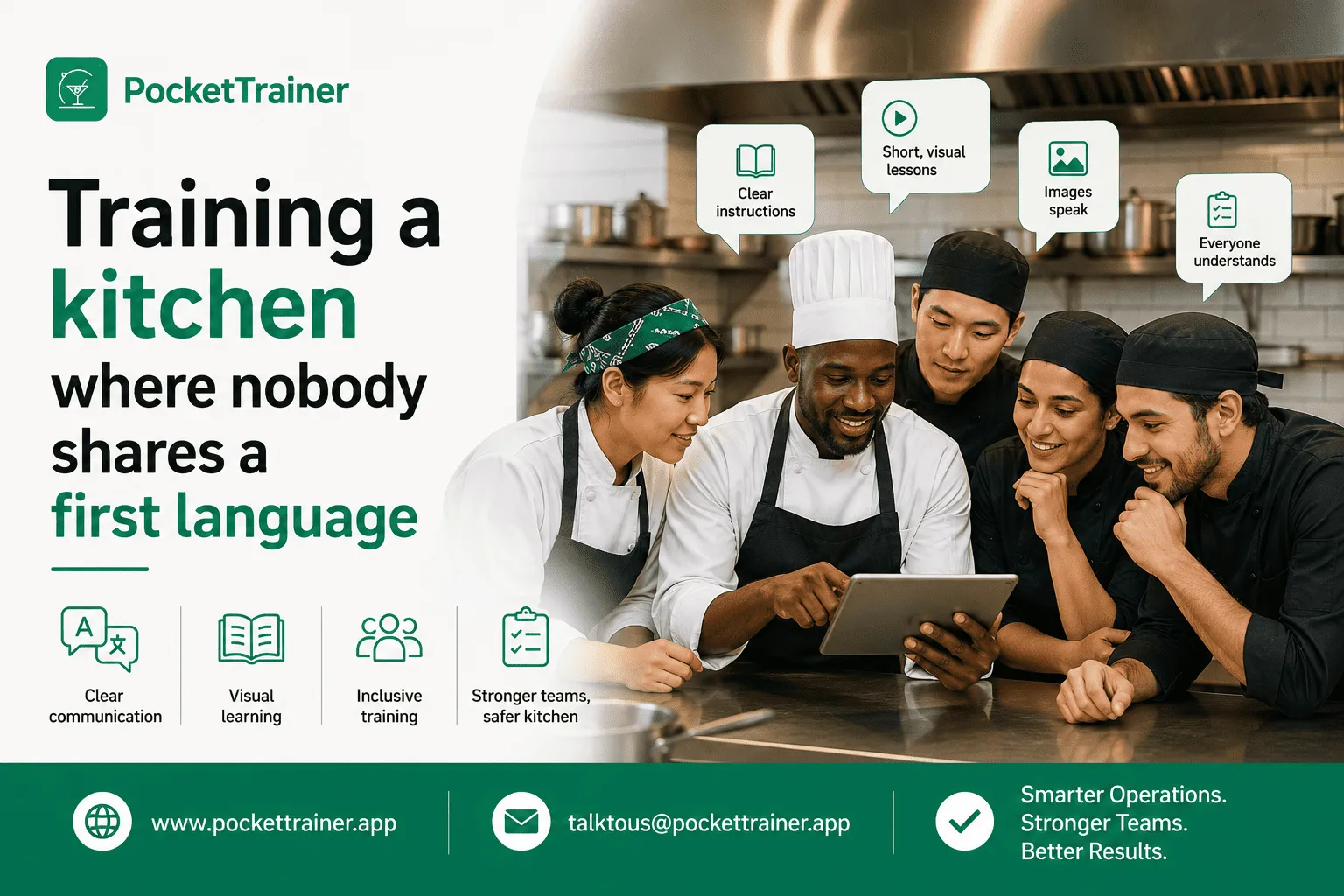
Quick summary
Most kitchens run on working English that is thinner than anyone assumes. The fix is rarely full translation. It is deciding which few things must be understood exactly, having those professionally translated, and replacing the rest with photographs, short video, and demonstration. Below are three worked examples you can copy this week.
The nod
Every chef who has run a busy kitchen knows the nod. You explain a change to the prep list, you ask if that is clear, and you get a nod. Service starts and the prep is wrong.
It is easy to read that as not listening. It is almost never that. It is someone who understood roughly seventy per cent of what you said, filled the rest in from experience, and did not want to hold up a briefing by asking you to repeat it in front of eight people. Anyone who has worked in a second language has done exactly the same thing, and would do it again.
A brigade with six first languages is normal in London, Dubai and most of Europe. What is not normal, and what causes the trouble, is training designed as though everyone on the section processes English at the same speed under pressure.
Working English is thinner than it looks
A commis who chats easily in the changing room may still be operating with real gaps at the pass. Conversational fluency and technical fluency are different things, and the second one collapses first when the room is loud and the tickets are stacking.
The vocabulary that fails is predictable. Words that sound similar and mean different things, like chilled and frozen, or seared and cooked through. Negatives buried in the middle of a sentence, so that do not hold this above four degrees is heard as hold this above four degrees. Idiom, which is everywhere in kitchen speech and translates to nothing. Numbers spoken quickly. And any instruction that arrives as a long sentence rather than a short one.
None of this is a reflection of intelligence or effort. It is how second-language processing behaves under time pressure, and it is entirely predictable, which means it can be designed around.
How do you train a team that does not share a first language?
Split the material into things that must be understood exactly and things that only need to be understood well enough. Have the first group professionally translated into the languages your team actually reads rather than the ones you assume. Replace as much of the second group as possible with photographs, short video, and live demonstration. Then check understanding by asking someone to show you or to answer a specific question, never by asking whether it is clear. The nod is not data.
Where language stops being an inconvenience and becomes a safety issue
There is one category where good enough is not good enough, and it is worth being blunt about it.
Allergen information has to be right every time, in both directions: what a guest tells the floor, and what the floor tells the kitchen. The Food Standards Agency’s best practice guidance for the out-of-home sector, updated in March 2025, recommends that allergen information should be “easily available in writing and be underpinned with a conversation”.
Read that sentence again with a mixed-language brigade in mind, because it settles the argument. If the written half is the part that carries the accuracy, then the written half has to be in a language the person reading it actually reads. A conversation in imperfect shared English, underpinned by nothing written, is the arrangement the guidance is specifically steering businesses away from.
So allergens, temperature control, cleaning chemical handling and anything with a legal consequence go to a professional translator. Professionally is doing real work in that sentence, so it is worth being precise about what it rules out. Google Translate and the general AI tools are not adequate here. They are least reliable on exactly the vocabulary that matters: culinary and technical terms, and none of them will tell you when they have got something wrong. Nor is a bilingual colleague translating on the spot an acceptable substitute: it is unpaid, unchecked, high-consequence work, and if they get a word wrong nobody will ever know until something happens.
The cost objection answers itself once you see the scope. The material in this category is short. It is a handful of cards and a page of procedures, not a manual, and that is the entire point of separating it out. The wider picture on allergen training is covered separately, and the language dimension sits underneath all of it.
The translate-versus-show split, in a real kitchen
The principle is easy to agree with and harder to act on, so here is what it looks like in practice. Three things, each of which can be done this week without a project.
Example one: the allergen card you have professionally translated
This is the one thing worth paying a translator for. It is short, so it is cheap, and it is the item where being wrong is serious.
What goes on it: The dish name exactly as it appears on the ticket, so there is no matching problem between the card and the pass. Then each of the 14 allergens as an icon and a word, because the icon carries across every language and the word removes ambiguity. Then a clear split between contains and may contain, kept visually distinct rather than run together in a sentence. Then the date the record was last changed, because information with no date is information nobody trusts.
What to have translated: The allergen words and the contains and may contain headings, into the languages your team actually reads. Not the dish name, which stays exactly as written on the menu and the ticket.
Where it lives: On the phone, and this is the part worth being firm about. The whole value of a digital record is that there is exactly one version of it and it is always the current one. The moment you also keep a separate paper card, you have two versions to maintain, and they will drift apart, because sooner or later someone changes a recipe and updates one of them. When they drift, the paper wins, because paper is what is in a chef’s hand at the pass. So the wrong version is the one that gets used.
If your kitchen genuinely needs something physical, and plenty do, print the current record rather than writing a separate card. Put the version date on it in large type and reprint it the day anything changes. Treat it as a printout with a shelf life. A laminated card is the worst version of this, because lamination signals permanence and attaches it to information that changes every time the kitchen does.
Example two: the fifteen-second slicer video
The opposite case. Nothing here needs translating at all, because the whole thing can be shown.
How to make it: phone, landscape, one continuous take, no narration. Narration is what makes a video language-dependent, and this one does not need any. Show the guard going on. Show the lock engaging. Show the hand position. Show the clean-down at the end. Fifteen seconds, maybe twenty. Do not script it and do not film it twice trying to make it look professional, because the value is in the hands, not the production.
Where it lives: attached to the task it belongs to, so someone finds it at the moment they need it rather than having to remember it exists.In Pocket Trainer, you can attach photos and video to any dish, cocktail, wine or course, and custom training content can be delivered in multiple languages, which makes the training easier to use across mixed-language teams.
Why it beats a written method: a new starter can watch it four times in a break without asking anyone and without an audience. That is the part that matters, and it is the part a written method in a second language cannot offer.
Example three: the photo-led prep list
The most common daily friction, and the easiest to fix.
The written version says brunoise two kilos of carrot, chiffonade the basil, portion the sauce into fours. Three technical French terms and a number, delivered in text, to a brigade where half the section learned those words on the job in a different country.
The photo version is a picture of the finished prep, in the correct container, with the correct label facing the camera, and something in shot for scale. Underneath it, the same instruction in short English. The photograph settles what brunoise means here, in this kitchen, at this size, which is a more specific question than any dictionary answers, because every kitchen cuts slightly differently and the brigade needs your version rather than the textbook one.
What this replaces is not the words. It is the argument about the words, which is where the time actually goes. The wider case for holding dish and product information in one structured place rather than in a manual is covered separately, and prep is where most kitchens feel the benefit first.
One more that costs nothing: colour-coded chopping boards are already a visual system, and a photograph of the board layout on the wall does more than a written list ever will. There is a short course on the colour-coding standard if you want the underlying rules rather than just the picture.
Want to see how this looks for your own kitchen?
Book a 15-minute demoWe will show you a dish with photos, a translated allergen field and a video attached, using your menu rather than a sample one.
What to do about the briefing itself
Pre-service briefings are where mixed-language teams lose the most information, because they combine everything that makes comprehension hard: speed, noise, an audience and no written record.
A few adjustments cost nothing. Say the important thing first rather than building up to it, because attention is highest at the start. Keep sentences short and put the negative at the front, so never above four degrees rather than do not hold this above four degrees. Write the two or three changes down somewhere the brigade can re-read afterwards. And ask a specific question of a specific person rather than asking the section whether everyone is happy, because they will always say yes.
What should you translate and what should you show instead?
Have professionally translated anything where being wrong has a legal or safety consequence: allergen information, temperature limits, chemical handling and cleaning procedures. Show everything you can see: plate-ups, prep sizes, storage layouts, equipment handling and cleaning sequences, using photographs and short video with no narration. Keep short written English for anything invisible, such as timing, sequence, and temperature, since those cannot be photographed and still need words. As a rough test, if you could point at it instead of describing it, photograph it.
Multilingual Kitchen Manager Checklist
Before each training cycle, check:
- Identify which team members need training in another language.
- Confirm which language each person actually reads most comfortably.
- Professionally translate safety-critical information, including allergens, temperature limits and chemical-handling procedures.
- Use photographs, short videos and demonstrations for tasks that can be shown visually.
- Keep written instructions short and clear.
- Put important briefing changes in writing so staff can review them after the briefing.
- Check understanding by asking a specific person to demonstrate or answer a specific question.
- Keep one current version of each training record rather than separate paper and digital versions.
- Review translated information whenever recipes, ingredients, procedures or menu information changes.
What does not work, and is worth naming
Running a full training manual through a translation tool and considering the job done. The output reads as slightly wrong in a way that erodes trust in everything else, and technical kitchen vocabulary is exactly where automatic translation is least reliable. This is the same reason the safety-critical material goes to a professional: not because machine translation is always bad, but because you cannot tell when it has failed.
Making one bilingual member of the brigade the permanent bridge. It is unpaid extra work; it puts them in an awkward position with their peers, and the whole system fails on their day off.
Assuming the language people speak is the language they read most comfortably. Frequently it is not, particularly where someone learned to speak a language at work and to read in a different one at school. Ask rather than assume, because the answer is often surprising and it costs one conversation to find out.
Takeaway
A multilingual brigade is not a problem to be solved. It is the normal condition of the trade in most cities, and kitchens that handle it well do the same few things: they have the safety-critical few things professionally translated, they photograph and film everything they can point at, they keep one version of each record rather than two, and they never take a nod as evidence.
If you do only one thing this week, do the allergen card. It is short, it is the item where being wrong is serious, and the FSA guidance already tells you it should be written down.
If your brigade speaks six languages and your training speaks one, that gap is worth twenty minutes
Book a 15-minute demoFAQs
1. Should we translate all our training material?
Rarely, and attempting it usually produces a large amount of mediocre translation rather than a small amount of reliable translation. Use a professional translator for anything with a safety or legal consequence, including allergens, temperature control, and chemical handling. For the rest, pictures, video, and demonstration generally beat translated text.
2. Can we use Google Translate or an AI tool for this?
Not for the safety-critical material. These tools are least reliable on culinary and technical vocabulary, which is precisely the vocabulary in question, and none of them signals when it has produced something wrong. For lower-stakes internal communication, they are often fine. The distinction to hold is consequence: if a mistranslation could hurt someone or breach an obligation, it goes to a professional.
3. Is it acceptable to have a bilingual staff member translate for colleagues?
For informal, low-stakes communication, it happens naturally and is fine. It should not be the system for anything safety-critical. It is unpaid additional responsibility; there is no check on accuracy, and the arrangement fails whenever that person is off.
4. Should we keep a paper copy of the allergen card as well?
Only as a printout of the current record, never as a separate document. Two versions will drift apart, and when they do, the paper one wins because it is the one in someone’s hand, which means the wrong version is the one being used. If you print, put the version date on it in large type and reprint whenever anything changes.
5. Does a photograph really replace written instruction?
For anything you can see, usually yes, and often better. A picture of the correct plate-up or the correct storage arrangement is unambiguous across every language at once. Where it does not work is anything invisible, such as timing, temperature, or sequence, which still needs words and is therefore worth translating carefully.