
What an EHO Actually Asks to See
By Janos Laszlo
- EHO
- EHO Inspections
- food safety inspection

Quick Summary
- UK food businesses must be able to show that staff have the right skills and up-to-date training for their roles.
- Food handlers do not have to hold a specific food hygiene certificate by law.
- Training records should show what training an employee completed and when.
- Food businesses must also ensure staff are appropriately supervised and instructed or trained in food hygiene matters relevant to their work.
- People responsible for developing or maintaining HACCP-based food safety procedures need adequate training in applying HACCP principles.
- A useful inspection drill is to ask a duty manager to produce a named employee’s training history without warning.
- Digital records can make it easier to retrieve training evidence by employee, site, role and course.
An environmental health officer(EHO) is not simply interested in how many training courses appear in your catalogue. They want to know whether the people handling food are appropriately trained and whether your business can demonstrate that.
A certificate on a wall can support that evidence, but it is not the whole record.
The stronger position is being able to show, for a named employee, what training they completed, when they completed it, what role it relates to, and whether their training is still appropriate for the work they are doing.
For restaurant operators, that creates a practical test:
Can the person responsible on today’s shift produce the relevant training record without calling head office?
What does an environmental health officer(EHO) look for during a food safety inspection?
The exact inspection process varies by local authority and the circumstances of the visit, so restaurants should not rely on a single checklist.
However, food safety inspections can involve reviewing the business’s food safety management procedures, speaking with the person in charge, observing food handling practices and checking evidence that the procedures are being followed.
Training is part of that wider picture.
UK food hygiene rules require food handlers to be supervised and instructed and/or trained in food hygiene matters appropriate to their work. They also require people responsible for developing and maintaining HACCP-based food safety procedures to have adequate training in applying HACCP principles.
The important point is that the law focuses on appropriate competence and training, rather than prescribing one specific certificate for every food handler.
GOV.UK also states that businesses must be able to show staff have the right skills and up-to-date training for their role and should keep records of completed training. (GOV.UK: Staff training, illness and hygiene)
What training records do I need for an environmental health inspection?
There is no single legally mandated training certificate that every food handler must hold.
Instead, you need to be able to demonstrate that employees have received training or instruction appropriate to the work they do.
A useful training record should make it easy to establish:
- Who completed the training
- What course, instruction or learning they completed
- When it was completed
- What role or responsibility the training relates to
- Whether additional or refresher training is required
- Who is responsible for the relevant food safety procedures
GOV.UK specifically advises food businesses to keep records of staff training so they can show them during an inspection. (GOV.UK: Staff training, illness and hygiene)
The Food Standards Agency guidance also makes clear that formal attendance on a course or attainment of a qualification is not itself required by the hygiene regulations. Competence can be developed through appropriate courses, on-the-job training, self-study, previous experience or a combination of methods, depending on the role and risk. (FSA guidance on food hygiene training)
What are the five training records restaurants should be ready to produce?
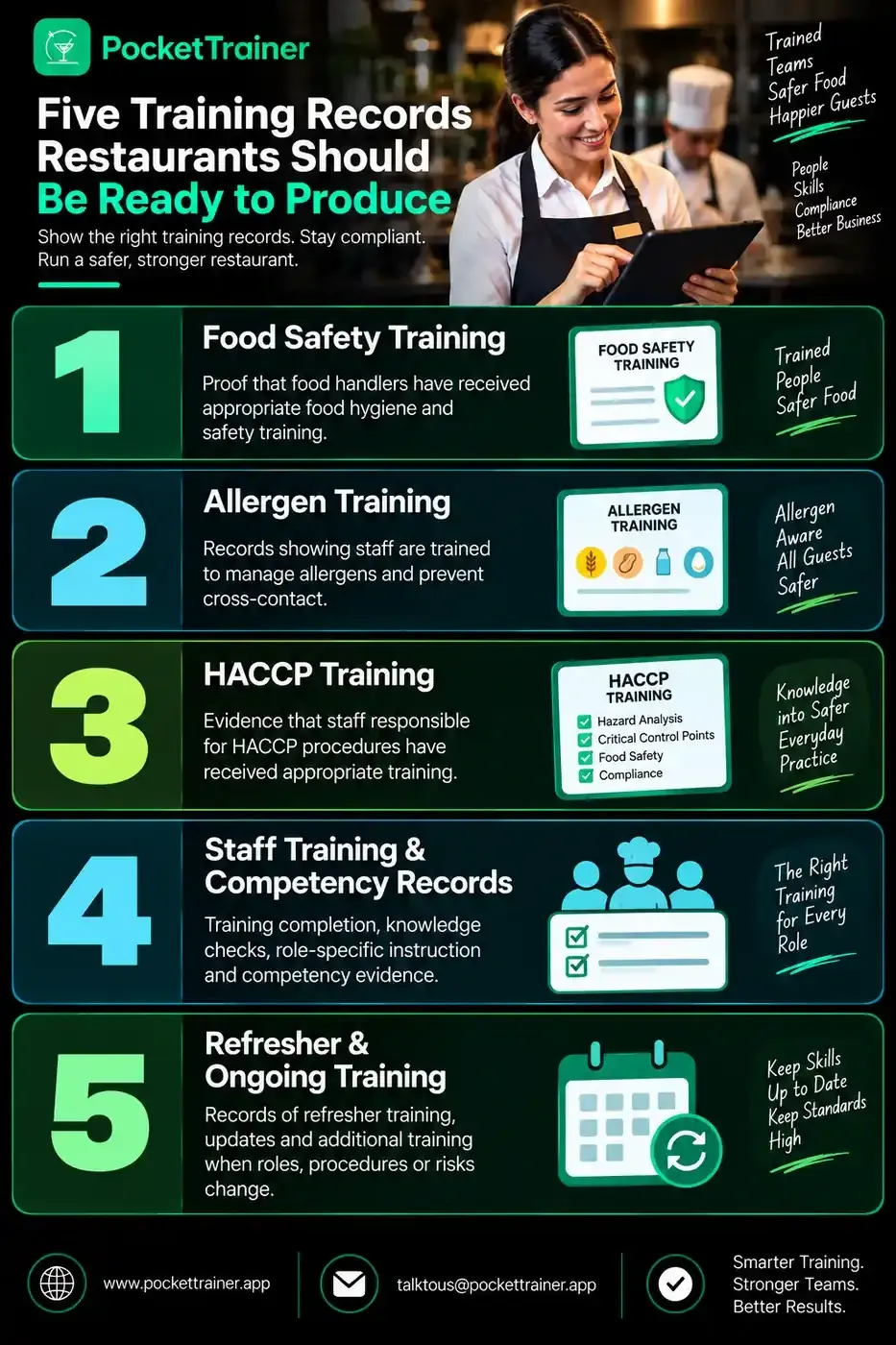
1. Who is working today and what are they trained to do?
This is where a training matrix becomes useful.
Managers should be able to connect the employees working on a particular shift with the training relevant to their roles.
For example:
| Employee | Role | Relevant training | Completed | Further action |
|---|---|---|---|---|
| Employee A | Chef | Food safety, allergens | Completed | None |
| Employee B | Kitchen assistant | Food hygiene, allergens | Completed | Refresher due |
| Employee C | Supervisor | Food safety, HACCP | Completed | None |
The exact training required will depend on the employee’s duties and the food safety risks in the business.
2. The food safety management system
Your food safety management procedures explain how your restaurant controls food safety risks.
Training records provide supporting evidence that employees have been instructed and trained to follow the procedures relevant to their work.
The Food Standards Agency states that people responsible for developing and maintaining HACCP-based food safety management procedures should receive adequate training in applying HACCP principles. (FSA guidance)
This is why the written system and staff training should not exist as two disconnected exercises.
3. Evidence that supervisors and managers are competent
The person responsible for food safety procedures needs training appropriate to their responsibilities.
That does not mean every restaurant must put every manager through exactly the same qualification.
The level and type of training should reflect the food operation, the procedures being used and the individual’s responsibilities.
4. Records for a specific named employee
A useful inspection test is to select an employee at random and ask:
When did this person start, what food safety training have they completed, and what training was relevant to their role?
Your records should allow the duty manager to answer without searching through multiple folders or contacting someone at head office.
5. Evidence of what happens when a training or safety gap is identified
Training records should not only show completed courses.
They can also help managers identify:
- Missing induction training
- Expired or overdue refresher training
- Employees who have changed roles
- New procedures requiring additional instruction
- Training gaps identified during supervision
- Follow-up actions after food safety incidents
A gap that has been identified and assigned for corrective action is easier to manage than a gap nobody knows exists.
What does a good restaurant training evidence pack contain?
A well-organised restaurant should be able to produce relevant evidence without relying on one person to remember where everything is stored.
Useful records can include:
Training records by site and role
Show:
- Employee name
- Role
- Course or training topic
- Completion date
- Training status
- Refresher or review date where applicable
Training gap list
Identify:
- Who has not completed required training
- What training is missing
- What action has been assigned
- Who is responsible for resolving the gap
New starter induction evidence
Record the training and instruction provided to new employees, particularly before they undertake food handling responsibilities.
Supervisory and HACCP training evidence
Keep evidence for those responsible for developing, maintaining or operating the relevant food safety management procedures.
Refresher schedule
Set review or refresher dates based on your training policy, role, risk and relevant guidance.
A three-year refresher cycle is common industry practice for many food safety qualifications, but it should not be presented as a universal legal expiry date. Local authority guidance commonly recommends refresher training at least every three years, while businesses may choose a more frequent schedule based on risk and their own requirements. (Horsham District Council, Oxford City Council)
Make your training records inspection-ready before you need them.
See how Pocket Trainer helps you organise staff training, completion records and compliance evidence in one place.
Book a 15-minute demoWhat do hospitality managers say about moving away from paper?
“I realised I made mistakes previously with my food bible, and now, when we use Pocket Trainer, we can put amazing facts and information all together.” - Renata Tresoldi, then general manager at CMP Bar & Grill in Dubai.
These comments are not evidence of UK legal requirements. They illustrate the operational problem that sits alongside the compliance question: information is more useful when the right person can find it when they need it.
“It’s easy, it’s smarter, it’s faster. And also what is very important is that we are not wasting paper.” - Claudio Brembilla, supervisor at Signor Sassi.
How does Pocket Trainer manage food training records?
Pocket Trainer provides training management tools that allow managers to manage training records and reporting across hospitality teams.
Its training management capabilities can support reporting by site and role, helping managers find relevant employee training information without relying on individual paper folders.
The hospitality course library includes UK-focused food safety, allergen, HACCP, health and safety and fire safety courses.
Pocket Trainer states that nine courses in its library are RoSPA Qualifications Course Assured, including Food Safety For Restaurants Level 2, Food Safety Level 3 UK, Food Allergen Awareness For Restaurants, HACCP For Managers UK, Health and Safety For Managers UK and Fire Warden UK. (Pocket Trainer course library)
RoSPA explains that Course Assurance involves independent review of course content, learning outcomes, delivery and related quality standards. It is assurance of the specific course, not a certification that a restaurant itself is legally compliant. (RoSPA Course Assurance)
That distinction matters.
A training platform does not make a restaurant compliant.
Compliance depends on the business having appropriate food safety procedures, competent staff, suitable supervision and training, and being able to demonstrate that those arrangements are working.
Bring your own compliance requirement and ask to see the completion record produced live, filtered by site and role.
Book a 15-minute demoHow can restaurants prepare for an environmental health inspection?
Use a simple evidence drill rather than waiting for the next inspection.
Step 1: Pick an employee
Choose someone currently working at the restaurant.
Step 2: Check their role
Identify the food handling responsibilities associated with that role.
Step 3: Retrieve their training history
Check the relevant food safety, allergen, and other role-specific training.
Step 4: Check the dates
Confirm when training was completed and whether any planned refresher or update is due.
Step 5: Check the food safety procedures
Make sure the employee’s training aligns with the procedures they are expected to follow.
Step 6: Record any gaps
If something is missing, assign corrective action and document what is being done.
This creates a much stronger operational habit than simply collecting certificates and hoping everything is up to date.
What should restaurants remember about training records?
The key issue is not the number of certificates you have.
It is whether your restaurant can demonstrate that the people doing the work have been appropriately trained and instructed for their roles.
A useful system should make it possible to answer:
- Who was trained?
- What were they trained on?
- When did they complete it?
- Is the training still appropriate?
- Can the person responsible on site access the record?
Those are practical questions worth testing before an environmental health officer(EHO) asks them.
Final thoughts
Food safety training records are evidence that your training system is operating in practice.
The legal requirement is not simply to collect certificates. Food businesses must ensure food handlers are appropriately supervised, instructed and/or trained for their work, and those responsible for HACCP-based procedures need appropriate training in applying HACCP principles.
The strongest approach is therefore straightforward: train people for their roles, keep accurate records, review gaps, keep procedures current and make the evidence accessible to the people managing the operation.
Bring your own compliance requirement and ask to see the completion record produced live, filtered by site and role.
Book a 15-minute demoFAQs
Does an environmental health officer(EHO) ask to see food hygiene certificates?
They may ask for evidence of training, but UK law does not require every food handler to hold a specific food hygiene certificate. Businesses must be able to show that staff have the appropriate skills and up-to-date training for their roles.
How long should restaurant training records be kept?
There is not one universal legal retention period for all restaurant training records. Businesses should establish a documented retention policy that supports their food safety management system, inspection needs and other applicable record-keeping obligations. Keeping leaver records can also be useful where historical training needs to be evidenced.
Is a three-year food safety certificate legally required?
No. A three-year period is commonly used as a refresher interval for food safety qualifications, but it should not be described as a universal legal expiry period. Refresher training should reflect the role, risk, changes to procedures and the business’s training policy.
What should a restaurant do if it finds a training gap?
Identify the gap, provide the appropriate instruction or training, record the action, and consider whether the employee should be supervised differently until they are competent to perform the relevant task.
Who needs HACCP training in a restaurant?
The people responsible for developing and maintaining HACCP-based food safety procedures, or operating relevant guides, need adequate training in applying HACCP principles. The level and content should reflect their responsibilities and the food operation.