
7 ways to reduce restaurant staff turnover (2026 guide for operators)
By Janos Laszlo
Quick Summary
- Restaurant turnover runs above 70% annually, with 2026 data putting it as high as 75–79%, and most operators know the problem without having a system that fixes it.
- The leading causes are wages, burnout, poor onboarding, lack of recognition, no visible growth path, and weak management, not any single factor alone.
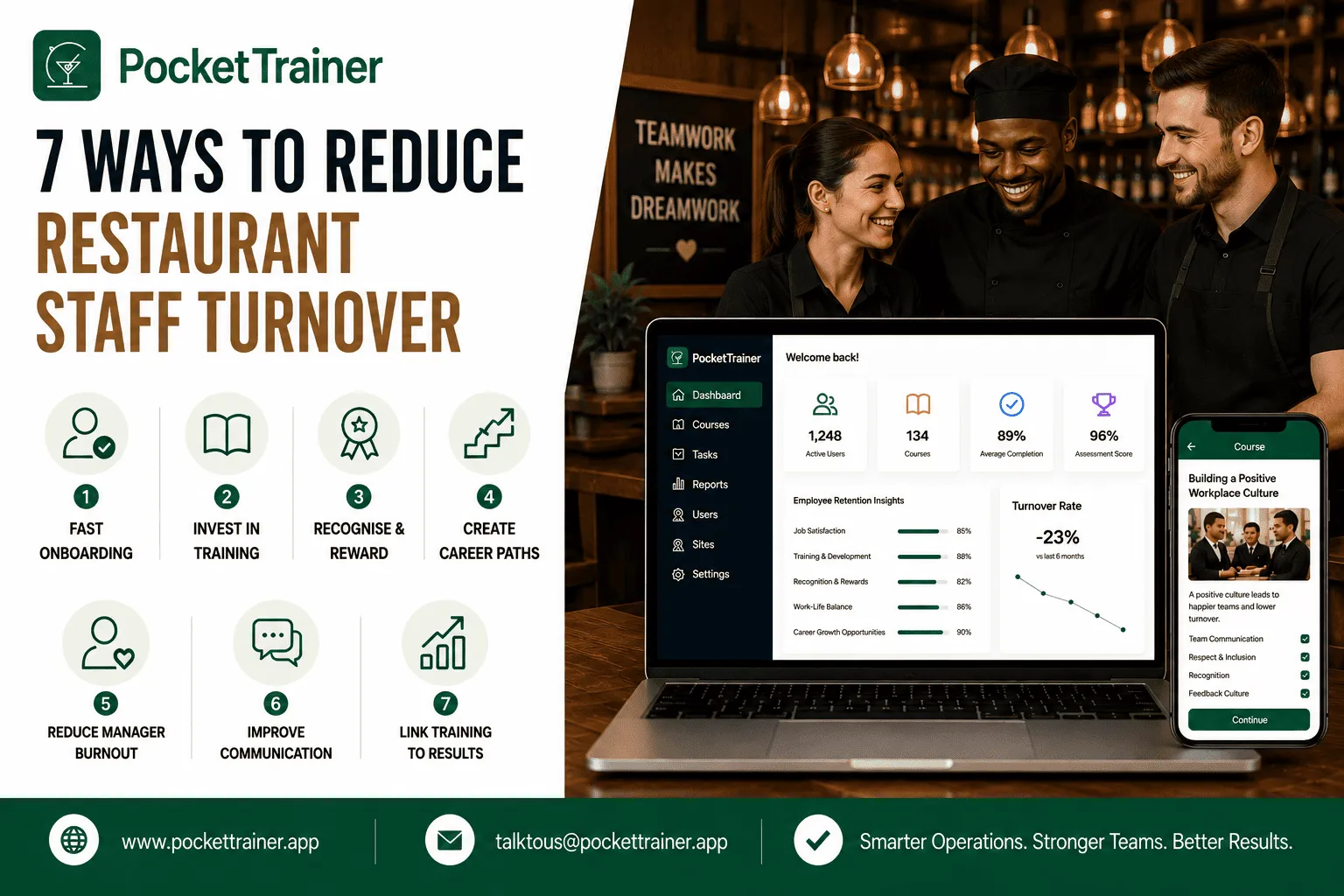
- Seven strategies address the causes directly: fast onboarding, real training investment, consistent recognition, clear growth paths, mobile training tools, workplace culture, and tying training to performance.
- Cornell’s Center for Hospitality Research puts the true cost of losing one employee at $5,864, once recruiting, training, and lost productivity are counted.
- None of this works as a one-off initiative. Retention is an operational system, not a culture campaign.
Restaurant turnover has run above 70% annually for several years, and multiple 2026 industry reports put it even higher, 75% according to Homebase’s 2025 data, with some sources citing 79.6% as the decade average. Most operators know the problem. Fewer have a system that actually fixes it. This post covers seven restaurant employee retention strategies that work in practice, not just in theory, with specific steps you can put in place this month.
What is the main cause of restaurant staff turnover?
Poor onboarding and lack of structured training are the leading causes of restaurant staff turnover. The scale of early departure is stark: the Harri Peach Report 2026 found only around 25% of new hospitality hires make it past their first 90 days, meaning roughly three in four leave within three months of starting, not because of pay. Operators who replace informal onboarding with structured, role-specific training consistently see retention improve within three months.
Pocket Trainer’s Retaining Employees, Mental Health For Restaurant Employees, and Conducting A Performance Appraisal courses give managers the tools to support and retain staff beyond the first 90 days.
That’s why this is a complete breakdown of 7 proven restaurant staff retention strategies designed to help you tackle burnout and build a culture that keeps great staff, regardless of your restaurant’s size.
Why are restaurant staff leaving in 2026?
Before improving retention, it’s worth understanding what’s actually pushing employees out. Here are the biggest reasons restaurant teams are quitting.
- Wages and financial pressure: 7shifts’ 2026 employee research found low pay is now tied with difficult managers as the leading cause of departure, with 73% of employees saying their relationship with their manager directly impacts job satisfaction.
- Burnout and heavy workloads: Excessive hours, unpredictable scheduling, and short staffing quickly lead to exhaustion.
- Poor onboarding experiences: Many new hires leave within their first 30–60 days because they feel unsupported or confused.
- Lack of recognition: 44% of restaurant employees say they quit due to a lack of appreciation.
- No visible growth path: Employees willing to stay in hospitality long-term often leave a specific job because they don’t see career progression where they are.
- Weak management and culture: Motivation is easily undermined by inconsistent leadership or unhealthy working conditions.
Once these problems set in, even well-resourced restaurants struggle to hold onto staff.
Restaurant staff retention strategies that actually work
The strongest restaurant employee retention plans for 2026 share seven traits: structured onboarding in the first week, continuous skills training, clear career progression, recognition and rewards, mobile training and communication tools, a strong workplace culture, and manager support systems.
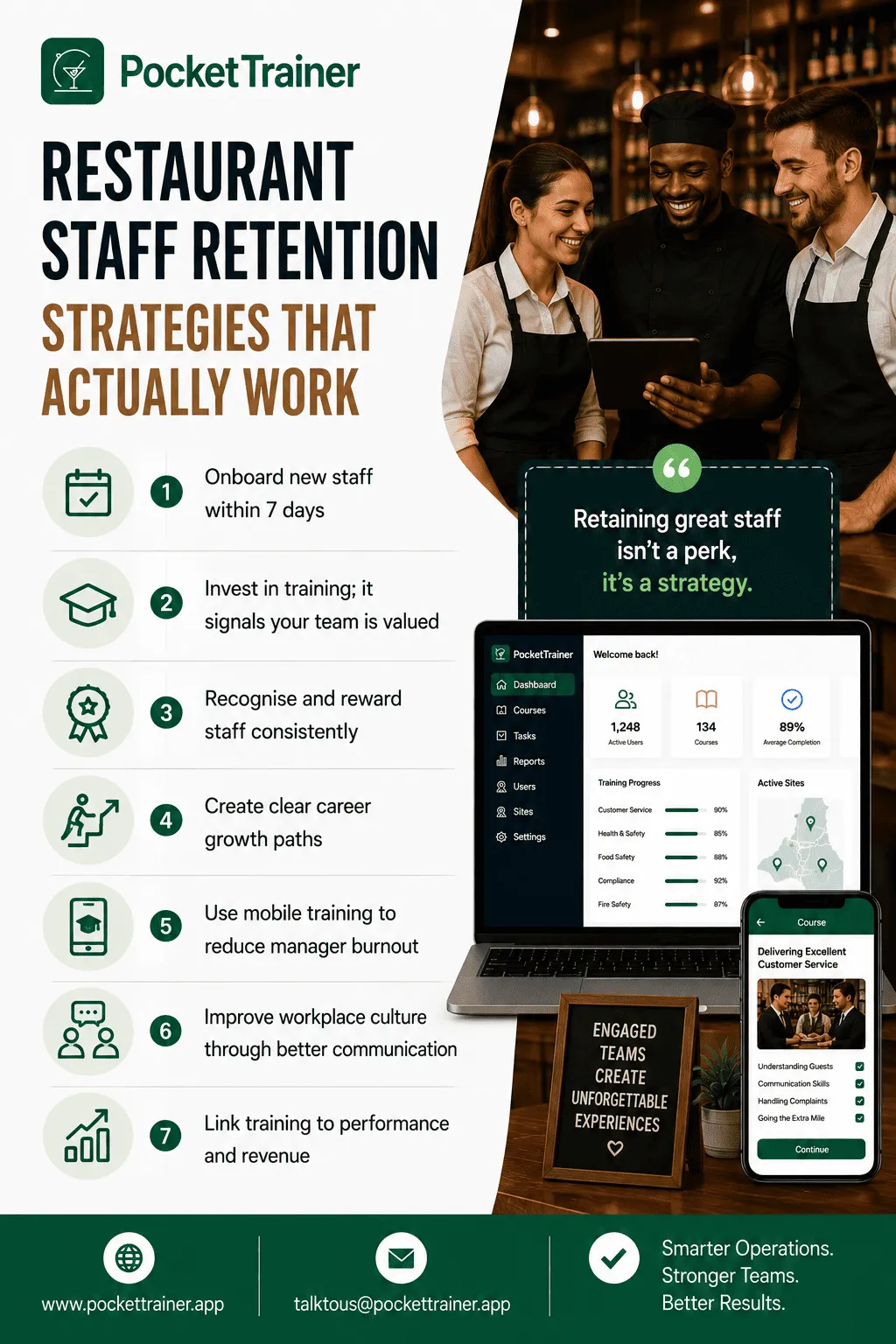
Restaurants that invest in growth and communication consistently record lower turnover and stronger performance.
1. Onboard new staff within 7 days
The first week is a make-or-break period for a new hire. When onboarding is rushed, employees feel lost, confidence drops, mistakes increase, and managers get frustrated. An organised, structured 7-day onboarding process makes employees feel confident and supported from day one.
What works best: mobile-access training guides, clear checklists for each role, menu and SOP libraries, and short quizzes to reinforce learning. Fast, structured onboarding builds confidence and reduces early resignation, especially when employees are allowed to learn at their own pace.
2. Invest in training; it signals your team is valued
Training does more than teach skills. It sends a message: you matter here. When restaurants invest in development, staff feel valued, engagement rises, performance improves, and retention increases.
According to Cornell’s Center for Hospitality Research, the true cost of turnover averages $5,864 per employee once recruiting, training, and lost productivity are counted, making retention-focused training one of the smartest investments a restaurant can make.
Certificates, skill progression, and structured learning create a sense of growth, even when wages are similar to competitors. This is why many operators now treat training as a competitive pay signal, not just an operational task, and are turning increasingly toward mobile-first online training for restaurant staff.
3. Recognise and reward staff consistently
Recognition has a direct impact on retention. As noted above, 44% of restaurant employees say they leave because they don’t feel appreciated.
Simple recognition systems can change that: public praise during shifts, digital certificates or badges, team shoutouts, and performance-based rewards. When employees feel seen and valued, loyalty increases.
Gamified recognition, earning certificates, and hitting skill milestones can make learning and performance more engaging, particularly for younger staff.
4. Create clear career growth paths
Many restaurant employees don’t want to leave the industry; they just want to see growth. Show them what’s possible: server to shift leader to supervisor, line cook to kitchen lead to sous chef, new hire to certified team member.
When employees can see a future, they invest more effort and stay longer. Structured learning programs make promotions fair, transparent, and achievable, and even certificates of completion for short courses give employees a sense of progress and purpose.
5. Use mobile training to reduce manager burnout
Managers often spend hours repeating the same training: explaining menus, teaching SOPs, correcting mistakes, answering basic questions. This drains time and energy that should go toward guests.
Mobile-first training lets staff learn on their phones, access SOPs instantly, complete quizzes, and stay updated across locations. Instead of managers repeating information daily, teams access structured training anytime.
Pocket Trainer combines courses, gamification, internal news feeds, and certificates in one place, helping teams stay aligned while freeing managers to focus on guests and operations. This directly complements the retention strategies above, making onboarding faster and keeping staff engaged through interactive learning and recognition features.
If you want to see how Pocket Trainer handles this across multi-site restaurant groups, book a 15-minute demo.
6. Improve workplace culture through better communication
Strong culture keeps employees longer than pay alone. Employees want fair scheduling, respectful leadership, clear communication, and real feedback opportunities.
Ways to improve culture: recognise achievements regularly, ask for staff feedback, share updates consistently, and lead with empathy. Pocket Trainer’s Feedback Skills For F&B Managers and Effective Team Building And Motivation courses give managers structured ways to build exactly this.
Internal communication feeds and recognition tools help create a sense of belonging, especially across multiple locations where teams rarely meet. When employees feel heard and included, retention improves naturally.
7. Link training to performance and revenue
Retention improves when employees understand their impact on business success. Better-trained staff upsell more effectively, make fewer mistakes, deliver faster service, and improve the guest experience.
Traditional restaurants average 2.5 to 3 table turns per service. Small improvements in speed and accuracy can meaningfully increase revenue over a service, a week, a year.
This connection between training and results is exactly what Pocket Trainer’s founder saw firsthand before the platform existed:

Playing loads the video from YouTube, which may set cookies.
When employees see how their skills drive sales and growth, and receive recognition or certificates for mastering those skills, they feel more motivated to stay and improve.
The real cost of high restaurant staff turnover
Turnover affects far more than hiring costs.
| Cost category | Figure |
|---|---|
| Direct replacement cost, hourly employee | $2,300+ |
| Training cost per new hire | ~$821 |
| Total turnover cost per employee (Cornell) | $5,864 |
| Table turns per service (industry average) | 2.5–3 |
Beyond the direct numbers: slower service, more mistakes, lower guest satisfaction, reduced table turnover, and manager burnout all compound the financial hit. Reducing turnover even slightly can save thousands annually and stabilise operations. Our guide on the real cost of untrained staff breaks this down further from the UK side specifically.
Bonus: the 30/30/30/10 rule
Many operators use a flexible budgeting guide known as the 30/30/30/10 rule: roughly 30% food costs, 30% labour costs, 30% overhead, and 10% profit. It isn’t a strict formula, more a starting point.
When restaurants invest wisely in labour, particularly in training, engagement, and retention, they often reduce hiring costs and improve productivity, which supports stronger margins over time.
How Pocket Trainer helps retain staff longer
Today’s successful restaurants treat training as culture, not compliance. Pocket Trainer makes it easier by gamifying learning with quizzes, news feeds, and certificates.
Structured online training for restaurant staff helps reduce onboarding stress, improve confidence, build consistent standards, create growth opportunities, and strengthen team communication. When staff feels invested in, they’re more likely to stay, and that stability leads to better service, stronger teams, and higher profitability.
The takeaway
Retention is not a culture initiative. It is an operational system. Operators who build structured onboarding, consistent training, and clear progression paths into their day-to-day running keep staff longer, spend less on hiring, and deliver better service.
If you want to see how Pocket Trainer supports that, book a 15-minute demo. By 2026 and beyond, the restaurant owners who prioritise these strategies are building teams that last longer and perform better.
Frequently asked questions
1 What is the main cause of restaurant staff turnover in 2026?
Poor onboarding and lack of structured training are the leading causes, closely tied to wages and lack of recognition. Most new hires who leave early do so because they felt unsupported in their first few weeks, not primarily because of pay.
2 How much does restaurant staff turnover actually cost?
Cornell’s Center for Hospitality Research puts the average total cost at $5,864 per employee once recruiting, training, and lost productivity are counted, with direct replacement costs for an hourly employee starting around $2,300.
3 Does mobile training actually reduce restaurant staff turnover?
Mobile training supports retention indirectly by reducing manager burnout (less time repeating the same information) and giving new hires faster, more confident onboarding, both of which are directly linked to why staff leave early. It works alongside recognition, culture, and growth paths rather than as a standalone fix.
4 What is the 30/30/30/10 rule for restaurants?
It’s a flexible budgeting guide allocating roughly 30% of revenue to food costs, 30% to labour, 30% to overhead, and 10% to profit. It’s a starting point rather than a strict formula, and operators who invest wisely in labour, including training and retention, often see it support stronger margins over time.
5 How quickly can better onboarding improve retention?
Operators who replace informal onboarding with structured, role-specific training consistently see retention improve within roughly three months, since the first 90 days are when most preventable early departures happen.