
Your Briefing is Too Full of Admin to Train Anyone
By Janos Laszlo
- shift briefing
- pre-service briefing
- staff communication
- menu training
- hospitality training
Quick summary
- The five minutes before service is the only moment the whole team is together, attentive, and not yet busy, which makes it the most valuable and most wasted training slot most venues have.
- Four categories don’t belong in a spoken briefing at all: run-outs, substitutions, section allocations, and housekeeping. All four can be read before the team walks in.
- What the briefing should keep is what only a person can deliver: one dish in depth, the tone for service, and a word with the newest team member.
- Allergen changes are the exception: say it and write it down, never one without the other, per the FSA’s own March 2025 best practice guidance.
- The test for whether a briefing landed isn’t “is everyone clear,” it’s asking one person one specific question that requires using the knowledge, not repeating it.
Everyone has stood in this briefing
Six minutes before doors. The team is half-changed, someone is still folding napkins, and the manager runs through four specials, two eighty-sixed items, a wine that has been substituted, an allergen change on the risotto, a birthday on table twelve, section allocations, and a reminder about the new aperitif.
Everybody nods. Doors open. Ninety minutes later, a server describes the special confidently and gets one of the three components wrong.
The usual diagnosis is that people were not listening. The more useful one is that the briefing was asked to carry eight things, six of which were noticeboard items, and the two that actually needed a person standing in front of a team got about forty seconds between them.
The five minutes are the best training slot you have
It is worth being clear about how rare that moment is, because most operators undervalue it.
It is the only point in the day when the entire team is in one place, facing the same direction, before the pressure starts. Nobody is mid-table. The kitchen is not yet calling. Attention is as high as it will be for the next eight hours. If you were designing a training slot from scratch, you would build exactly that, and you would protect it.
So the answer is not to take training out of the briefing. Training is the thing the briefing is uniquely good at, because it is the one job that genuinely needs a person, a room and a shared moment. Tasting a sauce together cannot be done by a document. Explaining why the chef built the dish that way lands differently from a person than from a screen. Reading out that the sea bass is off does not need any of that.
The problem is not the briefing. It is what has been allowed to crowd into it.
What should a pre-service briefing actually cover?
It should cover the things that need a person: one dish or drink in real depth, the reason behind it, and the line a server can use at the table, plus the tone you want for the service and a word with whoever is newest or least confident.
Everything that is purely informational- what has run out, substitutions, section allocations, and covers on the book- should be readable somewhere before the team walks in. The test is simple: if it could have been read, it should have been read, and the briefing should be spent on what could not.
Before Service: Move Admin Out, Keep Training In
Before — The briefing carries everything
Read out run-outs and 86s.
- Explain substitutions.
- Read section allocations and covers.
- Cover housekeeping and admin.
- Try to teach a dish or drink.
- Ask if everyone is clear.
- Start service.
After — The briefing carries what needs a person
Before the team arrives
→ Manager posts run-outs and substitutions
→ Team checks updates on their phone
→ Section allocations and other admin are available to read
During the briefing
→ 30 sec: What is the dish or drink?
→ 20 sec: Why is it built this way?
→ 15 sec: What should the server say to the guest?
→ 15 sec: What important detail must they check?
→ 10 sec: Ask one person one practical question
Total: 90 seconds of actual training
After the briefing
→ Team starts service
→ Staff can check the current written information when needed
→ Manager knows whether the training landed
What to move out, and where it goes
| Category | Why it doesn’t need a briefing | Where it goes instead |
|---|---|---|
| Run-outs and eighty-sixes | Changes until the last minute | Posted to the news feed as confirmed |
| Substitutions | A change to the product record, not an announcement | Updated in the dish/drink entry directly |
| Section allocations and covers | Read repeatedly during service regardless | Pinned, checked as needed |
| Housekeeping (rotas, holidays, admin) | None of it needs the team’s full attention | Read whenever convenient |
Four categories leave, and none of them needs a meeting.
Run-outs and eighty-sixes. These change until the last minute, which is exactly why they suit a written note that can be updated at 17:50 rather than a spoken list at 17:54.
Substitutions. A vermouth change or a supplier swap is a change to the product record, not an announcement. Update the entry, and anyone who checks it mid-service sees the current version rather than remembering what was said.
Section allocations and covers. Pin them. Nobody has ever retained a section list better for having heard it than for having read it, and people will check it three times during service regardless.
Housekeeping. Rotas, holiday requests, the reminder about the staff entrance. All of it can be read, and none of it deserves a minute of the only moment the whole team is together.
What this looks like in practice: the news feed
Where it goes is a practical question, and the pattern we see most often among teams using Pocket Trainer is worth describing properly, because it is what people actually do rather than what a process document says they should.
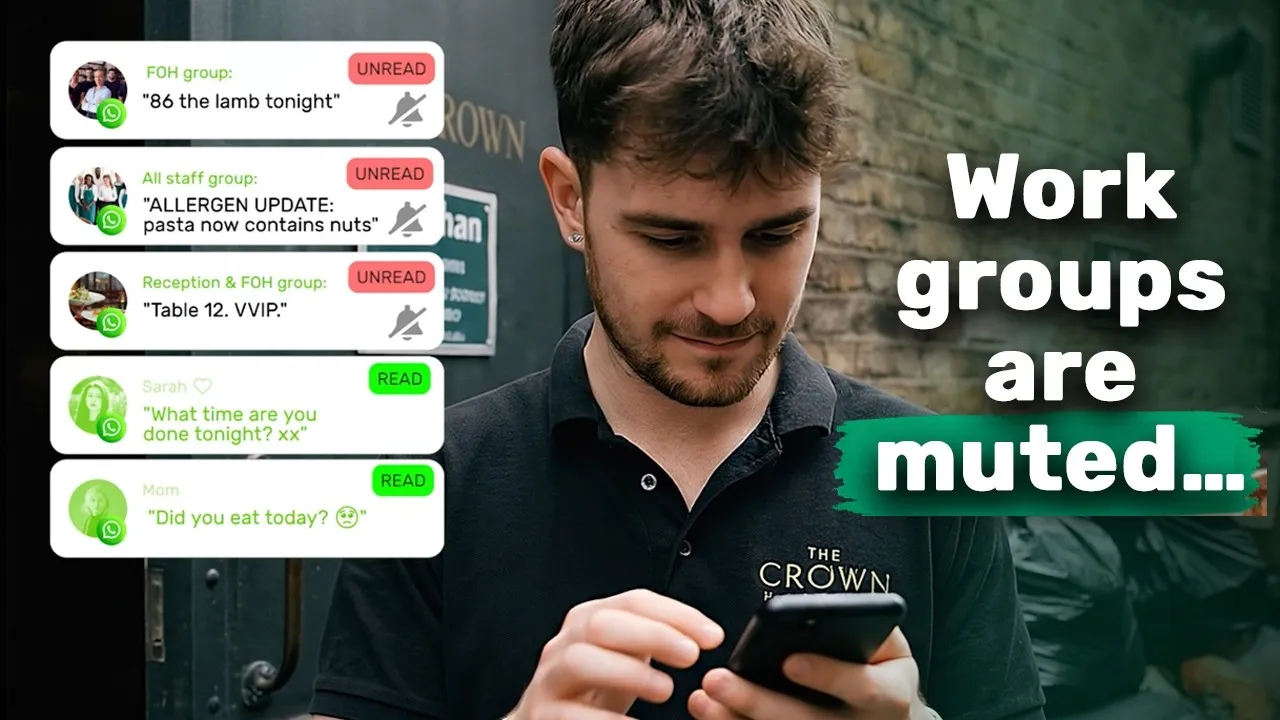
The duty manager posts the run-outs and substitutions to the news feed as they are confirmed, across the afternoon, rather than saving them up for one announcement before doors. A delivery is short; that goes up at three. The kitchen decides the lamb is off at half four; that goes up then. By the time the team arrives, it is all there.
Playing loads the video from YouTube, which may set cookies.
Three things follow from that, and none of them is available from a spoken list.
Everyone reads it before they walk in, on the phone they are already holding. Anyone starting late reads it instead of asking someone mid-service, which is the interruption that costs two people time rather than one. And it is still there at nine in the evening, when a server cannot remember whether it was the hake or the halibut that went, so they check rather than guess or walk to the pass to ask.
A board by the pass does the first of those and none of the rest. It also stops being read after about ten minutes, because it does not follow anyone onto the floor.
The other reason the feed works is that it sits alongside the dish and drink records, so a substitution and the product entry it affects are in the same place rather than in two systems that need reconciling. That’s the same digital food bible structure holding both records together.
What a ninety-second training briefing sounds like
Here is the whole thing, on one dish. It is shorter than most people expect.
What it is: the roast cauliflower, tahini, pomegranate. Thirty seconds, and the team tastes it if there is any to taste.
Why it is like that: the tahini is doing the job cream would normally do, so the dish eats rich without dairy and the vegan table gets something substantial rather than an afterthought. The pomegranate is there to cut it. Twenty seconds. This is the part that never survives a written note and is the reason the moment exists.
The line to use: if a guest is looking for something filling without meat, this is the one, and it is better with the orange wine than with anything from the white list. Fifteen seconds, and it is the sentence that turns knowledge into an order.
The one thing to check: tahini is sesame, which is one of the fourteen allergens and is invisible from the menu description. That’s exactly the kind of detail Pocket Trainer’s Food Allergen Awareness For Restaurants UK course trains staff to catch. Fifteen seconds, and it is the item that matters most.
Then one question to one person. Not is everyone happy. Ask the newest server what they would say to a guest who wants something substantial and meat-free, and listen to the answer. Ten seconds, and it tells you more about whether the briefing landed than any amount of nodding.
That is ninety seconds on one dish, and a team will remember it for weeks. Compare it with ninety seconds spent reading out four run-outs, which nobody will remember for ninety minutes. There is a short course on running these well if you want the full structure rather than one worked example.
Want to see how Pocket Trainer can move run-outs, substitutions and operational updates out of the briefing while keeping the training moment focused on the team? See how it could work for your operation
Book a 15-minute demoThe allergen change is the one that must be written down
One item deserves separating from the rest, and it does not fit neatly into either pile.
Say it in the briefing, because attention matters and sesame in a dish that does not sound like it contains sesame is exactly the kind of thing a team should hear from a person. But the spoken version cannot be the authoritative one.
The Food Standards Agency’s best practice guidance for the out-of-home sector, updated in March 2025, recommends that allergen information should be “easily available in writing and be underpinned with a conversation”. That is a good description of what a well-run briefing already does, provided the written half genuinely exists. Said out loud at 17:54 and written down nowhere is the conversation without the writing, which is the half the guidance is least comfortable with.
So the allergen change goes in the product record where a server can check it at the table, and gets mentioned in the briefing so people know to look. Both, not either.
How do you know whether the briefing landed?
Ask one specific person one specific question, and make it a question that requires them to use the knowledge rather than repeat it. Asking what is in the cauliflower dish tests memory. Asking what they would say to a guest who wants something substantial without meat tests whether they can actually use it on the floor. A room asked whether everyone is clear will always say yes, because agreeing is faster than admitting you missed something in front of your colleagues. Ten seconds and one name gives you an honest signal that five minutes of nodding will not.
The trade-off worth being honest about
Moving the admin out only works if the place you move it to is genuinely current and genuinely read.
A board nobody looks at is worse than a spoken list, and a product record three weeks out of date is worse again, because people trust it and are then wrong with confidence. The discipline shifts rather than disappears: instead of remembering to say it, someone has to own updating it, and that ownership needs a name and a time attached rather than being assumed.
The venues that make this work are the ones that decided explicitly who posts the run-outs and by when. The ones that struggle are the ones that assumed it would look after itself, then quietly drifted back to reading the list out because at least that way it definitely happened.
The takeaway
The five minutes before service is the best training moment you get, and most venues spend it as a noticeboard. Move the run-outs, substitutions, sections and housekeeping somewhere they can be read before the team walks in. Keep the dish, the why, the line to use and the word with the newest person. Write the allergen change down as well as saying it. Then ask one person one real question and listen to the answer.
You do not need longer briefings. You need the same five minutes carrying the two things that actually need a room.
If your briefing is carrying more than it can hold, that is worth a short conversation.
Book a 15-minute demoFAQs
1. How long should a pre-service briefing be?
Around five minutes is right, and the number matters less than the contents. A briefing running long is usually carrying noticeboard items rather than teaching too much. Fix what is in it and the length settles itself.
2. What should always be included in a pre-service briefing?
One dish or drink in depth with the reason behind it and the line a server can use, the tone you want for service, and a word with whoever is newest. Run-outs, substitutions, section allocations and housekeeping should be readable before the team walks in, so the briefing is not spent reading them aloud.
3. Where should run-outs and substitutions go instead?
Somewhere the team reads before they walk in and can still check mid-service. In practice that means the phone rather than a board, because a board stops being read once service starts. Post them as they are confirmed across the afternoon rather than saving them for one announcement, so the information is current when people arrive.
4. Is it enough to announce an allergen change verbally?
Say it, but do not rely on it. The FSA’s best practice guidance for the out-of-home sector recommends allergen information be “easily available in writing and be underpinned with a conversation”. The briefing is the conversation. The written record in the product entry is the part a server can check at the table, and it needs to exist as well.