
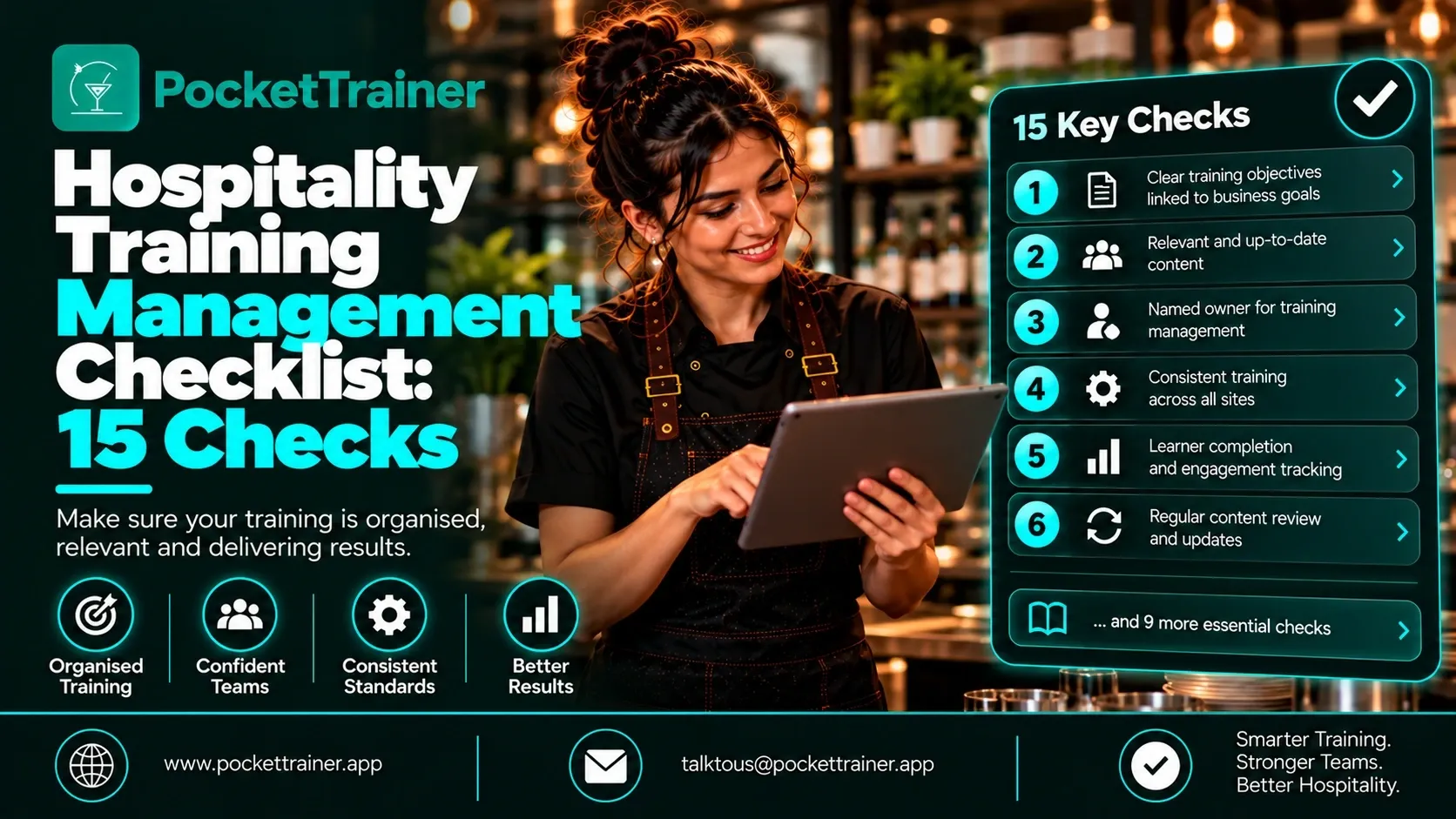
Hospitality Training Management Checklist: 15 Checks
By Janos Laszlo
Quick Summary
- Check ownership and decision-making before adding more training content.
- Make learning relevant to each role and reinforce it through practical observation where needed.
- Keep approved source documents current and control outdated versions.
- Protect employee records and define access and retention rules.
- Turn training reports into actions with named owners and deadlines.
- Repeat the health check after significant operational changes and at an agreed regular interval.
A hospitality training programme can look busy without being well controlled. Courses are assigned, documents are uploaded and managers chase completion, yet nobody can say which source is current, what happens after a failed knowledge check or when each topic should be reviewed.
This 15-point health check gives restaurant, bar, cafe and hotel groups a practical way to assess the training programme they already have. It focuses on ownership, content, delivery, reporting and follow-up, helping teams identify what works, what needs attention and who should act next.
It is an operational review tool, not a substitute for legal, food-safety, employment or data-protection advice.
How to Use This Hospitality Training Checklist
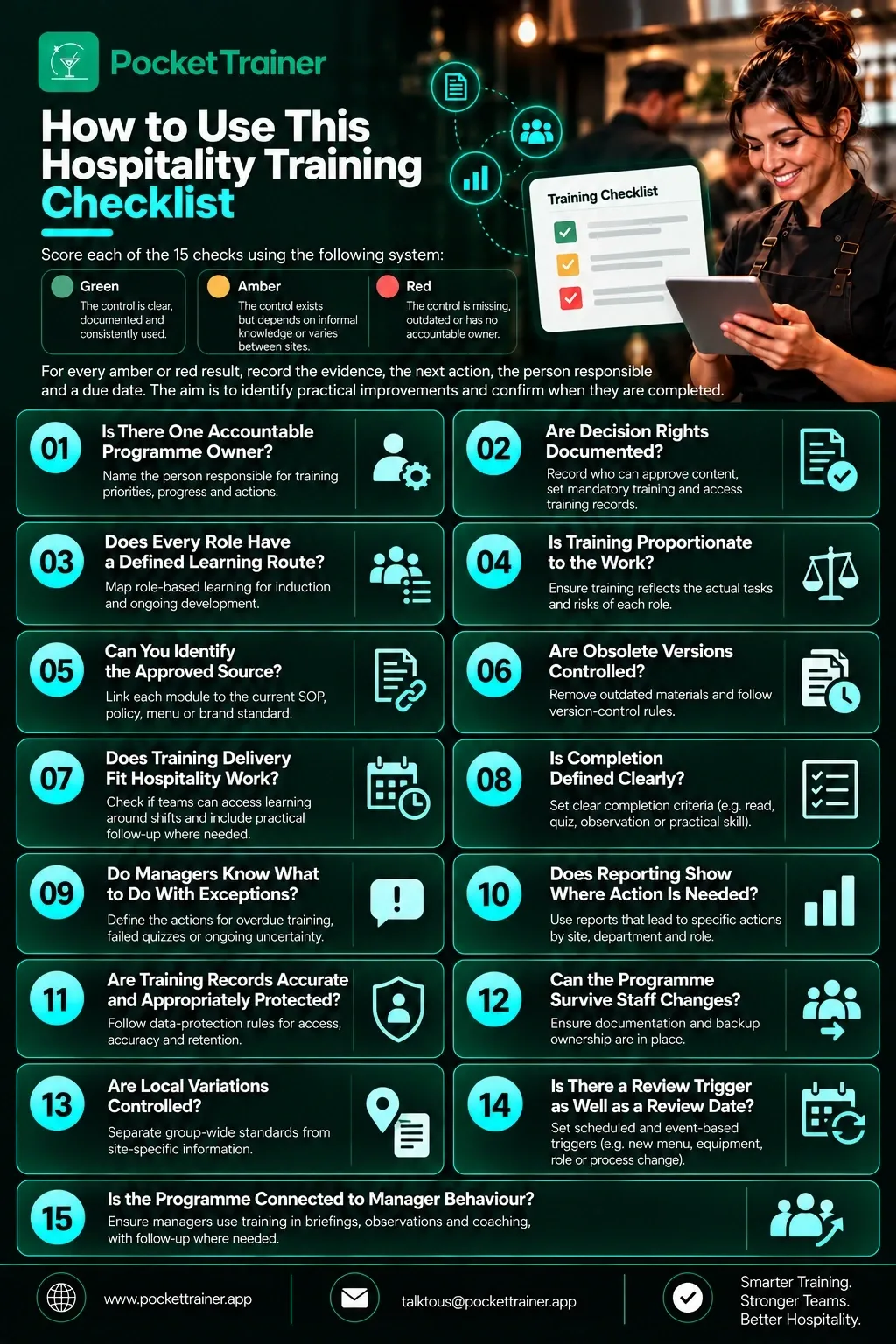
Score each of the 15 checks using the following system:
- Green: The control is clear, documented and consistently used.
- Amber: The control exists but depends on informal knowledge or varies between sites.
- Red: The control is missing, outdated or has no accountable owner.
For every amber or red result, record the evidence, the next action, the person responsible and a due date. The aim is not simply to produce a score. It is to identify practical improvements and confirm when they have been completed.
If you want to verify how Pocket Trainer tracks compliance training, bring your own compliance requirements and ask to see a live completion record filtered by site and role:
Book a 15-minute demo1. Is There One Accountable Programme Owner?
Name the person responsible for coordinating training priorities, reviewing progress and closing outstanding actions.
Other people may own content, systems or local delivery, but the overall programme needs a visible point of accountability. Without one, important tasks can fall between operations, HR, site managers and training teams.
Evidence to check: A named owner, documented responsibilities and a clear route for escalating unresolved issues.
2. Are Decision Rights Documented?
Record who can approve operational content, designate an item as mandatory, change a deadline and access individual training records.
A vague owner without authority cannot resolve conflicts between sites or departments. Clear decision rights help teams distinguish group-wide standards from local decisions and prevent unauthorised changes.
Evidence to check: An approval process, named content owners and documented access permissions.
3. Does Every Role Have a Defined Learning Route?
Map what each role needs before its first shift, during induction and as responsibilities develop.
Avoid assigning a generic training library to everyone. A kitchen team member, bartender, supervisor and general manager have different responsibilities and may need different combinations of knowledge, practical training and follow-up.
The Health and Safety Executive highlights new recruits, people changing jobs and those taking on additional responsibilities as groups with particular training needs.
Evidence to check: Role-based learning pathways, induction requirements and a process for reviewing training when responsibilities change.
4. Is Training Proportionate to the Work?
Training should reflect the work employees actually perform and the risks associated with their responsibilities.
For food safety, the Food Standards Agency explains that food handlers need supervision and training appropriate to the area in which they work. A certificate is not automatically required for every food handler. Appropriate skills may be developed through on-the-job training, self-study or previous experience.
Check current guidance and the needs of the role rather than applying one course requirement to every employee.
Official references:
- HSE guidance on health and safety training
- FSA guidance on staff training
Evidence to check: Role-appropriate training, relevant supervision and a clear way to identify additional learning needs.
5. Can You Identify the Approved Source?
For every operational training module, identify the current SOP, policy, menu file or brand standard on which it is based.
Record the source owner and review date. Training should translate the approved source into usable learning rather than becoming a competing version of the procedure.
For example, when a menu changes, the relevant training content should be reviewed against the approved menu and recipe information.
A structured restaurant SOP training approach can help connect operational procedures with accessible learning materials.
Evidence to check: An approved source document, named owner, version and review date for each critical item.
6. Are Obsolete Versions Controlled?
Search shared drives, site folders, messaging groups and the LMS for duplicate or outdated materials.
Remove access to obsolete content according to the organisation’s document-management rules, while retaining records where there is a justified legal or operational reason to do so.
This is especially important for multi-site groups, where an old procedure in one location can undermine a newer group-wide standard.
Evidence to check: Version-control rules, archived documents and a clear process for replacing outdated training.
7. Does Training Delivery Fit Hospitality Work?
Check whether teams can access learning around their shifts and whether managers have enough time for observation or practice where required.
A hospitality LMS can support accessible learning, consistency and completion tracking. However, some tasks require supervised demonstration or practical assessment in the workplace.
The delivery method should fit the task, the learner and the realities of the operation.
Evidence to check: Accessible learning, role-appropriate delivery methods and practical follow-up where needed.
8. Is Completion Defined Clearly?
Decide what completion means for each training item.
Depending on the task, it might mean reading an approved document, passing a knowledge check, completing manager observation, demonstrating a practical skill or meeting a combination of requirements.
Do not use one measure simply because it is easy to report. A completed quiz and a demonstrated practical skill are different types of evidence.
Evidence to check: A documented completion standard for each type of training and a consistent way to record the outcome.
9. Do Managers Know What to Do With Exceptions?
Document what should happen when an item is overdue, a learner fails a quiz, an employee repeatedly expresses uncertainty or someone needs an adjustment.
The appropriate response may be a reminder, coaching, reassignment, supervised practice or escalation to an authorised leader.
Make sure managers understand which actions they can take themselves and which require further approval. Employment decisions should remain with authorised leaders.
Evidence to check: An exception-handling process, named action owners and records showing that issues are followed up.
What Is the Most Important Part of a Hospitality Training Management Checklist?
The most important control is clear ownership linked to a next action.
A checklist can expose missing content, overdue training and unclear responsibilities, but it improves the programme only when someone has the authority and time to respond.
Every amber or red result should therefore have an owner, a due date and evidence of closure. Without that follow-through, the health check risks becoming another document that is completed and forgotten.
10. Does Reporting Show Where Action Is Needed?
Review training information by site, department and role where that level of detail serves a genuine operational purpose.
Pair every report with an action list. If leaders receive percentages without context, simplify the report until it answers practical questions: which team needs support, which item requires attention and who will follow up?
“If you’re just walking around in the dark and you don’t even know what you’re supposed to be measuring, how are you managing anything? You’re not managing anything. You’re just showing up every single day, hoping for the best.-Szilvia Olah”
Her point reinforces why every metric in a training health check should support a management decision.
Watch: Pocket Talk Episode 5: Training Restaurants Through a Downturn
The discussion supports the article’s focus on learning KPIs and accountability. For a broader measurement framework, read Real-World KPIs You Can Track to Prove Training ROI.
Evidence to check: Reports that lead to assigned actions, follow-up dates and documented outcomes.
11. Are Training Records Accurate and Appropriately Protected?
Training records can contain personal information about employees. Confirm the purpose and lawful basis for collecting it, restrict access appropriately, maintain accuracy and define justified retention periods.
Data-protection law does not set one universal retention period for all employee training records. The organisation needs to justify its retention schedule and consider other applicable legal and operational requirements.
Review the ICO’s guidance on collecting and keeping employment records before making policy decisions, and check for updates to the guidance.
Evidence to check: Access permissions, documented retention rules, a correction process and a clear reason for collecting each category of personal information.
12. Can the Programme Survive Staff Changes?
Test whether another authorised person can find the training calendar, approved source documents, open actions and reporting process.
A programme that depends on one individual’s memory has a continuity risk, even if current completion rates look strong.
Document routine tasks and make sure responsibilities can be transferred when an administrator, manager or training lead leaves.
Evidence to check: Accessible operating documentation, backup ownership and a process for transferring responsibilities.
13. Are Local Variations Controlled?
Separate group-wide standards from site-specific information.
Give local managers a clear route to request changes, and record who approved them. This allows a venue to address legitimate local needs without creating multiple uncontrolled versions of the same procedure.
For example, a group may require consistent core service standards while allowing local information to reflect a venue’s layout or operating arrangements.
Evidence to check: Documented central standards, a process for local requests and a record of approved variations.
14. Is There a Review Trigger as Well as a Review Date?
Scheduled reviews matter, but operational changes should also trigger a review.
Examples include:
- A new menu or recipe.
- New equipment or an updated procedure.
- A new site or job role.
- A change in operational responsibilities.
- A newly identified risk or recurring performance issue.
Record which training items depend on each source so that relevant changes are not missed.
Evidence to check: Review dates, event-based review triggers and a process for updating related learning when an approved source changes.
15. Is the Programme Connected to Manager Behaviour?
Ask managers how they use training in briefings, observations and coaching.
If learning stops at the completion screen, consider whether the programme needs a stronger workplace follow-up step. Depending on the role, that might mean observing a task, discussing a scenario, checking understanding during a briefing or providing supervised practice.
The goal is to connect learning with the work employees actually do.
Evidence to check: Manager follow-up, practical observations where appropriate and actions taken when gaps are identified.
If the health check reveals an ownership or follow-up gap, Pocket Trainer can help you review the operating model.
If you want to verify how Pocket Trainer tracks compliance training, bring your own compliance requirements and ask to see a live completion record filtered by site and role:
Book a 15-minute demoHow Often Should a Hospitality Training Programme Be Reviewed?
Set a regular review cadence that matches the pace and complexity of the operation, then add event-based reviews after material changes.
High-change periods, such as new openings or major menu launches, may require more frequent checks. The review schedule should be documented, assigned to an owner and linked to decisions rather than chosen only for reporting convenience.
A useful review should establish what has changed, what remains unresolved and whether the programme still reflects current operational needs.
The 15-Point Action Record
For every checklist item, record:
| Field | What to document |
|---|---|
| Status | Green, amber or red |
| Evidence | What demonstrates that the control works |
| Action | What needs to change |
| Owner | Who is accountable for the next step |
| Due date | When the action should be completed |
| Review trigger | When the control should be checked again |
Start with red controls affecting safety, role readiness, personal-data handling or the ability to identify the approved standard. Then address amber controls that create inconsistency or unnecessary manager effort.
Do not turn the health check into another static document. Review the actions with the people responsible for delivering them, and close each item only when there is evidence that the control works.
Where internal capacity is the main issue, consider a defined external project or managed support. Where ownership is clear, keep responsibility in-house and use suppliers only for the specialist help required.
A Healthier Programme Is Easier to Explain
After the review, a manager should be able to answer five questions:
- What does this role need?
- Which source is current?
- What has been completed?
- What needs follow-up?
- Who owns the next action?
If those answers are clear across every site, the programme is becoming manageable rather than merely active.
Repeat the health check with a small group of site managers instead of completing it only at head office. Their answers can reveal whether the documented process matches the reality of training during shifts.
Where several sites show the same amber result, treat it as a group-level control issue before asking each manager to solve it separately. This helps the central owner address the shared source, rule or reporting process while site teams focus on delivery.
Use Why You Should Reevaluate Your Staff Training System Every Year as a supporting guide for the annual review.
Pocket Trainer’s Training Management service may be relevant where the assessment reveals a genuine ownership or capacity gap. If the internal team can close the actions, keep responsibility with that team.
Keep the completed assessment with the programme’s action log and record the next review date. The objective is not a perfect score on day one. It is to make risks, ownership and improvement work visible enough that the next review can demonstrate progress.
Final Thoughts
A strong hospitality training programme is not defined by how many courses are available or how many employees have completed them. It is defined by whether learning is relevant, approved, accessible, followed up and connected to operational decisions.
Use these 15 checks to make gaps visible, assign ownership and confirm improvements with evidence. Repeat the review as the operation changes, and keep the focus on making training work consistently across every site.
Written by Janos Laszlo, founder and CEO of Pocket Trainer, drawing on 20+ years spent running and developing F&B teams across the UK, Europe and the GCC.
Frequently Asked Questions
Who should complete a hospitality training management checklist?
The programme owner should complete it with input from operations, people or HR leads and a small group of site managers. This combines the central process with the reality of training delivery during service.
Is this checklist a substitute for legal or food-safety advice?
No. It is an operational health check. It can help identify missing ownership, unclear records or outdated material, but legal, food-safety and data-protection requirements should be checked against current official guidance and qualified advice where needed.
What evidence should support each checklist answer?
Use practical evidence such as an approved source document, a named content owner, a current training pathway, a reporting action list or a recorded review date. Evidence should show that the control works, not simply that a document exists.
What should happen when a checklist item is marked red?
Assign an accountable owner, define the corrective action and set a due date. Prioritise issues that affect safety, role readiness, personal-data handling or access to approved standards, then verify that the corrective action has worked.
How often should the checklist be repeated?
Set a regular review interval appropriate to the operation and repeat relevant checks after material changes, such as a new menu, opening, procedure or role. The schedule should have a named owner and lead to documented actions.