
Hotel Staff Training Platform for Hotel Teams
By Janos Laszlo
- hotel training
- mobile learning
- hotel LMS
- hospitality training
- hotel operations
- staff training
Quick Summary
- Hotel staff work across the building, not at desks, so any hotel training software that isn’t mobile-first doesn’t reach most of the team.
- Hotels train more people, across more departments, to more standards than a restaurant does, and cross-training multiplies the complexity further.
- Generic LMS platforms fail hotels because they assume a desk, a simple org structure, and generic content, none of which match how a hotel actually runs.
- The features hotel teams use daily are mobile access, role and department-based content, compliance tracking, and checklists alongside training in one app.
- UK hotel compliance spans food safety, health and safety, fire, licensing, GDPR, and now a new duty under Martyn’s Law that many properties will fall under.
Hotel staff do not work at desks. Housekeepers are on the floors, maintenance is on call across the building, lifeguards are at the pool, front desk is with guests. If your training only exists on a computer in the back office, it does not exist for most of your team. That is the starting point for any serious conversation about a hotel staff training platform: it has to be mobile, or it does not happen.
What is a hotel staff training platform for?
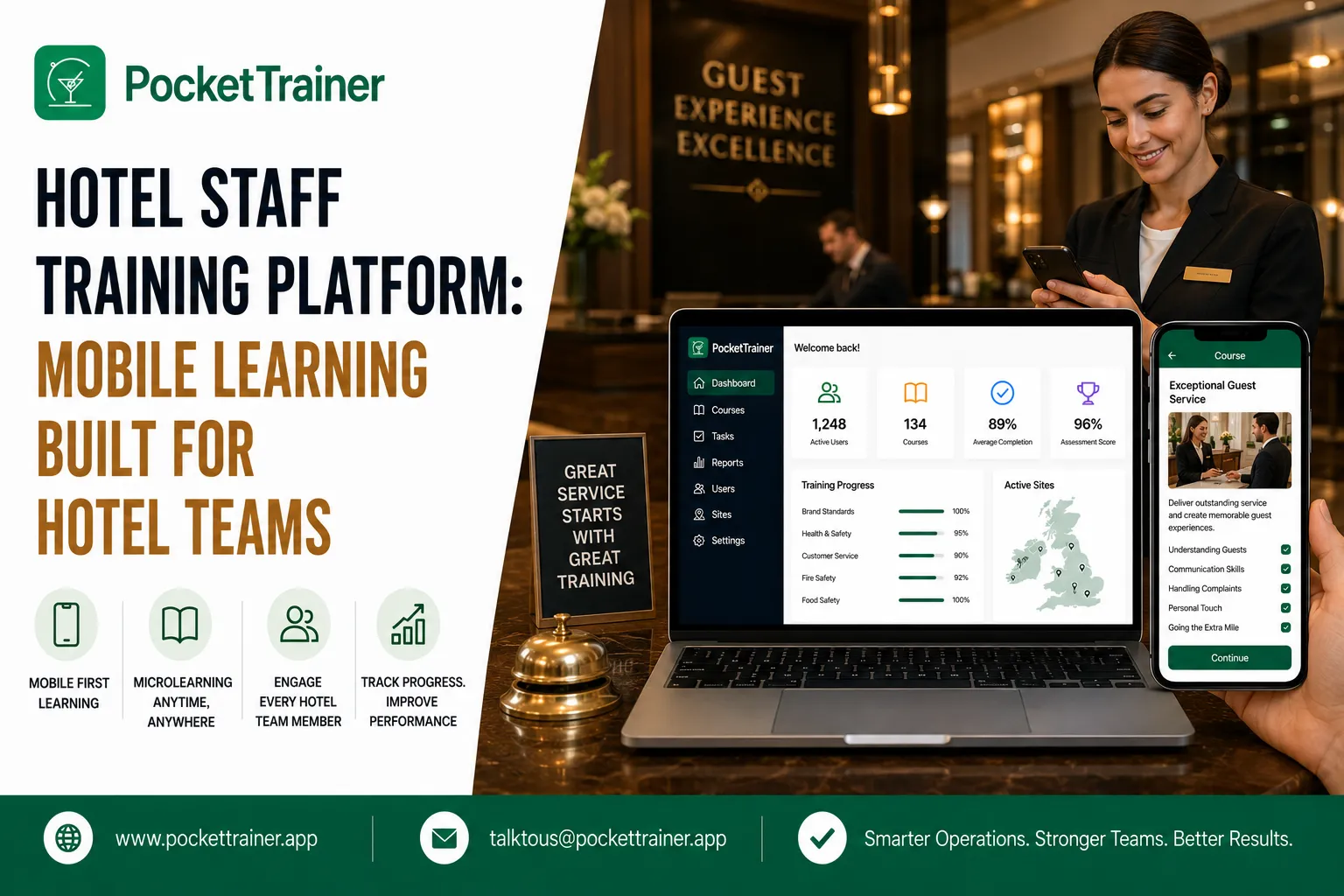
A hotel staff training platform brings onboarding, role-specific training, compliance learning and team communication into one place. For hotel operators, the goal is not simply to deliver courses — it is to make sure each department receives the right training, staff can access it on the job, and managers can see what has been completed across the property or group.
A hotel also trains far more people, across far more departments, to more standards than a restaurant does. This guide covers why generic learning platforms fail hotel teams, what hotel employee training actually needs to cover, the features hotel teams genuinely use, how to manage training across multiple properties, and where UK compliance fits in.
Why do hotels need different training software than restaurants?
Scale is the first difference. UK hospitality as a whole employs around 3.5 million people, and hotels regularly sit at the larger end of that workforce, often within a chain, which multiplies the complexity: more standards to hold, more information to distribute, more competency to control and evaluate. Without a system that tracks what was shared and what people actually know, that complexity becomes unmanageable.
Then there is departmental breadth. A restaurant trains front and back of house. A hotel trains front desk, housekeeping, maintenance and engineering, security, room service, spa and wellness, lifeguards, pool and beach attendants, IT and marketing, plus its own F&B operation. Each has its own standards, compliance requirements and learning needs.
| Department | What it needs |
|---|---|
| Front desk | Check-in/out standards, phone etiquette, complaint handling, systems knowledge, data protection |
| Housekeeping | Room and housekeeping standards, COSHH, manual handling, lost property |
| F&B and room service | Food safety, allergen awareness, menu knowledge, responsible alcohol service |
| Maintenance and engineering | Health and safety, working at height, lone working, equipment procedures |
| Security | Incident handling, counter-terrorism awareness |
| Spa, wellness, pool, beach | Department-specific safety and service standards |
Cross-training adds another layer. Hotels commonly cross-use employees to maximise the return on their people, so one team member might work as a waiter, then on reception, then support housekeeping. That means individuals need competency in more than one role, and the business needs to know who is signed off for what.
There is also a cultural difference worth naming, and restaurants could learn from it. Hotels tend to be genuinely training-focused. The larger the investment in a property, the more preparation goes into the service, and most hotels of any size have a learning and development budget and often a dedicated department. Compliance is never treated as optional, and neither is learning. Hotels do not leave competency to chance: they define what is expected, and they measure it. That discipline is a strength, but it also generates more training activity than any spreadsheet can hold.
Why do hotels need a different training approach from restaurants?
Hotels need a different training approach because they operate at greater scale and complexity than restaurants. A hotel typically employs more staff, often within a chain, and runs many more departments: front desk, housekeeping, maintenance, security, spa, pool and F&B, each with its own standards and compliance requirements. Hotels also cross-train staff across roles, so individuals need competency in more than one area and the business must track it. Because most of these staff work on the floor without desk access, a mobile training platform that delivers learning and records completion by department and role is far more practical than classroom or desktop training.
Why don’t generic LMS platforms work well for hotels?
Most learning platforms were not built for hotels. They were built for offices, then sold to everyone else, and the mismatch shows up fast.
They assume a desk. Generic hotel LMS platforms are designed for people who sit at a computer for part of the day, with long modules and desktop-first interfaces. A housekeeper with ten minutes between rooms is not the user they had in mind. They assume a simple org structure, one department, one role per person, which breaks immediately in a hotel where staff are cross-trained across functions. They come with generic content, corporate compliance modules that have nothing to say about check-in standards, housekeeping procedures, food safety or responsible alcohol service. And they rarely handle multi-property structures well, because a hotel chain is not the same shape as a head office with branches.
The result is a platform that technically hosts your training but does not fit how a hotel runs, so adoption stalls, staff do not use it, and the L&D team ends up managing the tool instead of the learning.
What hotel staff training needs to cover?
The content demand in a hotel is broad, because each department carries its own standards, which is why generic e-learning for hotels so often falls short: a single off-the-shelf course library cannot cover check-in standards, housekeeping chemical safety, and responsible alcohol service with equal depth.
On top of the departmental content sits the property’s own brand standard, the service sequence, the tone, the way this hotel does things, which every department shares. And for management, there is the leadership, compliance and reporting layer that holds it all together.
Does hotel staff training need to be mobile-first?
Here is the simple maths that makes the case. A hotel has more departments and more people than a restaurant, but the same single office. A housekeeper cannot walk to an office to complete a course or tick a checklist. Neither can a maintenance engineer, a lifeguard, a pool attendant or a security officer. Most hotel departments are on the job all day, on the floor.
Mobile training for hotel staff puts the learning where the people already are, on the phone in their pocket, completed between rooms or before a shift. That is the difference between training being scheduled and training being done.
“I can communicate with all of the teams just at the point of my phone, which I wasn’t able to do before. It’s easier, it’s more accessible, I think it’s a lot more effective.” Angela Rendzhova, Digital Marketing Specialist, INK Hotel Dubai
Watch: INK Hotel Dubai Testimonials hear directly from Ink Hotel’s team on communication, training, and what changed once it moved to a hotel staff training app.
If you want to see how a mobile platform works across your hotel departments
Book a 15-minute demoThe features hotel teams actually use
Not every feature on a sales sheet earns its place. These are the ones hotel teams use daily.
Mobile access comes first, for the reasons above. Role and department-based content assignment comes second, so housekeeping receives housekeeping training and front desk receives its own, while cross-trained individuals can be assigned more than one role’s content. Compliance tracking with dated completion records is third, because in a hotel compliance must be evidenced, not assumed.
Digital checklists and task management matter more in hotels than most operators expect: opening and closing procedures, room checks, cleaning schedules and maintenance rounds are all checklist work, and running them in the same hotel team training platform as the training means one tool rather than two. Communication features carry the rest, pushing updates to the right departments without gathering everyone in a room.
“To find the right timing where everybody is available, everybody is actually fresh and relaxed and able to focus. Time management and getting the team together is probably the most challenging part for us.” Judit Toth, then General Manager, INK Hotel Dubai
Her answer was a shared channel rather than more meetings:
“With Pocket Trainer I’m extremely happy that we are able to communicate at any time, at any day, and everybody gets the same message at the same time.” Judit Toth, then General Manager, INK Hotel Dubai
You can read the full story in our post on how a boutique hotel fixed internal communication.
Engagement is the quiet proof that the format fits.
“I love the news and the videos, the little videos that are in Pocket Trainer. I always keep watching them when I’m home.” Lyndah Nankya, Waitress, INK Hotel Dubai
Managing training across multiple properties
For a hotel group, the challenge shifts from delivering training to keeping it identical across properties. The mechanics are the same as for a multi-site restaurant group.
Content is created centrally and pushed to every property at once, so a new standard, procedure or compliance course lands everywhere simultaneously rather than being re-explained property by property. Assignment stays granular, by property, by department, by individual, so the housekeeping team in one hotel gets what it needs without irrelevant content from another site.
Reporting is what makes it real. A group administrator can filter completion data by property, department, region or country, and compare properties directly, seeing which are on top of their training and which are behind. That turns consistency across a chain from an assumption into a measurement, and lets head office act on a gap before it reaches a guest. We cover the operating model behind this in our guide to keeping training consistent across every site.
What should a hotel look for in a staff training platform?
A hotel should look for hotel training software that assigns training by department and by individual, since housekeeping, front desk, maintenance, spa and F&B have different needs and cross-trained staff need multiple roles’ content. It must be mobile-first, because most hotel staff work on the floor without desk access. It should include compliance courses with dated completion records, hold the property’s own standards and service sequences, support checklists and task management, and provide reporting that shows completion by property, department and person. For groups, central content distribution across properties is essential to keep the standard identical.
What compliance training do UK hotels legally need?
UK hotels carry the same legal training duties as any hospitality business, spread across more departments.
Food hygiene and allergen training apply to F&B and room service under retained Regulation (EC) 852/2004 and Natasha’s Law. Health and safety training applies to everyone under the Health and Safety at Work Act 1974, with COSHH training for housekeeping and cleaning teams handling chemicals, manual handling for anyone lifting, and working at height where relevant to maintenance. Fire safety training is required under the Regulatory Reform (Fire Safety) Order 2005. Where the hotel serves alcohol, licensing obligations apply, and where it handles guest data, UK GDPR does too.
There is also a newer duty hotels specifically need to check: the Terrorism (Protection of Premises) Act 2025, known as Martyn’s Law, which received Royal Assent in April 2025 and requires certain publicly accessible premises to prepare for and respond to a terrorist incident. Core provisions are commencing through 2026, with full enforcement expected in spring 2027, and hotels above certain capacity thresholds are squarely in scope. Pocket Trainer’s anti-terrorism and Martyn’s Law course covers what managers need to know as this duty comes into force.
The practical difficulty is not knowing the list; it is delivering it to a workforce spread across departments and shifts and proving each person completed it. That is exactly what a platform with dated completion records solves. Our complete guide to compliance training for UK restaurants and hotels sets out each requirement and the law behind it in full.
The takeaway
Hotels train more people, across more departments, to more standards than restaurants do, with cross-trained staff, multi-property consistency to hold and compliance that is never optional. Generic learning platforms fail them because they assume desks, simple roles, and generic content.
What works is a mobile-first hotel staff training platform that assigns content by property, department, and individual, carries the compliance courses with dated records, handles checklists alongside training, and reports completion across every property.
We will walk through it with your hotel in mind. You can also read more about the hospitality LMS behind it and the hospitality courses included as standard.
If you want to run training across every department and property from one mobile platform.
Book a 15-minute demoFAQs
1 What features should a hotel staff training app have that a generic LMS doesn’t?
A hotel staff training app needs mobile-first delivery for staff without desk access, role and department-based content assignment for cross-trained employees, compliance tracking with dated records, and support for multi-property structures. Generic LMS platforms typically assume a single department per person and a desktop-first interface, neither of which fits how a hotel actually operates.
2 Can one platform handle training for every hotel department?
Yes, provided it assigns content by department and role rather than delivering the same generic material to everyone. Front desk, housekeeping, F&B, maintenance, security and spa each need different content, and a hotel LMS built for the industry lets each department receive what’s relevant while head office retains full visibility.
3 How does mobile training work for staff without a desk, like housekeeping or maintenance?
Mobile training for hotel staff delivers short modules and checklists directly to a phone, completed between rooms, during a break, or before a shift starts. This removes the need for staff to access a desktop computer, which most hotel departments never do during a working day.
4 Does Martyn’s Law apply to hotels specifically?
It can, depending on a property’s capacity and whether it qualifies as a publicly accessible premises under the Act’s thresholds. Core provisions are commencing through 2026 with full enforcement expected in spring 2027, so hotel operators should check their venue’s status now rather than after enforcement begins.
5 How do hotel groups keep training consistent across multiple properties?
By creating content centrally and pushing it to every property at once, with assignment kept granular by property, department and individual. Centralised reporting that filters by property and department is what lets head office verify every site is actually meeting the standard, rather than assuming it.