
How to onboard restaurant staff in 7 days
By Janos Laszlo
- online training for restaurant staff
- seasonal staff training
- restaurant staff onboarding
- luxury hospitality
- hospitality LMS
- restaurant training app
- food safety training
- Clap Ibiza
Quick Summary
- Seasonal venues in markets like Ibiza, Monte Carlo, and Marbella have to onboard dozens of new staff at once and be guest-ready from night one, with no slow build across the year.
- Seasonal onboarding breaks for three reasons: volume, time pressure, and a lack of measurement at the end.
- A 7-day plan, induction, compliance, F&B and service knowledge, shadow shifts, then manager sign-off, gets a new hire floor-ready with a record to prove it.
- Clap Ibiza’s general manager describes the shift from scattered paperwork to one digital tool as what makes the compressed timeline realistic.
- Measurement, not just delivery, is what tells you who is actually ready, quizzes, sign-off, and engagement surveys all feed into that.
In the luxury seasonal markets, summer staffing is a discipline of its own. Pocket Trainer works with seasonal operators in Ibiza, Monte Carlo, Marbella, Mykonos, Portofino and Porto Cervo, venues that open for a short, intense window and have to deliver a world-class standard from the very first night. There is no slow build to competence across the year. The team is assembled, trained and expected to perform almost immediately, and the guest paying premium prices in August does not care that it is opening week.
That is the hardest version of a problem every restaurant faces in summer: taking on dozens of seasonal staff, many completely new to hospitality, and getting them floor-ready fast enough to hold the standard. This guide sets out how to onboard seasonal restaurant staff with online training, drawn from how Pocket Trainer’s seasonal clients actually run it, including Clap Ibiza, whose general manager Jonathan Giron shares how his team does it below.
Why does seasonal restaurant onboarding fail?
Seasonal onboarding fails when volume, time pressure, and a lack of measurement hit at once, which is exactly what happens in the compressed weeks before a summer venue opens.
Most groups do not have an onboarding problem in the quiet months. They have it in summer, because three pressures land at once.
The first is volume. You are not inducting one new starter; you are inducting many at the same time, often completely new hires with no hospitality background and a huge learning gap to close. The second is time. Teams are setting up restaurants for the season, not sitting in a classroom, so learning has to happen straight into busy operations, which means it has to be efficient and spot on or it does not happen at all. The third, the one most operators miss, is measurement. Teams put real effort into training, but there is no evaluation at the end, so nobody actually knows whether a new starter is competent or just present.
In a seasonal venue, these pressures are sharpest, because the window is so short.
“Support is crucial as we face major changes within the team, and an easy-to-use tool that provides the necessary information is a great help in preparing our training sessions and monitoring the team’s progress.” - Jonathan Giron, General Manager, Clap Ibiza
When the team changes that fast, the tool that prepares and monitors it is not a convenience; it is what holds the season together.
How Do You Train Seasonal Staff for a Luxury Venue Quickly?
You train seasonal staff for a luxury venue quickly by capturing your standards digitally and delivering them before the season opens, so every new hire arrives at their first shift already knowing the brand, the menu, and the service. Because seasonal venues operate in a short, high-pressure window, on-the-job training alone is too slow and too inconsistent.
A structured platform delivers brand knowledge, compliance, and role training to each starter’s phone, then measures competency before they take a guest. This is how a venue in a market like Ibiza or Monte Carlo opens at a world-class standard from the first night, and rebuilds it fast each new season.
What Changed When the Documentation Moved Into One Tool
The old way of onboarding meant assembling everything separately: handbooks here, compliance records there, menu notes somewhere else. For a venue turning over its team every season, that fragmentation is where time is lost.
“The onboarding process used to be more challenging because you had to prepare everything separately. With Pocket Trainer, all the documentation and information is available in a single digital tool, which makes things easier for both the instructor and the learner, since you can access it at any time via your smartphone.” - Jonathan Giron, General Manager, Clap Ibiza
One tool, on the phone the staff member already carries, accessible at any time. That is what makes a compressed seasonal onboarding realistic rather than aspirational.

Playing loads the video from YouTube, which may set cookies.
Want every standard in one place before the doors open?
Book a 15-minute demoWhat does a 7-day restaurant onboarding plan look like?
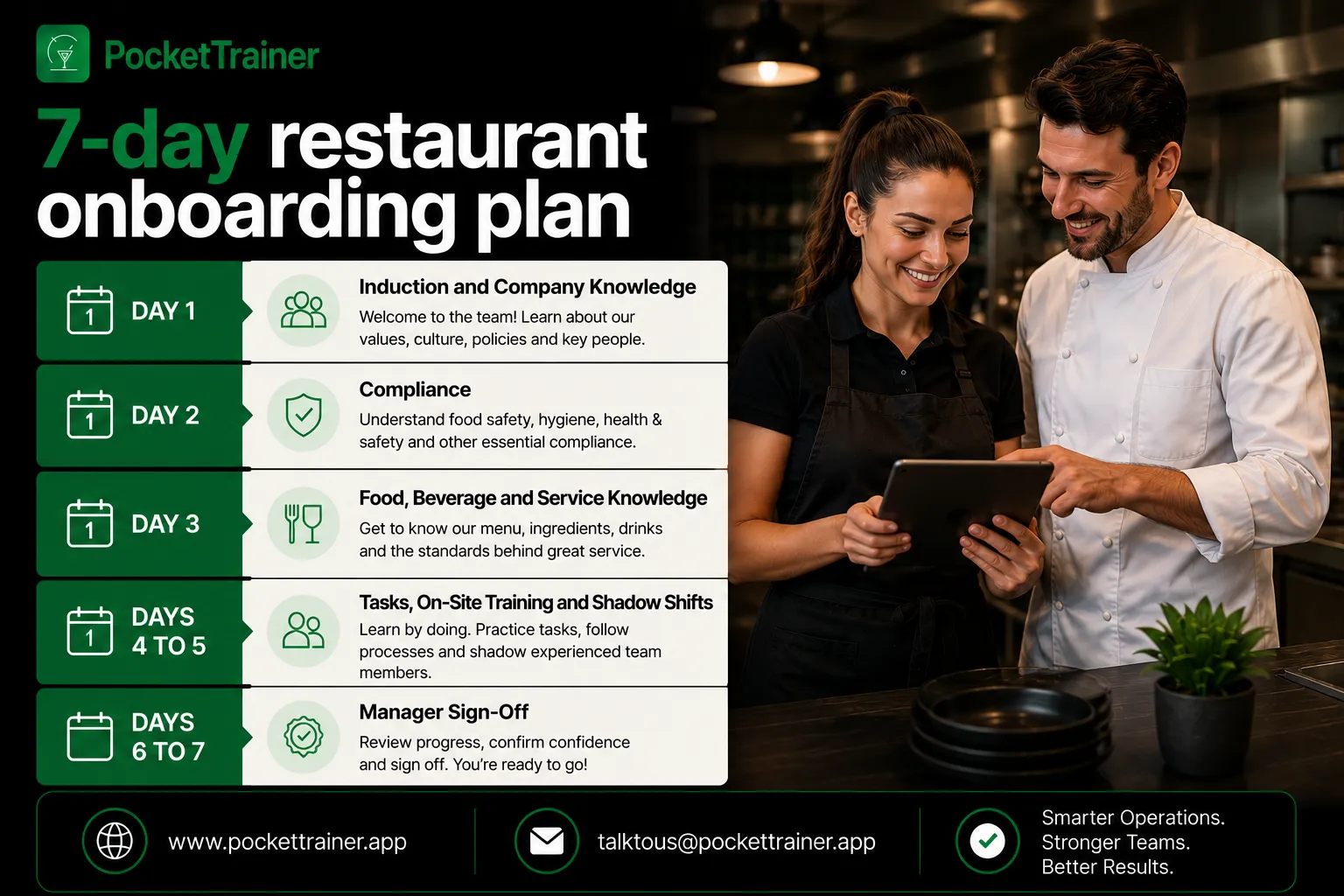
This is the structure that takes a seasonal hire from nothing to floor-ready in a week, and leaves you with a record of what they actually know.
| Day | Focus | What Happens |
|---|---|---|
| 1 | Induction and company knowledge | App access, handbooks, job descriptions, brand and HR induction courses |
| 2 | Compliance | Food safety, allergens, health and safety, fire safety, COSHH |
| 3 | Food, beverage and service knowledge | Digital F&B guides, role-specific courses |
| 4–5 | Application | On-site tasks, shadow shifts alongside experienced staff |
| 6–7 | Manager sign-off | Competency confirmed, backed by quiz and completion records |
Day 1: Induction and Company Knowledge
Give the new starter access to everything on day one: the app, all company materials, handbooks, job descriptions, and the essential induction courses covering the concept, the brand, and the HR essentials. This matters more than operators think. A guest expects a new server to introduce the brand and answer for the concept from their first shift, so brand knowledge is day one, not something added later.
Day 2: Compliance
Day two is the legal floor: food safety, food allergen awareness, health and safety, fire safety and COSHH. These are non-negotiable and come before any role training, because a starter cannot work the floor without them. Delivered digitally, every starter completes the same courses, and you hold the records, which matters the moment an audit or a claim lands.
Day 3: Food, Beverage and Service Knowledge
Day three opens the digital F&B guides, the company courses on food, beverage and service, and the role-specific courses. Knowing the menu, the drinks list and the allergens is what separates a server who can sell and reassure a guest from one still asking the kitchen mid-service.
Days 4 to 5: Tasks, On-Site Training and Shadow Shifts
With the knowledge in place, the starter moves to application: access to tasks and on-site training, and shadow shifts begin. Because they arrive already knowing the theory, the experienced staff member beside them is coaching application, not teaching basics. That is what makes a week realistic instead of optimistic.
Days 6 to 7: Manager Sign-Off
The week ends with manager sign-off, the step most onboarding skips and the most important one. The manager confirms competency before the starter takes a solo shift, backed by the quiz results and completion records from the previous six days.
This is also where the real work of seasonal training begins, not ends.
“A temporary employee can absorb the information in a matter of days; it’s a whole different story when it comes to truly internalizing it. That’s where our work comes in: monitoring their performance on the floor, identifying areas for improvement together with the client, and building on their strengths.” - Jonathan Giron, General Manager, Clap Ibiza
Days get them floor-ready. Monitoring keeps them improving across the season.
Why does onboarding need to be measured, not just delivered?
A structured onboarding programme is only as good as its ability to prove competency, not just deliver content, which is where most seasonal onboarding quietly fails.
Anyone can hand a new starter a stack of courses. The question is whether they learned anything, and most onboarding never answers it. A structured digital programme measures at every step: compliance ends in an assessment, role knowledge is quizzed, and manager sign-off ties it together with a record of what each starter passed.
For Clap Ibiza, the measurement tool that stood out was surveys.
“One thing I really like is surveys, because they let you gauge each team member’s engagement and see how much knowledge and interest they’re bringing to the table. This allows you to take immediate action and be a fairer leader by rewarding those who go the extra mile.” - Jonathan Giron, General Manager, Clap Ibiza
Measurement is not only about competence. It tells you who is engaged, so you can act on it while the season is still running.
How Do I Onboard New Restaurant Staff Quickly With Online Training?
You onboard restaurant staff quickly by sequencing the learning so brand and compliance essentials come first, then role skills, then supervised practice, with a competency check at the end. Give new starters app access on day one to company materials and induction content, then move through compliance, then food, beverage and service knowledge, then shadow shifts and sign-off. Online training removes the bottleneck of one manager teaching everyone, because every starter learns the same content to the same standard on their own device. The key is to measure competency with quizzes and sign-off, so you know who is floor-ready rather than assuming it.
What About Onboarding Across Multiple Sites or Franchises?
The same sequence holds whether you are onboarding for one venue or several, but multi-site groups add a consistency requirement: every location needs the identical standard, not a local interpretation of it. That is a different problem from the 7-day plan itself, and our guide to standardising training across every location covers what changes when a group, rather than a single venue, is running this process.
The Takeaway
Seasonal staffing does not break because you cannot find people. It breaks because you take on many new starters at once, have almost no time to train them, and never measure whether they are ready, all compressed into a window that cannot afford a slow start. A 7-day plan that runs induction, compliance, role knowledge, supervised shifts and sign-off closes that gap and gives you a record to stand behind. It is how the luxury seasonal venues Pocket Trainer works with open at full standard on night one, and rebuild that standard every new season.
Want every new starter floor-ready in seven days?
Book a 15-minute demoYou can also explore the hospitality LMS, the hospitality courses included as standard, and how custom training content turns your own F&B guides into structured learning.
FAQs
1 How long should it take to onboard a new restaurant hire?
For a seasonal venue, seven days is achievable when the plan sequences induction and compliance first, then role knowledge, then supervised practice, ending with a measured sign-off. Longer, unstructured onboarding often takes weeks without actually producing a more competent starter.
2 What should happen on day one of restaurant onboarding?
Give the new starter full access on day one: the app, company materials, handbooks, job descriptions, and induction courses covering the brand and HR essentials. Brand knowledge belongs on day one, not weeks in, since guests expect a new server to represent the concept from their first shift.
3 How do you know if a seasonal hire is actually ready for the floor?
Through measurement, not assumption: quiz results from compliance and role training, plus a manager sign-off that confirms competency before the starter takes a solo shift. Delivering training without measuring it leaves you knowing what was taught, not what was learned.
4 Can the same onboarding process work across multiple restaurant locations?
Yes, the same sequence applies, but multi-site groups need every location trained to an identical standard rather than a local interpretation of it, which requires centralised content and reporting rather than each site running its own version.
5 Does online onboarding work for staff with no hospitality experience?
Yes, and it’s especially suited to it, since structured digital modules teach the same standard to every starter regardless of background, then measure whether it landed, rather than relying on an experienced colleague to informally pass on knowledge.