
When to Outsource L&D in Hospitality: 7 Signs
By Janos Laszlo
Quick Summary
- Consider outsourced L&D when planning, reviewing and following up on training have no realistic owner.
- Diagnose whether the problem is capacity, expertise, content, technology or leadership authority before choosing a solution.
- Start with a defined scope, clear responsibilities and a review or handover date.
- Keep ownership of operational standards, approvals and legal duties within the business.
- Use external support to strengthen the training system, not create unnecessary long-term dependence.
Outsourced learning and development (L&D) is worth considering when training matters to the operation but nobody has enough protected time, authority or specialist capacity to keep it moving.
For a restaurant, bar or hotel group, the need might be temporary expertise for a new opening, recurring programme management or a clearer training structure that an internal manager can eventually take over.
The decision should start with the operating gap, not a list of supplier services. This guide explains seven signs that outsourced L&D may help, how to identify the real constraint and how to choose a suitable level of support.
What Should Outsourced L&D Solve?
The strongest reason to seek outsourced L&D for hospitality is not simply that another provider can supply courses. It is that the business needs a reliable owner for a defined result.
That result might be a consistent opening programme, a usable training pathway for each role, a regular reporting and review process, or a system that an internal L&D lead can take over later.
A hospitality LMS can help deliver and track training, while custom hospitality training content can turn current SOPs and standards into usable learning materials.
Outsourced L&D addresses a different question: who will plan the work, coordinate the people involved and keep managers moving after launch?
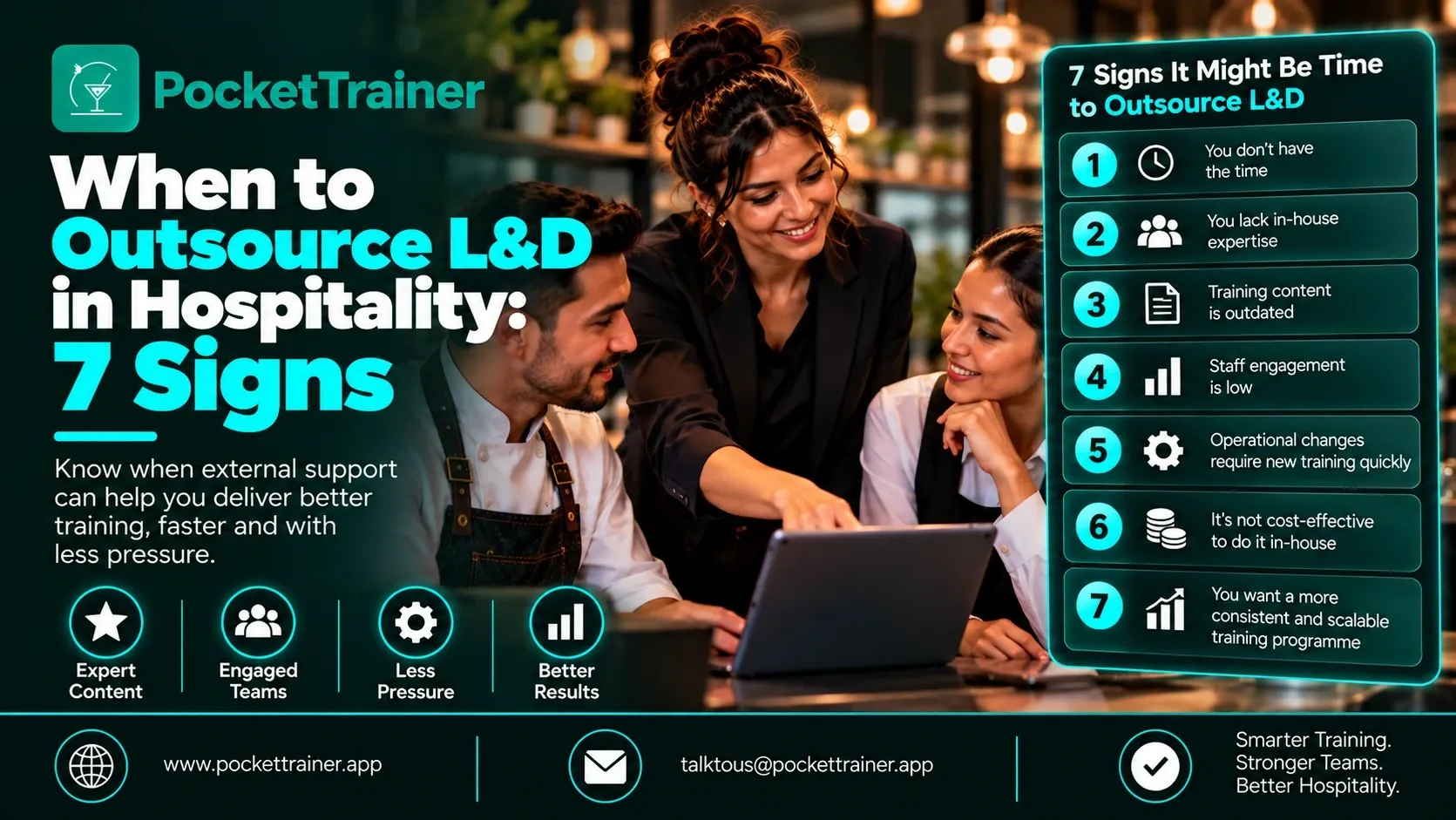
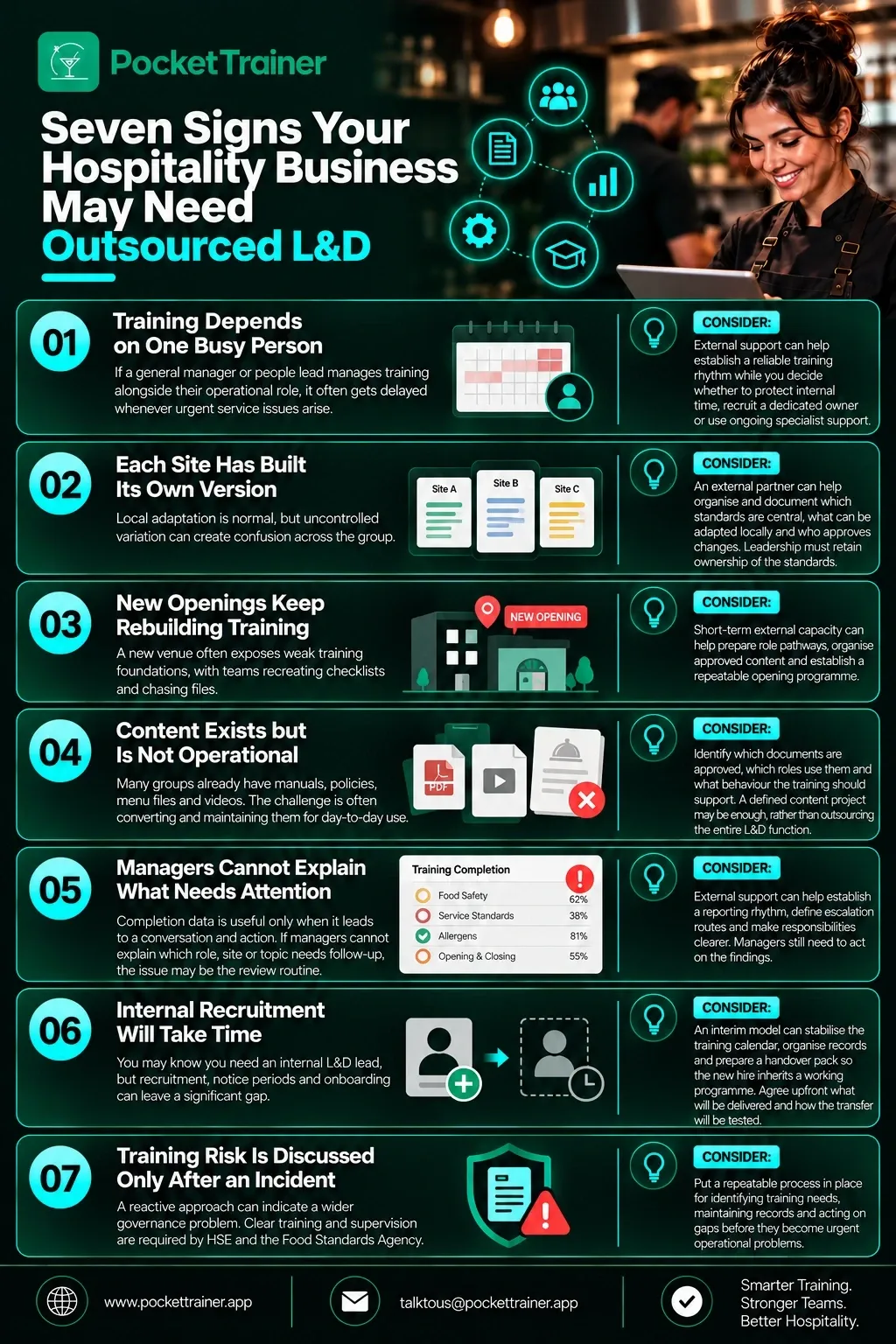
Seven Signs Your Hospitality Business May Need Outsourced L&D
1. Training Depends on One Busy Person
If a general manager, people lead or operations director manages the entire training programme alongside a demanding operational role, training will often lose time to urgent service issues.
The warning sign is not one delayed course. It is a repeated pattern in which calendars, content updates and manager follow-up stop whenever the person responsible becomes busy.
External support may help establish a reliable operating rhythm while the business decides whether to protect more internal time, recruit a dedicated owner or use ongoing specialist support.
2. Each Site Has Built Its Own Version
Local adaptation is normal in hospitality, but uncontrolled variation can create confusion.
If sites use different induction packs, service sequences or versions of the same SOP, the group needs a governance decision. Which standards are central? What can be adapted locally? Who approves changes?
An external partner can help organise and document these decisions, but leadership must retain ownership of the standards.
“As long as there is excitement and they feel like they take ownership in it and they’re part of it truly, then they’re going to deliver an excellent service. - Judit Toth INK Hotel Dubai”
The point is important: external support can create structure, but operational ownership still needs to exist inside the business.
Watch the INK Hotel team: INK Hotel testimonials on YouTube
The video adds an operator perspective on team communication, training accessibility and helping employees feel involved in their development.
3. New Openings Keep Rebuilding Training
A new venue can expose weak training foundations quickly. Teams recreate checklists, chase files and rely on experienced managers to explain the same information again.
Short-term external capacity can be useful when the requirement has a clear deadline and deliverable, such as preparing role pathways, organising approved content or establishing a repeatable opening programme.
The goal should be reusable foundations that the business can maintain, not permanent dependence on an external provider.
4. Content Exists but Is Not Operational
Many hospitality groups already have manuals, policies, menu files and videos. The problem is often converting and maintaining those materials rather than creating more content.
Before commissioning new courses, identify which source documents are approved, which roles use them and what behaviour the training should support.
For example, a restaurant may have an SOP but no clear way to make it accessible to staff, explain the procedure consistently or update the related learning when the process changes.
If this is the main constraint, a defined content project may be more appropriate than outsourcing the entire L&D function. Explore how restaurant SOPs can become mobile training before deciding how much support is needed.
5. Managers Cannot Explain What Needs Attention
Completion data is useful only when it leads to a conversation and an appropriate action.
If reports exist but managers cannot explain which role, site or topic needs follow-up, the problem may be the review routine rather than the training platform itself.
External support can help establish a reporting rhythm, define escalation routes and make responsibilities clearer. The operator still needs managers who can act on the findings.
6. Internal Recruitment Will Take Time
A hospitality group may already know it needs an internal L&D lead, but recruitment, notice periods and onboarding can leave a significant gap.
An interim model can help stabilise the training calendar, organise records and prepare a handover pack so that the new hire inherits a working programme rather than a blank page.
Agree from the beginning what the external team will deliver, what the future internal owner will take over and how the transfer will be tested.
7. Training Risk Is Discussed Only After an Incident
A reactive approach to training can indicate a wider governance problem.
The Health and Safety Executive (HSE) explains the importance of clear instructions, adequate training and supervision, including for people who are new to a role, changing jobs or taking on additional responsibilities. Food businesses also need appropriate food-hygiene supervision and training.
Relevant official guidance includes:
These responsibilities remain with the employer and food business. An external partner may support planning, delivery and record management, but it does not remove the operator’s legal accountability.
The objective is to establish a repeatable process for identifying training needs, maintaining appropriate records and acting on gaps before they become urgent operational problems.
What Should You Diagnose Before Outsourcing?
Start by naming the blocked outcome and the constraint behind it.
| If the main problem is… | Consider starting with… |
|---|---|
| Missing or outdated learning materials | A defined content project |
| Difficult training delivery or record management | An LMS and a clearer operating process |
| No time to coordinate and review training | Protected internal capacity or outsourced L&D |
| Inconsistent standards across sites | Clear governance, content ownership and approval rules |
| A temporary gap before an internal hire starts | Interim support and a documented handover |
These are starting points, not automatic recommendations. More than one constraint may be present, so confirm the underlying problem before committing to a wider service.
Choose the Smallest Useful Scope
A broad retainer is not always the best first step. Define a scope around one business outcome, one operating period and one accountable sponsor.
Examples include preparing role pathways for a new opening, establishing a quarterly review routine or organising the training programme before an internal hire arrives.
Agree these five points in writing:
- Business outcome: What should be different when the work is complete?
- Scope and ownership: Which roles and sites are included, and what does the external team own?
- Approved sources: Which documents and standards are authoritative, and who approves changes?
- Reporting: What information will be reported, to whom and how often?
- Review or handover: When will the arrangement be assessed, renewed, reduced or transferred?
If ownership is the main constraint, Pocket Trainer can help you assess whether managed support fits the operation.
Bring your own compliance requirement and ask to see the completion record produced live, filtered by site and role.
Book a 15-minute demoWhen Should Hospitality L&D Stay In-House?
Keep programme ownership in-house when a capable person has enough time, authority and access to manage it consistently.
External specialists can still support defined projects without taking over the operating rhythm. A business might retain internal ownership while commissioning specialist content, help with a new opening or temporary support during recruitment.
The decision is not a judgement on the quality of the existing team. It is a practical assessment of capacity, expertise and accountability.
Protect Control of Standards and Records
The operator should always be able to identify the approved source behind a training item, who approved it and what record is needed for follow-up.
Training records can contain personal information about employees. Organisations should review the relevant data-protection requirements, including their lawful basis for processing, the purposes for collecting information, access controls and justified retention periods.
Set permissions by role, document why information is collected and agree what happens to records during a supplier change or handover. Involve the organisation’s data-protection lead where appropriate.
These points belong in procurement and governance discussions, not as an afterthought once the programme is live.
A Practical Decision Scorecard
Score each statement from zero to two:
- 0: Not true
- 1: Partly true
- 2: Consistently true
| Statement | Score |
|---|---|
| A named person has protected time to own the programme. | /2 |
| Every site knows which training standards are central and which are local. | /2 |
| Current source documents are identifiable and approved. | /2 |
| Managers know what to review and what action follows. | /2 |
| The business can absorb a new opening or major update without stopping routine training. | /2 |
| Training records have defined access, accuracy and retention rules. | /2 |
| A future internal owner could understand the programme from the documentation. | /2 |
| Total | /14 |
A low score does not automatically mean outsourcing is required. It highlights where the operating model needs attention. Use the gaps to choose a targeted project, interim support or a longer managed arrangement.
For a recurring governance check, use the questions in Why You Should Reevaluate Your Staff Training System Every Year alongside this scorecard.
The Final Test: Would Training Continue if the Owner Left?
Ask one question: if the current training owner became unavailable tomorrow, would the programme continue?
If the answer is no, the immediate need is resilience. Outsourced L&D can provide capacity while the business builds a repeatable system, but the best arrangement should leave the operator with clearer ownership, better records and more control than it had before.
Before approving support, ask the proposed partner to work through one real example from need to follow-up. Use an upcoming induction, menu change or manager-development priority. This reveals whether the proposal reflects the operation and whether responsibilities are understood.
Set a review date while the reason for outsourcing is still clear. Assess whether the original constraint has changed, whether internal capacity has improved and whether the scope should continue, reduce or transfer.
A review does not mean the arrangement has failed. It is how the operator retains control of the decision.
Final Thoughts
Outsourced L&D is most useful when it solves a clearly defined operating problem. Before choosing a provider, establish whether the gap is capacity, content, systems, expertise or ownership.
Set clear responsibilities, protect the operator’s control of standards and records, and agree how success will be reviewed. The aim is not simply to move work outside the business. It is to build a training programme that is more consistent, manageable and resilient.
Written by Janos Laszlo, founder and CEO of Pocket Trainer, drawing on 20+ years spent running and developing F&B teams across the UK, Europe and the GCC.
If you want to see how Pocket Trainer records compliance training, bring your own compliance requirements and ask to see a live completion record filtered by site and role:
Book a 15-minute demoFrequently Asked Questions
Is outsourced L&D only suitable for multi-site hospitality groups?
No. A single restaurant, bar or hotel may use external support for a new opening, a content rebuild or an interim capacity gap. The deciding factors are the required outcome, available internal capacity and clarity of ownership, not simply the number of venues.
Can outsourced L&D replace manager accountability?
No. An external team can organise work and provide specialist support, but operational leaders still own standards, approvals and decisions affecting their teams. Managers remain essential for coaching, practical observation and action when training identifies a gap.
What should be agreed before outsourced L&D begins?
Agree the business outcome, scope, decision rights, approved source documents, reporting cadence and a review or handover date. These basics make it possible to assess whether the support is solving the intended problem.
How do you know whether outsourced L&D is working?
Review the outcomes agreed at the start. Depending on the scope, this may include having current content, a reliable review rhythm, clearer manager follow-up, better-defined responsibilities or a programme that an internal owner can take over.
Should a hospitality business outsource all its training?
Not necessarily. A business may need help with one content project, a temporary capacity gap or ongoing programme coordination. Choose the smallest scope that addresses the real constraint, then review whether it remains appropriate.